Vancouver updates homelessness response: site cleanups, Suboxone pilot and motel‑voucher review
September 22, 2025 | Vancouver, Clark County, Washington
This article was created by AI summarizing key points discussed. AI makes mistakes, so for full details and context, please refer to the video of the full meeting. Please report any errors so we can fix them. Report an error »
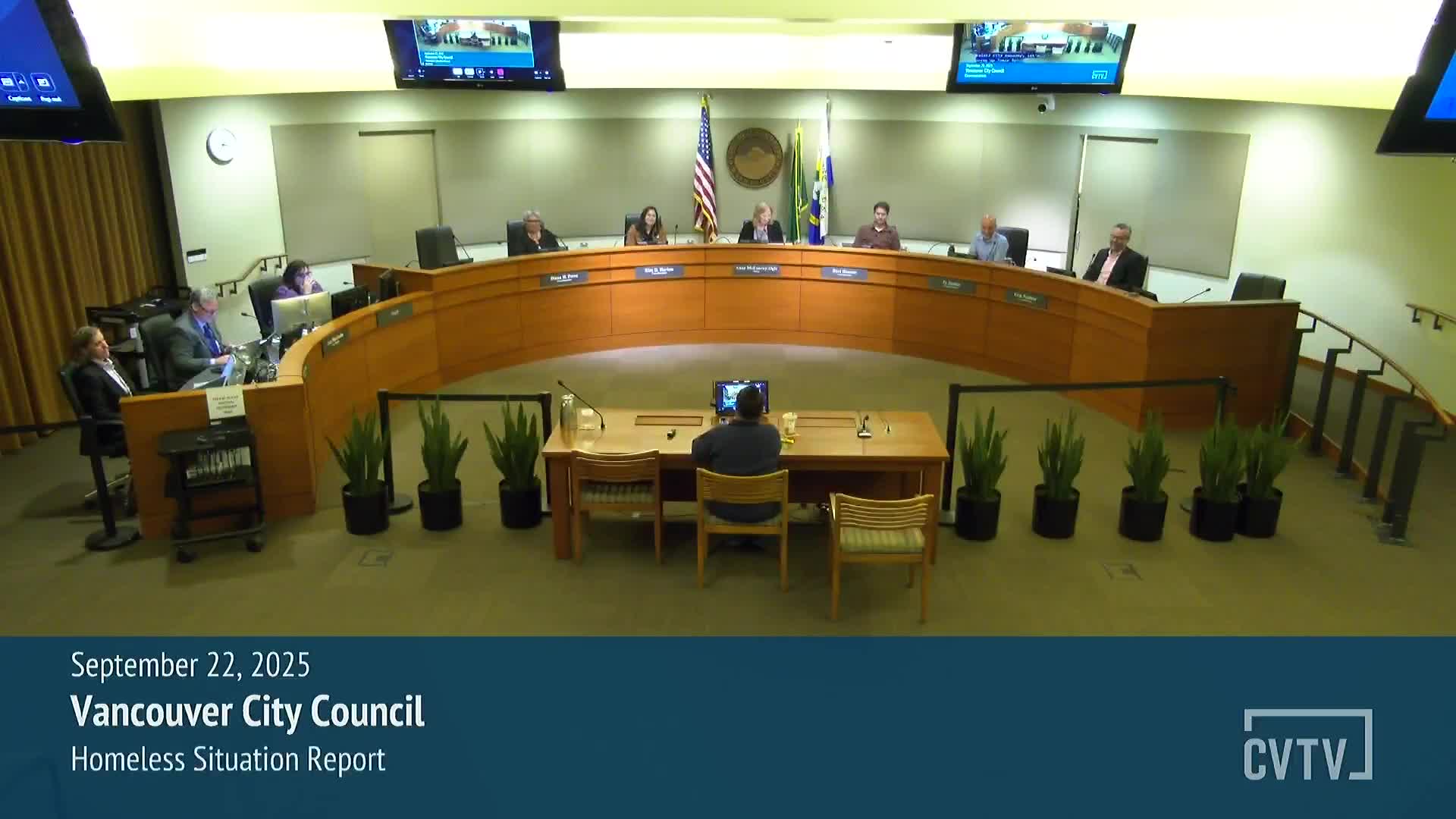
Jamie Spinelli, the city’s homeless response manager, updated the Vancouver City Council on Sept. 22 about outreach operations, site cleanups, health partnerships and program challenges tied to the city’s unsheltered homelessness response.
Spinelli said crews removed about 13.29 tons of solid waste from public property in August, and another nearly 10 tons by a separate crew, bringing the year‑to‑date total to nearly 215 tons. She reported the city lost four people in August, bringing the total deaths since December to 23. Police calls related to unsheltered homelessness account for roughly 10% of incident reports and about 16.2% of response hours, she said. Spinelli added that nine people across sites moved into housing in August, four obtained employment and six had job interviews.
Spinelli described several operational items: the four Safe Stay Communities pallet shelters were repainted over the weekend to reduce an institutional appearance; the My Vancouver mobile app for homelessness reporting is being retired and replaced with a web form; and the HEART team has handled nearly 5,000 calls since 2019 via the app and related systems.
On clinical services, Spinelli said the fire department has begun a program to administer Suboxone in the field and staff plan to coordinate that work with outreach teams. "Suboxone is a medication that's utilized for people who use opioids," Spinelli said, explaining it is part of medication‑assisted treatment that can reduce withdrawal and cravings and help people engage in other recovery supports. Spinelli said the fire department will partner with outreach staff to improve engagement and connect people to ongoing care.
Spinelli also reported system constraints: Columbia River's mobile health team remains understaffed, limiting on‑site clinical services such as wound care and prescription support; staff described continued difficulty placing some people into detox and inpatient treatment, though Lifeline had indicated it was trying to lower barriers so people with methamphetamine in their system could enter detox.
Councilor Perez said she will meet with Council for the Homeless, the city manager and the police chief to discuss issues with the motel‑voucher program and look for improvements. Spinelli described "warm handoffs" as standard practice when people choose to relocate out of area: staff try to ensure there is a contact or receiving program in place rather than simply transporting someone without confirmed supports.
Spinelli highlighted individual successes in August: one longtime participant at Safe Park, a veteran named Dale, secured housing with his daughter and granddaughter in a townhome pending a housing inspection; a person from Hope Village entered inpatient treatment and then a three‑month sober‑living program outside the region; another participant from out of state obtained a Section 8 voucher and returned to Indiana.
No council votes were taken on new policy during the update. Councilors and staff asked for follow‑up details; Spinelli said staff would provide written materials on the report and continue coordination with partners.
Spinelli said crews removed about 13.29 tons of solid waste from public property in August, and another nearly 10 tons by a separate crew, bringing the year‑to‑date total to nearly 215 tons. She reported the city lost four people in August, bringing the total deaths since December to 23. Police calls related to unsheltered homelessness account for roughly 10% of incident reports and about 16.2% of response hours, she said. Spinelli added that nine people across sites moved into housing in August, four obtained employment and six had job interviews.
Spinelli described several operational items: the four Safe Stay Communities pallet shelters were repainted over the weekend to reduce an institutional appearance; the My Vancouver mobile app for homelessness reporting is being retired and replaced with a web form; and the HEART team has handled nearly 5,000 calls since 2019 via the app and related systems.
On clinical services, Spinelli said the fire department has begun a program to administer Suboxone in the field and staff plan to coordinate that work with outreach teams. "Suboxone is a medication that's utilized for people who use opioids," Spinelli said, explaining it is part of medication‑assisted treatment that can reduce withdrawal and cravings and help people engage in other recovery supports. Spinelli said the fire department will partner with outreach staff to improve engagement and connect people to ongoing care.
Spinelli also reported system constraints: Columbia River's mobile health team remains understaffed, limiting on‑site clinical services such as wound care and prescription support; staff described continued difficulty placing some people into detox and inpatient treatment, though Lifeline had indicated it was trying to lower barriers so people with methamphetamine in their system could enter detox.
Councilor Perez said she will meet with Council for the Homeless, the city manager and the police chief to discuss issues with the motel‑voucher program and look for improvements. Spinelli described "warm handoffs" as standard practice when people choose to relocate out of area: staff try to ensure there is a contact or receiving program in place rather than simply transporting someone without confirmed supports.
Spinelli highlighted individual successes in August: one longtime participant at Safe Park, a veteran named Dale, secured housing with his daughter and granddaughter in a townhome pending a housing inspection; a person from Hope Village entered inpatient treatment and then a three‑month sober‑living program outside the region; another participant from out of state obtained a Section 8 voucher and returned to Indiana.
No council votes were taken on new policy during the update. Councilors and staff asked for follow‑up details; Spinelli said staff would provide written materials on the report and continue coordination with partners.
View the Full Meeting & All Its Details
This article offers just a summary. Unlock complete video, transcripts, and insights as a Founder Member.
✓
Watch full, unedited meeting videos
✓
Search every word spoken in unlimited transcripts
✓
AI summaries & real-time alerts (all government levels)
✓
Permanent access to expanding government content
30-day money-back guarantee
