Student and community members urge clearer district policy on law‑enforcement contact with students and protections for transgender students
This article was created by AI summarizing key points discussed. AI makes mistakes, so for full details and context, please refer to the video of the full meeting. Please report any errors so we can fix them. Report an error »
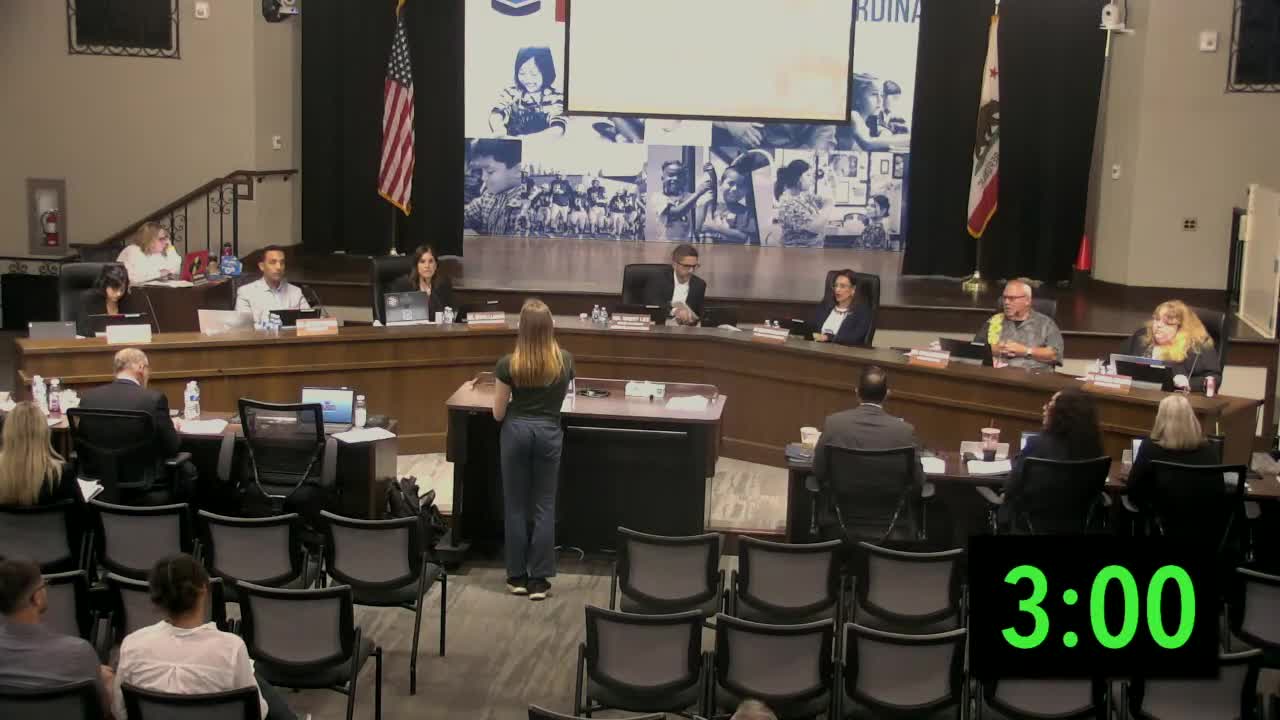
Several public commentators, including a student speaker, asked the Riverside Unified School District board to review and strengthen district policy governing law‑enforcement contact with students, particularly for transgender students and other vulnerable populations.
The student speaker described recent national rhetoric and policy proposals they said label transgender people in ways that could lead to federal enforcement actions. Citing the district’s policy (referred to in the comment as “EAR 5 4.11”), the speaker said the policy currently is “vague” and urged the board to require a judicial order before law‑enforcement officers interview or arrest students on school property unless an immediate public‑safety exception applies. The student also noted that some neighboring districts (Chino, Redlands, Murrieta, Temecula Valley) have more detailed policies, including explicit language requiring judicial authorization in some circumstances.
Why it matters: public commenters said unclear local policy could expose students to questioning or arrest without court authorization, especially amid heightened federal enforcement activities related to immigration and other matters. The speaker said the board should amend district policy to protect due process rights and student safety.
What the board heard: the comment period included a direct request that the board review policy language and consider inserting explicit safeguards requiring judicial orders or similar procedural protections; speakers also urged clearer notification and rights‑advisement procedures for students and families.
Board response and next steps: staff did not present an immediate policy change at this meeting. Commenters asked the board to direct staff to compare local policy to the policies cited in other districts and to return with recommended edits to ensure clarity about when officers may question or detain students and what parental notification or legal safeguards will be provided.
Ending: The board received public comment. No formal policy vote occurred; the speaker and others asked the board to prioritize a policy review and to publish any recommended revisions for public comment.
The student speaker described recent national rhetoric and policy proposals they said label transgender people in ways that could lead to federal enforcement actions. Citing the district’s policy (referred to in the comment as “EAR 5 4.11”), the speaker said the policy currently is “vague” and urged the board to require a judicial order before law‑enforcement officers interview or arrest students on school property unless an immediate public‑safety exception applies. The student also noted that some neighboring districts (Chino, Redlands, Murrieta, Temecula Valley) have more detailed policies, including explicit language requiring judicial authorization in some circumstances.
Why it matters: public commenters said unclear local policy could expose students to questioning or arrest without court authorization, especially amid heightened federal enforcement activities related to immigration and other matters. The speaker said the board should amend district policy to protect due process rights and student safety.
What the board heard: the comment period included a direct request that the board review policy language and consider inserting explicit safeguards requiring judicial orders or similar procedural protections; speakers also urged clearer notification and rights‑advisement procedures for students and families.
Board response and next steps: staff did not present an immediate policy change at this meeting. Commenters asked the board to direct staff to compare local policy to the policies cited in other districts and to return with recommended edits to ensure clarity about when officers may question or detain students and what parental notification or legal safeguards will be provided.
Ending: The board received public comment. No formal policy vote occurred; the speaker and others asked the board to prioritize a policy review and to publish any recommended revisions for public comment.
View the Full Meeting & All Its Details
This article offers just a summary. Unlock complete video, transcripts, and insights as a Founder Member.
✓
Watch full, unedited meeting videos
✓
Search every word spoken in unlimited transcripts
✓
AI summaries & real-time alerts (all government levels)
✓
Permanent access to expanding government content
30-day money-back guarantee
