Salem council urges state to reserve $200 million for public higher education
September 26, 2025 | Salem City, Essex County, Massachusetts
This article was created by AI summarizing key points discussed. AI makes mistakes, so for full details and context, please refer to the video of the full meeting. Please report any errors so we can fix them. Report an error »
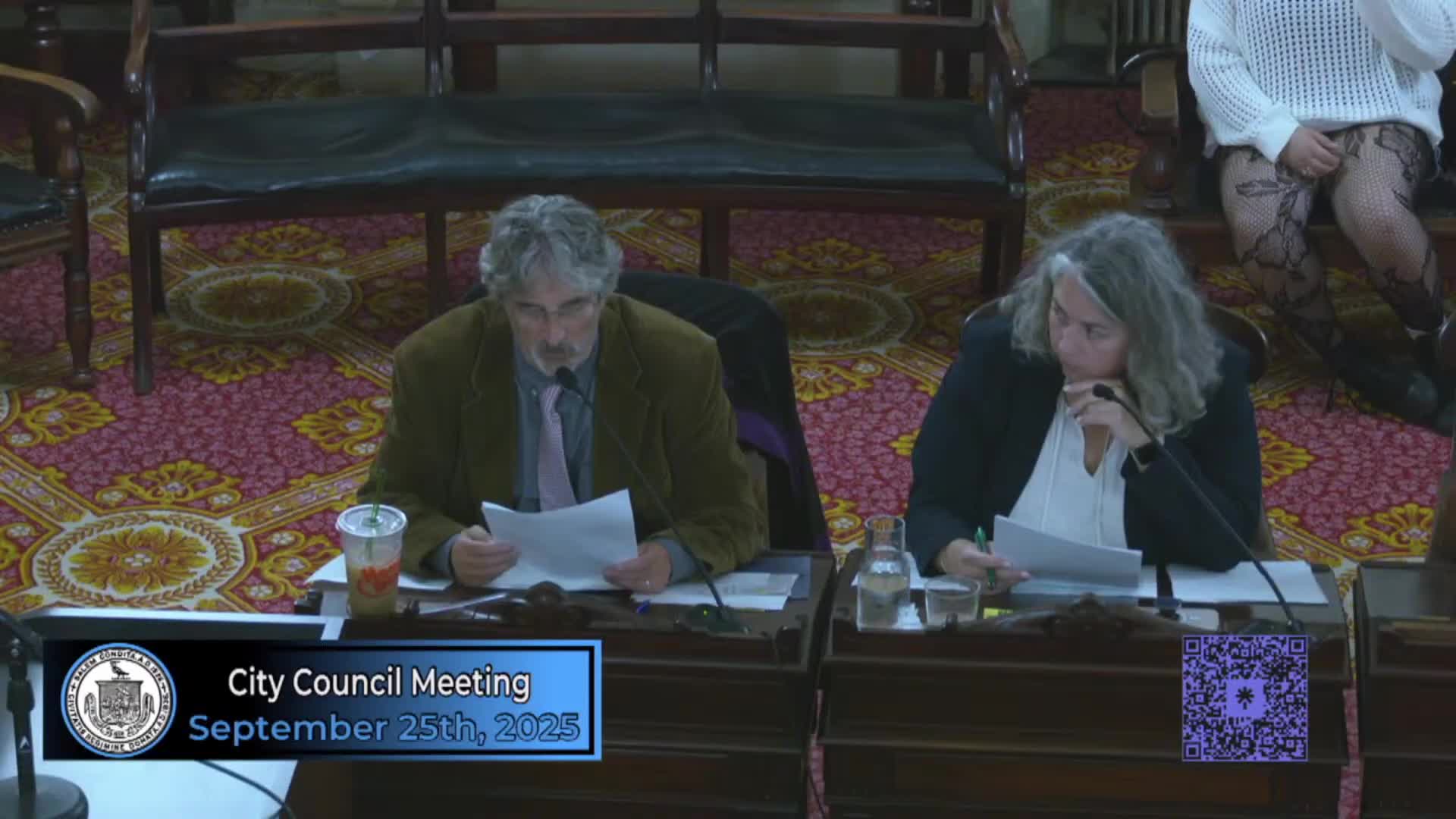
The Salem City Council on Sept. 25 adopted a resolution urging state lawmakers and Governor Maura Healey to set aside $200 million from revenues generated by the Fair Share surtax to stabilize funding for Massachusetts public colleges and universities.
The resolution, introduced by Councilor Cohen and supported by public testimony from students, faculty and community groups, asks the state to use a portion of Fair Share revenues and to increase state funding so institutions do not have to rely as heavily on tuition, private grants or federal funding that has recently been reduced or paused. The resolution also mentions the governor’s DRIVE (Discovery, Research, and Innovation in the Vibrant Economy) proposal as part of the broader funding conversation.
Public comment at the council meeting included several Salem State students and faculty who described strain from federal reductions and the effect on students. Ella (given name in transcript) a UMass Amherst student, said state disinvestment had practical impacts on students’ ability to attend and complete degrees; Henry Morgan, executive director of Phenom, and Nicholas Jones, a first‑year Salem State student, urged the council to support legislative action. Faculty and staff noted the civic and economic benefits of public higher education programs that serve the North Shore.
A roll call vote recorded 11 yeas and no nays; the resolution passed unanimously among members present. The council directed the city clerk to send the adopted resolution to Governor Maura Healey, the Legislature’s Ways and Means Committee and other named state officials and committees.
Why this matters: proponents say stable state funding will protect programs, research, and student supports that benefit local communities and future workforce needs. The resolution asks state leaders to prioritize public higher education funding to reduce student debt burdens and preserve community‑engaged research that serves municipalities such as Salem.
Details: The resolution references the Fair Share Amendment (the surtax on incomes above $1 million approved by Massachusetts voters) and asks the state to reserve $200 million for public higher education as a first step toward stabilizing funding. The council’s action was largely symbolic — a municipal resolution intended to press state action — but came with broad local support from students, educators and nonprofit leaders who testified during the public comment period.
Next steps: The city will send the resolution to state elected officials and committees listed in the text of the resolution and encourage legislative action.
The resolution, introduced by Councilor Cohen and supported by public testimony from students, faculty and community groups, asks the state to use a portion of Fair Share revenues and to increase state funding so institutions do not have to rely as heavily on tuition, private grants or federal funding that has recently been reduced or paused. The resolution also mentions the governor’s DRIVE (Discovery, Research, and Innovation in the Vibrant Economy) proposal as part of the broader funding conversation.
Public comment at the council meeting included several Salem State students and faculty who described strain from federal reductions and the effect on students. Ella (given name in transcript) a UMass Amherst student, said state disinvestment had practical impacts on students’ ability to attend and complete degrees; Henry Morgan, executive director of Phenom, and Nicholas Jones, a first‑year Salem State student, urged the council to support legislative action. Faculty and staff noted the civic and economic benefits of public higher education programs that serve the North Shore.
A roll call vote recorded 11 yeas and no nays; the resolution passed unanimously among members present. The council directed the city clerk to send the adopted resolution to Governor Maura Healey, the Legislature’s Ways and Means Committee and other named state officials and committees.
Why this matters: proponents say stable state funding will protect programs, research, and student supports that benefit local communities and future workforce needs. The resolution asks state leaders to prioritize public higher education funding to reduce student debt burdens and preserve community‑engaged research that serves municipalities such as Salem.
Details: The resolution references the Fair Share Amendment (the surtax on incomes above $1 million approved by Massachusetts voters) and asks the state to reserve $200 million for public higher education as a first step toward stabilizing funding. The council’s action was largely symbolic — a municipal resolution intended to press state action — but came with broad local support from students, educators and nonprofit leaders who testified during the public comment period.
Next steps: The city will send the resolution to state elected officials and committees listed in the text of the resolution and encourage legislative action.
Don't Miss a Word: See the Full Meeting!
Go beyond summaries. Unlock every video, transcript, and key insight with a Founder Membership.
✓
Get instant access to full meeting videos
✓
Search and clip any phrase from complete transcripts
✓
Receive AI-powered summaries & custom alerts
✓
Enjoy lifetime, unrestricted access to government data
30-day money-back guarantee
