187th District Court disposes of multiple felony cases: pleas, probation and revocations
October 06, 2025 | Judge Stephanie Boyd 187th District, District Court Judges, Judicial, Texas
This article was created by AI summarizing key points discussed. AI makes mistakes, so for full details and context, please refer to the video of the full meeting. Please report any errors so we can fix them. Report an error »
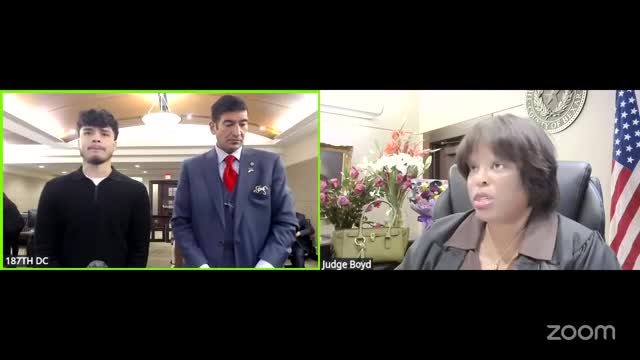
Judge Stephanie Boyd of the 187th District Court on Oct. 1, 2025, took pleas, imposed probation conditions and entered revocation sentences across a multi-defendant docket during a virtual session.
The docket produced a mix of outcomes: a defendant seeking deferred adjudication was given a reset to produce restitution, several defendants received suspended prison terms with probation and conditions, and at least one previously supervised defendant had community supervision revoked and was sentenced to prison.
The results matter because they alter defendants' custody status and set conditions — including restitution, drug testing and referrals to felony drug court — that will determine whether individuals remain in the community or serve prison time.
Most urgent among the cases was State of Texas v. Darwin Gomez (2023CR9393). Gomez entered a plea with punishment stipulated at 10 years in prison, a $2,000 fine and an affirmative deadly-weapon finding; the state opposed deferred adjudication. The judge paused final disposition to allow Gomez to attempt to post restitution: the court set a reset date and instructed him to return with a cashier’s check or money order made payable to the complainant. During a brief allocution Gomez said, “Completely regret everything that I ever did… I put my whole family and my wife through hardship,” and described efforts to stabilize his life, including union employment with IBEW Local 60. The transcript shows the complainant’s asserted out-of-pocket losses totaled about $15,232.36; the judge told Gomez to consult counsel and the state about restitution and reset the case for Nov. 17, 2025.
In State v. Genevieve Perez (2025CR050122, plea date on the docket), the defendant pleaded no contest to a possession charge. Under the plea the agreed punishment was 6 years’ incarceration with a $1,000 fine, and the state recommended community supervision. The court accepted the plea and sentenced Perez to 6 years’ imprisonment suspended and probated for six years with conditions including a $1,000 fine, 200 hours of community service (100 hours creditable upon completion of parenting classes), regular reporting by Zoom or in person, IVR monitoring and twice-monthly testing, a TAP evaluation and a referral to felony drug court; no contact was ordered with Justin Kane.
State v. Javier Jorge Valdez (2025CR010372 on the docket) also resolved with a plea recommending prison assessed at 8 years with a $1,000 fine and state recommendation of community supervision. The court accepted the plea and sentenced Valdez to eight years’ incarceration suspended and probated for six years, with standard reporting, random UAs, proof of employment within 45 days, parenting classes, 200 hours of community service (satisfied upon class completion), no unsupervised contact with minors and other conditions described on the record.
A different docket matter produced multiple revocations. Joe Anthony Thomas faced motions to adjudicate and revoke in several files. Thomas admitted violations, and the court adjudicated guilt on the violations and revoked community supervision. For cause number 2023CR11355 the court imposed 10 years in prison with credit for time served and ordered the sentence to run concurrent with another active case; in cause number 2022CR3270 the court imposed 6 years in prison, also ordered to run concurrent with related causes. The court also imposed no-contact and no-residence-with-minors conditions in the revocations.
In State v. Jesse Ramos (2025CR5007621), the defendant pleaded as part of a bargain calling for 8 years’ assessed punishment and a $2,000 fine with state recommendation of community supervision. The court followed the plea and sentenced Ramos to eight years suspended and probated for eight years with a $2,000 fine (probated), regular reporting, random UAs and field visits, 200 hours of community service restitution (satisfied if he obtains GED or trade certification), proof of employment within 35 days, and no contact with Ethan Durand; the court noted restitution had been paid in full in that case.
In State v. Reuben Renteria Jr. (2025CR004501), the court accepted an application for deferred adjudication. The plea included a $1,500 fine; the state recommended deferred adjudication to run concurrently with an earlier case. The court deferred adjudication and set conditions including TAP evaluation, substance-abuse treatment as appropriate, 200 hours of community service restitution and a referral to felony drug court; the court ordered the defendant to report to felony drug court on Oct. 7, 2025, and warned that failure to appear or to be accepted could result in a TAP evaluation in custody and a motion to revoke.
Courtroom practitioners and defendants were frequently directed to consult counsel about restitution details and to provide cashier’s checks or money orders to complainants where specified. The judge emphasized that deferred adjudication carries the potential for a subsequent adjudication and prison term if conditions are violated and reminded several defendants that felony convictions carry firearm-disability consequences and limits on appeal rights when pleas include waivers.
The docket also included requests for competency evaluations in a different matter (2024CR008524), where defense counsel asked for an updated mental-competency examination; the judge ordered an expedited competency evaluation and set a brief reset to allow the evaluation to be completed.
The court session illustrates the mix of dispositions typical on a felony docket: some defendants obtained community supervision under stringent conditions; one defendant’s community supervision was revoked and replaced with prison time; and several cases were continued so restitution or competency issues could be resolved.
Looking ahead, several cases were set for procedural resets or referrals (including the Nov. 17, 2025 reset in the Gomez matter and scheduled drug-court appearances).
The docket produced a mix of outcomes: a defendant seeking deferred adjudication was given a reset to produce restitution, several defendants received suspended prison terms with probation and conditions, and at least one previously supervised defendant had community supervision revoked and was sentenced to prison.
The results matter because they alter defendants' custody status and set conditions — including restitution, drug testing and referrals to felony drug court — that will determine whether individuals remain in the community or serve prison time.
Most urgent among the cases was State of Texas v. Darwin Gomez (2023CR9393). Gomez entered a plea with punishment stipulated at 10 years in prison, a $2,000 fine and an affirmative deadly-weapon finding; the state opposed deferred adjudication. The judge paused final disposition to allow Gomez to attempt to post restitution: the court set a reset date and instructed him to return with a cashier’s check or money order made payable to the complainant. During a brief allocution Gomez said, “Completely regret everything that I ever did… I put my whole family and my wife through hardship,” and described efforts to stabilize his life, including union employment with IBEW Local 60. The transcript shows the complainant’s asserted out-of-pocket losses totaled about $15,232.36; the judge told Gomez to consult counsel and the state about restitution and reset the case for Nov. 17, 2025.
In State v. Genevieve Perez (2025CR050122, plea date on the docket), the defendant pleaded no contest to a possession charge. Under the plea the agreed punishment was 6 years’ incarceration with a $1,000 fine, and the state recommended community supervision. The court accepted the plea and sentenced Perez to 6 years’ imprisonment suspended and probated for six years with conditions including a $1,000 fine, 200 hours of community service (100 hours creditable upon completion of parenting classes), regular reporting by Zoom or in person, IVR monitoring and twice-monthly testing, a TAP evaluation and a referral to felony drug court; no contact was ordered with Justin Kane.
State v. Javier Jorge Valdez (2025CR010372 on the docket) also resolved with a plea recommending prison assessed at 8 years with a $1,000 fine and state recommendation of community supervision. The court accepted the plea and sentenced Valdez to eight years’ incarceration suspended and probated for six years, with standard reporting, random UAs, proof of employment within 45 days, parenting classes, 200 hours of community service (satisfied upon class completion), no unsupervised contact with minors and other conditions described on the record.
A different docket matter produced multiple revocations. Joe Anthony Thomas faced motions to adjudicate and revoke in several files. Thomas admitted violations, and the court adjudicated guilt on the violations and revoked community supervision. For cause number 2023CR11355 the court imposed 10 years in prison with credit for time served and ordered the sentence to run concurrent with another active case; in cause number 2022CR3270 the court imposed 6 years in prison, also ordered to run concurrent with related causes. The court also imposed no-contact and no-residence-with-minors conditions in the revocations.
In State v. Jesse Ramos (2025CR5007621), the defendant pleaded as part of a bargain calling for 8 years’ assessed punishment and a $2,000 fine with state recommendation of community supervision. The court followed the plea and sentenced Ramos to eight years suspended and probated for eight years with a $2,000 fine (probated), regular reporting, random UAs and field visits, 200 hours of community service restitution (satisfied if he obtains GED or trade certification), proof of employment within 35 days, and no contact with Ethan Durand; the court noted restitution had been paid in full in that case.
In State v. Reuben Renteria Jr. (2025CR004501), the court accepted an application for deferred adjudication. The plea included a $1,500 fine; the state recommended deferred adjudication to run concurrently with an earlier case. The court deferred adjudication and set conditions including TAP evaluation, substance-abuse treatment as appropriate, 200 hours of community service restitution and a referral to felony drug court; the court ordered the defendant to report to felony drug court on Oct. 7, 2025, and warned that failure to appear or to be accepted could result in a TAP evaluation in custody and a motion to revoke.
Courtroom practitioners and defendants were frequently directed to consult counsel about restitution details and to provide cashier’s checks or money orders to complainants where specified. The judge emphasized that deferred adjudication carries the potential for a subsequent adjudication and prison term if conditions are violated and reminded several defendants that felony convictions carry firearm-disability consequences and limits on appeal rights when pleas include waivers.
The docket also included requests for competency evaluations in a different matter (2024CR008524), where defense counsel asked for an updated mental-competency examination; the judge ordered an expedited competency evaluation and set a brief reset to allow the evaluation to be completed.
The court session illustrates the mix of dispositions typical on a felony docket: some defendants obtained community supervision under stringent conditions; one defendant’s community supervision was revoked and replaced with prison time; and several cases were continued so restitution or competency issues could be resolved.
Looking ahead, several cases were set for procedural resets or referrals (including the Nov. 17, 2025 reset in the Gomez matter and scheduled drug-court appearances).
View the Full Meeting & All Its Details
This article offers just a summary. Unlock complete video, transcripts, and insights as a Founder Member.
✓
Watch full, unedited meeting videos
✓
Search every word spoken in unlimited transcripts
✓
AI summaries & real-time alerts (all government levels)
✓
Permanent access to expanding government content
30-day money-back guarantee
