Building official outlines timeline, local amendments for adoption of 2024 international building and fire codes
October 02, 2025 | Surprise, Maricopa County, Arizona
This article was created by AI summarizing key points discussed. AI makes mistakes, so for full details and context, please refer to the video of the full meeting. Please report any errors so we can fix them. Report an error »
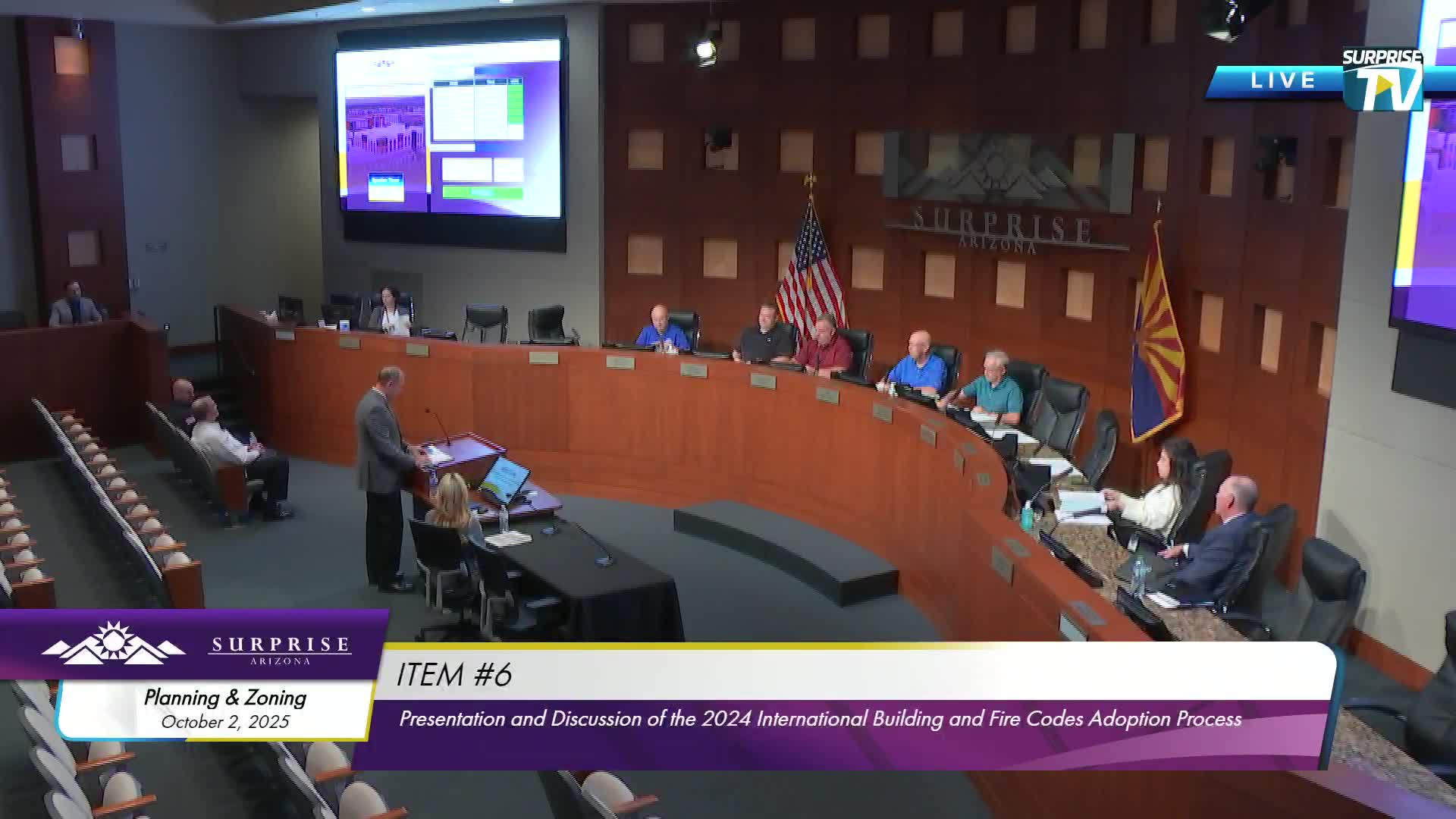
Carl Montgomery, the city’s building official, and colleagues presented an update Oct. 2 on the city’s planned adoption of the 2024 International Building and Fire Codes and related local amendments.
Montgomery said the city has been preparing over more than a year and that other regional jurisdictions (Phoenix and Glendale) are at differing stages of adoption. He told commissioners the city plans to return Nov. 6 to request commission support for adoption and to present to the city council Dec. 2; if adopted, the 2024 codes would be effective Jan. 1, 2026.
Montgomery and Fire Marshal Keith Tanner described highlights of the proposed local amendments. Key fire code notes include retaining requirements for automatic sprinklers in certain commercial occupancies and for custom homes in areas without adequate water supply, and removing the full‑area smoke requirement for fire alarm systems (a change meant to align regionally). Building code amendments noted in the presentation include floodplain coordination with Maricopa County, continuation of minimum masonry reinforcement standards carried forward from the 2018 cycle, and a retained requirement for 5/8‑inch Type X gypsum between attached garages and dwellings to increase fire separation.
Staff also described several customer‑focused adjustments developed from stakeholder feedback: making certain work exempt from permit while still requiring code compliance (replacement windows and doors that do not alter the rough opening; residential HVAC replacements of the same type, size and location; skylights and tubular daylighting devices that do not structurally alter roof members), allowing an air‑conditioning unit to be installed in an existing finished garage without triggering the IRC energy provisions, and permitting a metal awning or patio cover with a three‑foot setback without requiring one‑hour fire protection when planning setbacks allow a three‑foot separation.
Other items discussed include optional use of the Residential Energy Services Network (ResNet) testing protocol, proposed adjustments to electrical receptacle heights in garages for safety considerations, and retaining existing kitchen island and bathroom receptacle rules similar to the 2018 code. Staff said whole‑house surge protection will remain optional. The presentation noted the public comment period lasted 87 days, staff held two public outreach meetings (Sept. 3 at City Hall and at the Assante Library) with low attendance (three people total reported across sessions), and staff received minimal opposition during the comment period.
Montgomery said staff had received stakeholder input about water‑conservation measures and agreed to allow the city’s water demand calculator as an option, not a mandate, with support from the water resource management department. He said code adoption steps remain: finalize local amendments, return Nov. 6 for commission recommendation and Dec. 2 for council adoption.
No vote was required Oct. 2; staff requested direction and said they will return with final ordinance language for formal adoption.
Montgomery said the city has been preparing over more than a year and that other regional jurisdictions (Phoenix and Glendale) are at differing stages of adoption. He told commissioners the city plans to return Nov. 6 to request commission support for adoption and to present to the city council Dec. 2; if adopted, the 2024 codes would be effective Jan. 1, 2026.
Montgomery and Fire Marshal Keith Tanner described highlights of the proposed local amendments. Key fire code notes include retaining requirements for automatic sprinklers in certain commercial occupancies and for custom homes in areas without adequate water supply, and removing the full‑area smoke requirement for fire alarm systems (a change meant to align regionally). Building code amendments noted in the presentation include floodplain coordination with Maricopa County, continuation of minimum masonry reinforcement standards carried forward from the 2018 cycle, and a retained requirement for 5/8‑inch Type X gypsum between attached garages and dwellings to increase fire separation.
Staff also described several customer‑focused adjustments developed from stakeholder feedback: making certain work exempt from permit while still requiring code compliance (replacement windows and doors that do not alter the rough opening; residential HVAC replacements of the same type, size and location; skylights and tubular daylighting devices that do not structurally alter roof members), allowing an air‑conditioning unit to be installed in an existing finished garage without triggering the IRC energy provisions, and permitting a metal awning or patio cover with a three‑foot setback without requiring one‑hour fire protection when planning setbacks allow a three‑foot separation.
Other items discussed include optional use of the Residential Energy Services Network (ResNet) testing protocol, proposed adjustments to electrical receptacle heights in garages for safety considerations, and retaining existing kitchen island and bathroom receptacle rules similar to the 2018 code. Staff said whole‑house surge protection will remain optional. The presentation noted the public comment period lasted 87 days, staff held two public outreach meetings (Sept. 3 at City Hall and at the Assante Library) with low attendance (three people total reported across sessions), and staff received minimal opposition during the comment period.
Montgomery said staff had received stakeholder input about water‑conservation measures and agreed to allow the city’s water demand calculator as an option, not a mandate, with support from the water resource management department. He said code adoption steps remain: finalize local amendments, return Nov. 6 for commission recommendation and Dec. 2 for council adoption.
No vote was required Oct. 2; staff requested direction and said they will return with final ordinance language for formal adoption.
Don't Miss a Word: See the Full Meeting!
Go beyond summaries. Unlock every video, transcript, and key insight with a Founder Membership.
✓
Get instant access to full meeting videos
✓
Search and clip any phrase from complete transcripts
✓
Receive AI-powered summaries & custom alerts
✓
Enjoy lifetime, unrestricted access to government data
30-day money-back guarantee
