Council hears low uptake of water rebate programs; staff to improve outreach and website access
October 02, 2025 | South Pasadena City, Los Angeles County, California
This article was created by AI summarizing key points discussed. AI makes mistakes, so for full details and context, please refer to the video of the full meeting. Please report any errors so we can fix them. Report an error »
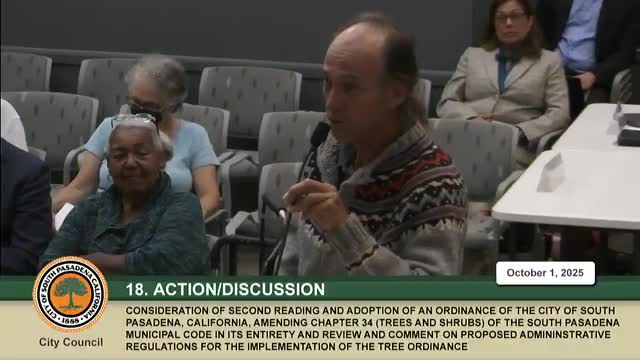
Public Works and sustainability staff reported Oct. 1 that several conservation rebate programs have low participation despite available funds. Councilmembers and residents urged the city to improve website navigation and outreach to increase use of rebates for turf removal, water-efficient plants, dishwashers and other measures.
Council Member Cacciotti said it took her many clicks to find the rebate information online and urged a simpler front-page structure for environmental incentives. "It shouldn't take me 7 clicks to try to find that incentive," she said. Staff acknowledged the problem and said they will reorganize the website and increase promotion in partnership with the Public Affairs Division.
Staff gave specifics: the city's conservation fund held more than $500,000 and annual allocations (~$120,000) have often been underspent. NREC recommended several increases for FY 25-26; staff said they raised co-funding for turf removal (residential co-funding raised from $2 to $4 per sq ft), increased the dishwasher rebate from $500 to $750, boosted rain-barrel and cistern co-funding, and expanded other measures. Staff also noted an existing tree-replacement rebate ($100 per tree, up to 10 trees) and that they are exploring a multifamily clothes-washer rebate.
Why it matters: The rebates are intended to reduce residential and municipal water use; low uptake means unspent funds and missed water savings opportunities. Councilmembers asked staff to pair rebate promotions with community events and Creek/utility partners and to make application steps clearer.
What's next: Staff will relaunch the rebate pages with clearer pathways, coordinate promotion with the chamber and Athens (trash/collection contractor) events, and return with metrics linking rebate spending to measurable water-use reductions.
Ending: Council approved the staff recommendation to maintain and expand rebates; staff will return with updated participation KPIs and outreach plans.
Council Member Cacciotti said it took her many clicks to find the rebate information online and urged a simpler front-page structure for environmental incentives. "It shouldn't take me 7 clicks to try to find that incentive," she said. Staff acknowledged the problem and said they will reorganize the website and increase promotion in partnership with the Public Affairs Division.
Staff gave specifics: the city's conservation fund held more than $500,000 and annual allocations (~$120,000) have often been underspent. NREC recommended several increases for FY 25-26; staff said they raised co-funding for turf removal (residential co-funding raised from $2 to $4 per sq ft), increased the dishwasher rebate from $500 to $750, boosted rain-barrel and cistern co-funding, and expanded other measures. Staff also noted an existing tree-replacement rebate ($100 per tree, up to 10 trees) and that they are exploring a multifamily clothes-washer rebate.
Why it matters: The rebates are intended to reduce residential and municipal water use; low uptake means unspent funds and missed water savings opportunities. Councilmembers asked staff to pair rebate promotions with community events and Creek/utility partners and to make application steps clearer.
What's next: Staff will relaunch the rebate pages with clearer pathways, coordinate promotion with the chamber and Athens (trash/collection contractor) events, and return with metrics linking rebate spending to measurable water-use reductions.
Ending: Council approved the staff recommendation to maintain and expand rebates; staff will return with updated participation KPIs and outreach plans.
View the Full Meeting & All Its Details
This article offers just a summary. Unlock complete video, transcripts, and insights as a Founder Member.
✓
Watch full, unedited meeting videos
✓
Search every word spoken in unlimited transcripts
✓
AI summaries & real-time alerts (all government levels)
✓
Permanent access to expanding government content
30-day money-back guarantee
