APS board accepts preliminary early‑literacy results showing 6.4 percentage‑point gain in third‑grade proficiency
October 02, 2025 | ALBUQUERQUE PUBLIC SCHOOLS, School Districts, New Mexico
This article was created by AI summarizing key points discussed. AI makes mistakes, so for full details and context, please refer to the video of the full meeting. Please report any errors so we can fix them. Report an error »
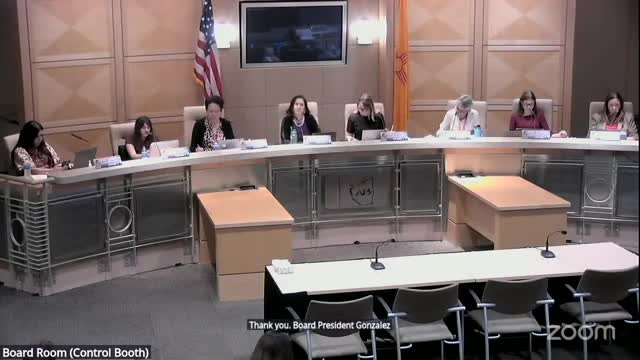
The Albuquerque Public Schools Board of Education accepted a preliminary progress monitoring report on Goal 1 (early literacy) at its Oct. 1 meeting, after about an hour of questions about assessment methods, subgroup results and supports for students with disabilities.
Dr. Gabriela Duran Blakey, superintendent, told the board that 31.7% of third‑grade students identified under the Yazzie/Martinez decision and African American students demonstrated grade‑level proficiency or higher on the state English language arts summative assessment, “a 6.4 percentage point increase from last year and above our 2024–25 target of 29.3 percent.” She said the result “marks real progress toward our 2028 goal of 37.3 percent.”
Why it matters: the board framed the vote as an acknowledgement that administration and schools are producing measurable gains on a multi‑year goal for foundational reading. The discussion focused on whether the reported gains are reliable, how interim (AMIRA) assessments will be used, and how special education and English‑learner (EL) students will be supported going forward.
Most important details
- Vote: The board voted to accept the monitoring report. The motion was made by Board Member Courtney Jackson and seconded by Board Secretary Janelle Astorga; the roll call vote was recorded as unanimous in favor.
- District data presented: 31.7% overall proficiency for the targeted third‑grade cohort; a 6.4 percentage‑point year‑over‑year increase; the district’s 2024–25 target was 29.3% and the 2028 target is 37.3%.
- Subgroup changes: presenters said every tracked student group improved, calling out a roughly 12 percentage‑point gain for Native American students and growth for students identified with disabilities (described in the meeting as moving from 6.9% to 10.7%, a 4.1‑point increase). Administrators and board members discussed both percent‑point and percent‑change frames for subgroup gains.
Assessment, accessibility and interim monitoring
Administrators described AMIRA (an interim, computer‑based reading assessment) as the tool they will expand for third‑grade progress monitoring. In response to board questions, staff said students with Individualized Education Programs (IEPs) will receive the accommodations their IEPs require during AMIRA and other interim assessments, and that the district offers paper‑and‑pencil and braille options where needed. A district staff member noted the AMIRA product includes an oral fluency component in which students speak to a microphone; the district said it has arranged visits and support from the vendor and is working with special education leaders to align accommodations.
Board members pressed administrators on three recurring concerns:
- reliability of computer‑based voice recognition for ELs and some students with disabilities; administrators said teachers remain present during interim assessments and that the district is testing equipment and training staff to reduce noise and technical problems;
- whether classroom observation tools are being used consistently to align instruction to standards; administrators said they are revising and simplifying a dense walkthrough/observation tool and will roll out targeted professional development; and
- how the district will reduce subgroup gaps; district leaders pointed to inclusive classroom practices, targeted IEP alignment to grade‑level standards and new datasets that link interim results to classroom interventions.
Quotes
"These are early results to stay on top of our progress monitoring calendar," Dr. Gabriela Duran Blakey said, noting the district presented preliminary numbers because the state release was still under embargo.
"A 6.4% increase in a year. That's incredible," Board Member Courtney Jackson said during the board discussion.
What the board decided and next steps
The board accepted the report as presented; the motion's recorded intent was to acknowledge the conversation and the district's progress monitoring work rather than to adopt a final, state‑released dataset. Administrators told the board they expect the New Mexico Public Education Department embargo on statewide data to be lifted Oct. 3 and that finalized tables and visualizations will be posted after that release.
Administrators committed to integrating more specific reporting on students with IEPs in the next monitoring packet and to presenting the district’s revised classroom walkthrough tool and priority standards at upcoming principal and board briefings. Board members asked staff to bring any vendor‑support plans and documentation of AMIRA accommodations to the next report.
Ending
Board members and administrators framed the vote as acceptance of preliminary, promising results while reserving final confirmation for the statewide release. The district said it will return with more detailed breakdowns (including the interim AMIRA 1.1/1.2 results and standard‑level analyses) once state data are public and vendor technical issues have been checked.
Dr. Gabriela Duran Blakey, superintendent, told the board that 31.7% of third‑grade students identified under the Yazzie/Martinez decision and African American students demonstrated grade‑level proficiency or higher on the state English language arts summative assessment, “a 6.4 percentage point increase from last year and above our 2024–25 target of 29.3 percent.” She said the result “marks real progress toward our 2028 goal of 37.3 percent.”
Why it matters: the board framed the vote as an acknowledgement that administration and schools are producing measurable gains on a multi‑year goal for foundational reading. The discussion focused on whether the reported gains are reliable, how interim (AMIRA) assessments will be used, and how special education and English‑learner (EL) students will be supported going forward.
Most important details
- Vote: The board voted to accept the monitoring report. The motion was made by Board Member Courtney Jackson and seconded by Board Secretary Janelle Astorga; the roll call vote was recorded as unanimous in favor.
- District data presented: 31.7% overall proficiency for the targeted third‑grade cohort; a 6.4 percentage‑point year‑over‑year increase; the district’s 2024–25 target was 29.3% and the 2028 target is 37.3%.
- Subgroup changes: presenters said every tracked student group improved, calling out a roughly 12 percentage‑point gain for Native American students and growth for students identified with disabilities (described in the meeting as moving from 6.9% to 10.7%, a 4.1‑point increase). Administrators and board members discussed both percent‑point and percent‑change frames for subgroup gains.
Assessment, accessibility and interim monitoring
Administrators described AMIRA (an interim, computer‑based reading assessment) as the tool they will expand for third‑grade progress monitoring. In response to board questions, staff said students with Individualized Education Programs (IEPs) will receive the accommodations their IEPs require during AMIRA and other interim assessments, and that the district offers paper‑and‑pencil and braille options where needed. A district staff member noted the AMIRA product includes an oral fluency component in which students speak to a microphone; the district said it has arranged visits and support from the vendor and is working with special education leaders to align accommodations.
Board members pressed administrators on three recurring concerns:
- reliability of computer‑based voice recognition for ELs and some students with disabilities; administrators said teachers remain present during interim assessments and that the district is testing equipment and training staff to reduce noise and technical problems;
- whether classroom observation tools are being used consistently to align instruction to standards; administrators said they are revising and simplifying a dense walkthrough/observation tool and will roll out targeted professional development; and
- how the district will reduce subgroup gaps; district leaders pointed to inclusive classroom practices, targeted IEP alignment to grade‑level standards and new datasets that link interim results to classroom interventions.
Quotes
"These are early results to stay on top of our progress monitoring calendar," Dr. Gabriela Duran Blakey said, noting the district presented preliminary numbers because the state release was still under embargo.
"A 6.4% increase in a year. That's incredible," Board Member Courtney Jackson said during the board discussion.
What the board decided and next steps
The board accepted the report as presented; the motion's recorded intent was to acknowledge the conversation and the district's progress monitoring work rather than to adopt a final, state‑released dataset. Administrators told the board they expect the New Mexico Public Education Department embargo on statewide data to be lifted Oct. 3 and that finalized tables and visualizations will be posted after that release.
Administrators committed to integrating more specific reporting on students with IEPs in the next monitoring packet and to presenting the district’s revised classroom walkthrough tool and priority standards at upcoming principal and board briefings. Board members asked staff to bring any vendor‑support plans and documentation of AMIRA accommodations to the next report.
Ending
Board members and administrators framed the vote as acceptance of preliminary, promising results while reserving final confirmation for the statewide release. The district said it will return with more detailed breakdowns (including the interim AMIRA 1.1/1.2 results and standard‑level analyses) once state data are public and vendor technical issues have been checked.
Don't Miss a Word: See the Full Meeting!
Go beyond summaries. Unlock every video, transcript, and key insight with a Founder Membership.
✓
Get instant access to full meeting videos
✓
Search and clip any phrase from complete transcripts
✓
Receive AI-powered summaries & custom alerts
✓
Enjoy lifetime, unrestricted access to government data
30-day money-back guarantee
