Florida League of Cities briefs Panama City charter review board on charter basics and forms of government
October 02, 2025 | Panama City, Bay County, Florida
This article was created by AI summarizing key points discussed. AI makes mistakes, so for full details and context, please refer to the video of the full meeting. Please report any errors so we can fix them. Report an error »
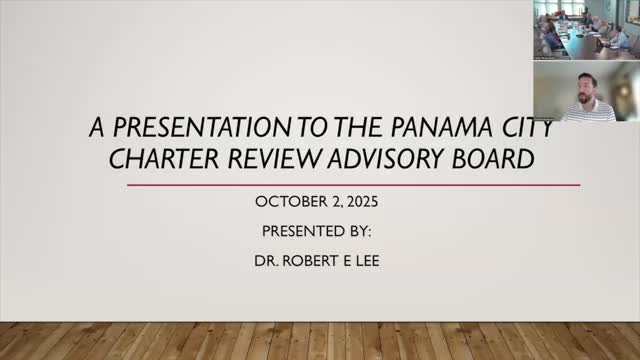
The Florida League of Cities and local university instructors gave the Panama City Charter Review Advisory Board a primer on what belongs in a municipal charter and the strengths and weaknesses of different forms of local government.
The presentation, led by Chris Holly, director of member services and training for the Florida League of Cities, and Dr. Robert Lee, associate professor at Florida Gulf Coast University and an instructor for the League, emphasized that a city charter functions as a local constitution and advised the board to keep the charter narrowly focused on structure and high-level rules.
"City charter is a legal document that should be limited in scope," Dr. Robert Lee said, urging the board to avoid embedding detailed operational rules that can limit a city's flexibility to accept grants or respond quickly to changing needs. He gave one example of a charter that required voter referenda for capital projects above a certain dollar threshold; that requirement, he said, had prevented a city from accepting state or federal grant funds that required fast turnaround.
The League presenters outlined common charter sections: a preamble and legal description, the legislative branch (number of officials, terms, districting), the executive (selection, powers and removal), legal counsel and clerk functions, and procedures for amendments and citizen initiatives. They recommended drafting powers broadly — for example, stating powers "to govern the city, to include but not be limited to" — rather than listing highly specific authorities that can create unintended limits.
On forms of government, both Holly and Dr. Lee described four common approaches and their tradeoffs: the council–manager form; strong-mayor form; commission form; and hybrid arrangements. They said the council–manager form is the most common in Florida for cities the size of Panama City and generally offers clearer separation between policy (elected commission) and administration (professional manager). "It's the form I would argue that's most likely to maintain compliance with state and federal laws," Dr. Lee said of the council–manager model.
They cautioned that strong-mayor systems can concentrate hiring and firing authority in an elected official who may lack professional management experience, and that hybrid or ambiguous arrangements often cause confusion about who has authority.
The presenters urged the board to separate charter recommendations from items better handled by ordinance or policy. "Refer the other non‑charter issues in a separate memo to the commission for future ordinance or resolution consideration," Dr. Lee suggested, so the charter remains a durable, legal framework while allowing the commission to handle operational details.
The presentation included data and comparative materials the League said it can provide to the board, including charter language used by other Florida municipalities and examples of governance structures.
The board followed the League's overview with a question-and-answer session that touched on agenda authority, clerk and attorney selection, and how different electoral and districting choices affect governance.
The board asked the presenters for follow‑up examples and pledged to use the materials as a basis for drafting recommended charter language and a separate memo of non‑charter policy suggestions.
The presentation, led by Chris Holly, director of member services and training for the Florida League of Cities, and Dr. Robert Lee, associate professor at Florida Gulf Coast University and an instructor for the League, emphasized that a city charter functions as a local constitution and advised the board to keep the charter narrowly focused on structure and high-level rules.
"City charter is a legal document that should be limited in scope," Dr. Robert Lee said, urging the board to avoid embedding detailed operational rules that can limit a city's flexibility to accept grants or respond quickly to changing needs. He gave one example of a charter that required voter referenda for capital projects above a certain dollar threshold; that requirement, he said, had prevented a city from accepting state or federal grant funds that required fast turnaround.
The League presenters outlined common charter sections: a preamble and legal description, the legislative branch (number of officials, terms, districting), the executive (selection, powers and removal), legal counsel and clerk functions, and procedures for amendments and citizen initiatives. They recommended drafting powers broadly — for example, stating powers "to govern the city, to include but not be limited to" — rather than listing highly specific authorities that can create unintended limits.
On forms of government, both Holly and Dr. Lee described four common approaches and their tradeoffs: the council–manager form; strong-mayor form; commission form; and hybrid arrangements. They said the council–manager form is the most common in Florida for cities the size of Panama City and generally offers clearer separation between policy (elected commission) and administration (professional manager). "It's the form I would argue that's most likely to maintain compliance with state and federal laws," Dr. Lee said of the council–manager model.
They cautioned that strong-mayor systems can concentrate hiring and firing authority in an elected official who may lack professional management experience, and that hybrid or ambiguous arrangements often cause confusion about who has authority.
The presenters urged the board to separate charter recommendations from items better handled by ordinance or policy. "Refer the other non‑charter issues in a separate memo to the commission for future ordinance or resolution consideration," Dr. Lee suggested, so the charter remains a durable, legal framework while allowing the commission to handle operational details.
The presentation included data and comparative materials the League said it can provide to the board, including charter language used by other Florida municipalities and examples of governance structures.
The board followed the League's overview with a question-and-answer session that touched on agenda authority, clerk and attorney selection, and how different electoral and districting choices affect governance.
The board asked the presenters for follow‑up examples and pledged to use the materials as a basis for drafting recommended charter language and a separate memo of non‑charter policy suggestions.
Don't Miss a Word: See the Full Meeting!
Go beyond summaries. Unlock every video, transcript, and key insight with a Founder Membership.
✓
Get instant access to full meeting videos
✓
Search and clip any phrase from complete transcripts
✓
Receive AI-powered summaries & custom alerts
✓
Enjoy lifetime, unrestricted access to government data
30-day money-back guarantee
