Longmont residents, county officials spar over proposed compost facility and open-space land swap
October 02, 2025 | Boulder County, Colorado
This article was created by AI summarizing key points discussed. AI makes mistakes, so for full details and context, please refer to the video of the full meeting. Please report any errors so we can fix them. Report an error »
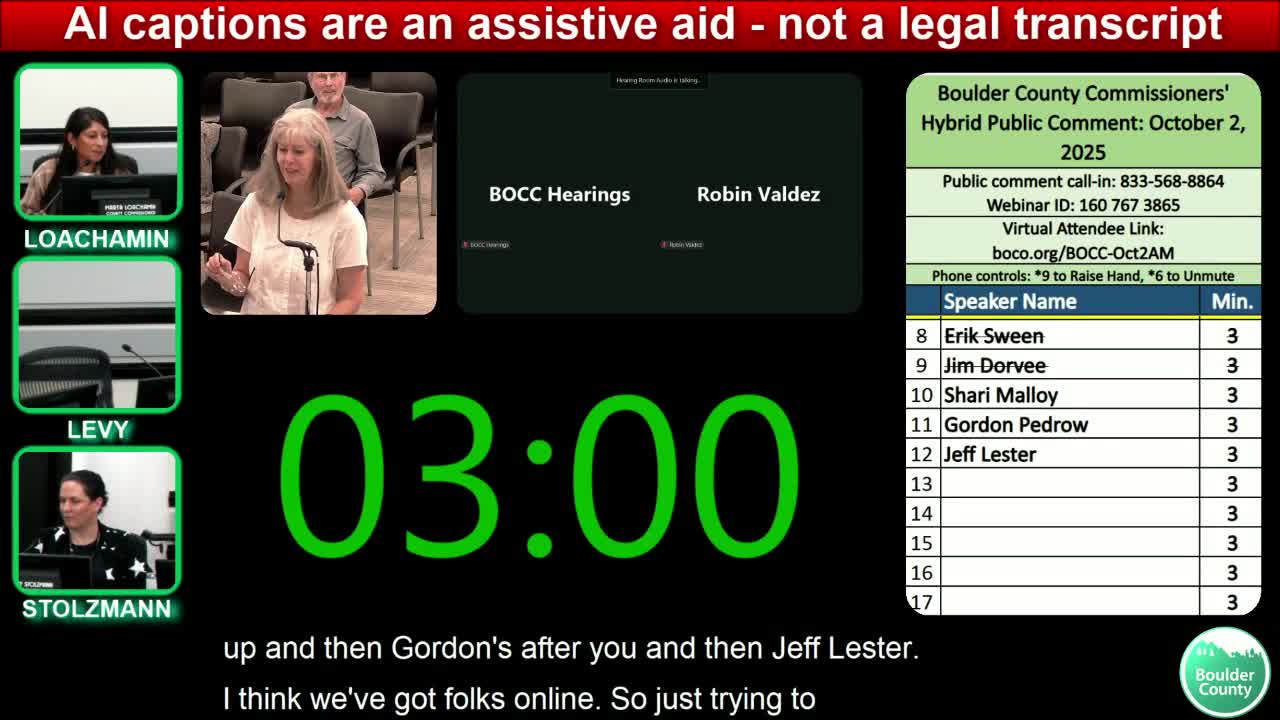
Longmont residents and open-space advocates told the Boulder County Board of County Commissioners on Oct. 2 that a proposed land exchange that would allow a regional composting facility on land tied to Longmont’s open-space program would violate prior commitments and undermine voter trust.
The comments came during the public-comment portion of the county’s meeting, where speakers said the proposal—under discussion between Longmont and Boulder County staff—would convert parcels bought with open-space dollars or intended for conservation into industrial use for composting, truck access and other public-works functions.
The issue matters because Longmont voters in November extended an open-space sales tax with 74% approval, and several speakers said the ballot language and intergovernmental commitments did not allow conversion of land purchased for open space into industrial uses. “When people see land we pay to protect being positioned for a different purpose, confidence in open-space programs decline,” said Sherry Malloy, a Longmont resident and open-space advocate. “Longmont Friends of Open Space cannot support the extension of the county’s open space tax given that Boulder County plans to utilize Longmont’s open space for industrial development.”
Gordon Pedro, a former Longmont city manager and member of Longmont Friends of Open Space, told commissioners the city purchased a parcel known as the Distal property with commitments to restore and manage it as open space. He warned that repurposing such parcels would break promises and set a precedent that could put other voter-funded open space at risk. “If open space purchased with voter-approved funds can be swapped or converted to industry, then every parcel becomes vulnerable,” Pedro said.
Jeff Lester, a Longmont resident, cited an intergovernmental agreement (IGA) with the town of Frederick from 2011 that he said requires protection of the St. Vrain and Boulder creeks corridor and buffers against industrial use. He said the Distal parcel lies within that corridor and that industrializing it would contradict the IGA and the St. Vrain integrated reclamation plan, which he described as guiding habitat restoration and flood resilience.
Commissioner Elise Stoltzmann, who said she is a lead commissioner on the county’s composting work, responded to the speakers and described a multi-year site search and coordinated discussions with Longmont staff. She said county officials had explored multiple options, that Longmont staff had proposed a swap that would have placed open space protections on other land, and that the Longmont Parks and Recreation Advisory Board ultimately did not recommend the swap. Stoltzmann said the county remains a partner to Longmont and will not push a swap if Longmont’s council rejects it. “If the Longmont City Council doesn’t want to do the swap, then the Boulder County commissioners won’t do the swap,” she said.
Speakers pressed several specific objections: claims that the Distal parcel had been purchased using open-space funds and was committed to restoration; that a land swap would replace riparian corridors with truck traffic, runoff and wildlife disruption; and that approving such a conversion would erode public trust and jeopardize future open-space funding.
County staff and commissioners also argued the county is trying to address a separate waste issue: Stoltzmann noted the county has approximately 600 tons of woody biomass currently going to landfill that could be composted. She said county staff are still evaluating sites and trying to find “win-win” solutions with municipal partners.
The county did not take any formal vote at the Oct. 2 meeting. Commissioners said they would continue coordinating with Longmont staff and the Longmont City Council, and that any swap would depend on Longmont’s decisions and community input.
Provenance: The topic was introduced during public comment beginning with Sherry Malloy’s remarks (00:21:02) and continued through Commissioner Stoltzmann’s response (00:40:20).
The comments came during the public-comment portion of the county’s meeting, where speakers said the proposal—under discussion between Longmont and Boulder County staff—would convert parcels bought with open-space dollars or intended for conservation into industrial use for composting, truck access and other public-works functions.
The issue matters because Longmont voters in November extended an open-space sales tax with 74% approval, and several speakers said the ballot language and intergovernmental commitments did not allow conversion of land purchased for open space into industrial uses. “When people see land we pay to protect being positioned for a different purpose, confidence in open-space programs decline,” said Sherry Malloy, a Longmont resident and open-space advocate. “Longmont Friends of Open Space cannot support the extension of the county’s open space tax given that Boulder County plans to utilize Longmont’s open space for industrial development.”
Gordon Pedro, a former Longmont city manager and member of Longmont Friends of Open Space, told commissioners the city purchased a parcel known as the Distal property with commitments to restore and manage it as open space. He warned that repurposing such parcels would break promises and set a precedent that could put other voter-funded open space at risk. “If open space purchased with voter-approved funds can be swapped or converted to industry, then every parcel becomes vulnerable,” Pedro said.
Jeff Lester, a Longmont resident, cited an intergovernmental agreement (IGA) with the town of Frederick from 2011 that he said requires protection of the St. Vrain and Boulder creeks corridor and buffers against industrial use. He said the Distal parcel lies within that corridor and that industrializing it would contradict the IGA and the St. Vrain integrated reclamation plan, which he described as guiding habitat restoration and flood resilience.
Commissioner Elise Stoltzmann, who said she is a lead commissioner on the county’s composting work, responded to the speakers and described a multi-year site search and coordinated discussions with Longmont staff. She said county officials had explored multiple options, that Longmont staff had proposed a swap that would have placed open space protections on other land, and that the Longmont Parks and Recreation Advisory Board ultimately did not recommend the swap. Stoltzmann said the county remains a partner to Longmont and will not push a swap if Longmont’s council rejects it. “If the Longmont City Council doesn’t want to do the swap, then the Boulder County commissioners won’t do the swap,” she said.
Speakers pressed several specific objections: claims that the Distal parcel had been purchased using open-space funds and was committed to restoration; that a land swap would replace riparian corridors with truck traffic, runoff and wildlife disruption; and that approving such a conversion would erode public trust and jeopardize future open-space funding.
County staff and commissioners also argued the county is trying to address a separate waste issue: Stoltzmann noted the county has approximately 600 tons of woody biomass currently going to landfill that could be composted. She said county staff are still evaluating sites and trying to find “win-win” solutions with municipal partners.
The county did not take any formal vote at the Oct. 2 meeting. Commissioners said they would continue coordinating with Longmont staff and the Longmont City Council, and that any swap would depend on Longmont’s decisions and community input.
Provenance: The topic was introduced during public comment beginning with Sherry Malloy’s remarks (00:21:02) and continued through Commissioner Stoltzmann’s response (00:40:20).
Don't Miss a Word: See the Full Meeting!
Go beyond summaries. Unlock every video, transcript, and key insight with a Founder Membership.
✓
Get instant access to full meeting videos
✓
Search and clip any phrase from complete transcripts
✓
Receive AI-powered summaries & custom alerts
✓
Enjoy lifetime, unrestricted access to government data
30-day money-back guarantee
