Planning commission reviews draft development code sections on permit processing and administration
October 16, 2025 | Cathedral City, Riverside County, California
This article was created by AI summarizing key points discussed. AI makes mistakes, so for full details and context, please refer to the video of the full meeting. Please report any errors so we can fix them. Report an error »
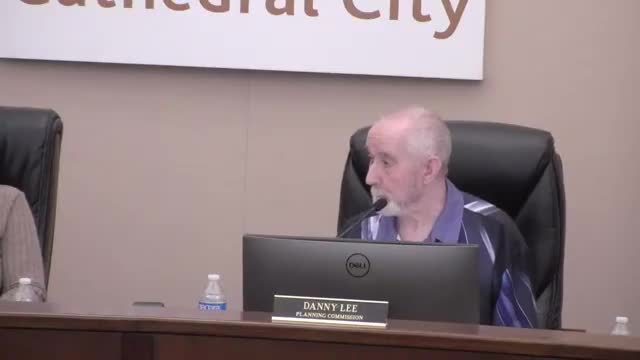
Cathedral City Planning Commission members spent the bulk of their Oct. 15 meeting reviewing staff and consultant recommendations to reorganize the city Development Code and sought guidance on several proposed procedural and administrative changes.
The discussion covered two draft code divisions: Division 6, which lays out application and permit-processing procedures, and Division 7, which sets administration, appeals and nonconforming-use rules. Brent, a consultant from Mentor Harness, told the commission the proposal "presents processing procedures for discretionary permits and other approvals required by the development code." Chair Gerry Lee emphasized that the item was for discussion and guidance and that "there's no vote on this item."
Why it matters: the draft would change how many routine land-use decisions are handled, introduce a new mid-level discretionary permit to be decided by staff, and create a standardized process for small administrative adjustments. Commissioners raised questions about transparency, limits on staff discretion, and how the city should handle aging or vacant properties.
Key proposals and discussion points
- Minor use permit: The draft creates a new director-level permit called a "minor use permit," intended to be a lower-level, discretionary review that generally would not go to the Planning Commission but would remain appealable. As the consultant described it, the minor use permit is "a lower level, think of a conditional use permit. It's still discretionary, but it's not reviewed by the planning commission." Commissioners asked that the staff later identify specific land uses that would be routed to this new permit rather than to full conditional-use review.
- Administrative adjustment (replacement for administrative variance): Consultants proposed replacing the current, varied administrative-variance thresholds with a single, standardized administrative adjustment (a "20%" example was discussed). Brent said the aim is to "standardize that variance allowance at the director's discretion," while acknowledging the percent number was a first draft and could change. Commissioners expressed concern that a single percent could be an awkward measure (yielding fractional inches or large absolute changes depending on the baseline) and urged the consultants and staff to provide concrete examples and transparency mechanisms.
- Design review thresholds (Director / ARC / Planning Commission): The draft splits design review into director-level review for minor exterior and site changes and an Architectural Review Committee (ARC) or Planning Commission review for larger, character-defining changes. The consultant summarized that director-level review would cover items such as minor façade changes and additions under certain thresholds, while ARC would handle "large wholesale changes" and multifamily development in R-4 and other higher-impact projects. Commissioners asked whether the ARC remains necessary given increased objective standards and more director-level approvals.
- Time limits and extensions: The draft sets a default time limit of 24 months for entitlements with a possible 12-month director-approved extension (current practice was described as up to 36 months). Commissioners debated whether the shorter default plus an administratively granted extension would help keep projects active or unintentionally enable speculative entitlements; staff agreed to explore milestone-based extension criteria.
- Nonconforming provisions and vacancy/abandonment: Division 7 includes updated nonconforming-use rules and an amortization provision discussed in the hearing. Staff noted the city already treats abandonment differently from vacancy and that current code treats 90 days as abandonment; staff indicated they will return with options for enforcement and vacancy standards. Community Development Director Firestone said the city earlier proposed an enforcement ordinance (fees/monitoring) that council did not adopt but that staff will continue working on enforcement refinements.
- Specific plans: The draft proposes a minimum lot/area threshold of 5 acres for use of the specific-plan process, with the city council able to waive that minimum. Commissioners questioned whether 5 acres is too small for the specific-plan tool and suggested staff compile current specific-plan acreages, examples and alternative tools (planned development, PD/PUD) so the commission can better weigh a minimum threshold.
Transparency and appeals
Multiple commissioners emphasized the need for transparency when more decisions are delegated to administrative (director-level) review. Commissioner McPhail and Vice Chair Mead asked for a simple reporting mechanism so commissioners and the public can see what administrative approvals are being issued (examples suggested included an online dashboard or a periodic report). Commissioners also requested clearer, consolidated language on who may appeal which administrative decisions and a table that maps approval, advisory and appeal authorities for each permit type.
What the commission directed staff to do
Commissioners and staff agreed to collect written comments and questions so the consultant can incorporate them into the draft. Several commissioners asked staff to:
- Produce concrete examples showing how the administrative adjustment would apply in real projects, including infill scenarios. (Source: Brent; multiple commissioners)
- Produce options for transparency/reporting of administrative approvals (e.g., dashboard or periodic reports). (Source: Vice Chair Mead; Commissioner McPhail)
- Return with a comparison of specific-plan sizes in Cathedral City and nearby jurisdictions and identify alternative tools (PD/PUD) for smaller or atypical projects. (Source: Chair Lee; staff)
- Revisit the time-extension proposal to consider milestone or performance requirements before granting extensions. (Source: Commissioners)
- Bring enforcement and abandonment/vacancy options back together with zoning changes so the city can address derelict or long-vacant properties. (Source: Director Firestone)
Votes at a glance
- Approval of minutes (Planning Commission minutes of Aug. 20, 2025): Motion to approve moved by Commissioner MacPhail and seconded by Vice Chair Mead. Roll call vote: Bedard: Aye; Malecoff: Aye; McPhail: Aye; Vice Chair Mead: Aye; Chair Lee: Aye. Motion carried, all ayes.
Next steps and schedule
Staff and the consultant said the next deliverables include zoning district provisions to the steering committee in early November and Planning Commission review in December; general development standards and specific-use standards (including home-occupation language and accessory dwelling unit rules) will follow in winter and spring sessions. Consultants said objective design standards will arrive in the spring, with a consolidated public-review draft and adoption process to follow later next year.
Quotes (selected, verbatim from transcript)
- "This is the item that was taken to the steering committee... you will get a presentation from Mentor Harness" — Brent (Consultant, Mentor Harness).
- "There's no vote on this item." — Chair Gerry Lee.
- "The minor use permit is a lower level, think of a conditional use permit. It's still discretionary, but it's not reviewed by the planning commission." — Brent (Consultant, Mentor Harness).
- "I am very concerned... about limiting home businesses" — Commissioner Bedard.
- "If we look at minor variances or minor adjustments... they were used for mostly for dimensions" — Vice Chair Mead.
- "There is a difference between vacant and abandoned." — Director Firestone (Community Development Director).
Ending note
Commissioners and staff agreed that the discussion was exploratory. Chair Lee asked commissioners to submit additional comments in writing so staff can collate them and forward them to the consultant for incorporation into future drafts. The Planning Commission will review subsequent draft sections on zoning districts, development standards and objective design criteria in the coming months.
The discussion covered two draft code divisions: Division 6, which lays out application and permit-processing procedures, and Division 7, which sets administration, appeals and nonconforming-use rules. Brent, a consultant from Mentor Harness, told the commission the proposal "presents processing procedures for discretionary permits and other approvals required by the development code." Chair Gerry Lee emphasized that the item was for discussion and guidance and that "there's no vote on this item."
Why it matters: the draft would change how many routine land-use decisions are handled, introduce a new mid-level discretionary permit to be decided by staff, and create a standardized process for small administrative adjustments. Commissioners raised questions about transparency, limits on staff discretion, and how the city should handle aging or vacant properties.
Key proposals and discussion points
- Minor use permit: The draft creates a new director-level permit called a "minor use permit," intended to be a lower-level, discretionary review that generally would not go to the Planning Commission but would remain appealable. As the consultant described it, the minor use permit is "a lower level, think of a conditional use permit. It's still discretionary, but it's not reviewed by the planning commission." Commissioners asked that the staff later identify specific land uses that would be routed to this new permit rather than to full conditional-use review.
- Administrative adjustment (replacement for administrative variance): Consultants proposed replacing the current, varied administrative-variance thresholds with a single, standardized administrative adjustment (a "20%" example was discussed). Brent said the aim is to "standardize that variance allowance at the director's discretion," while acknowledging the percent number was a first draft and could change. Commissioners expressed concern that a single percent could be an awkward measure (yielding fractional inches or large absolute changes depending on the baseline) and urged the consultants and staff to provide concrete examples and transparency mechanisms.
- Design review thresholds (Director / ARC / Planning Commission): The draft splits design review into director-level review for minor exterior and site changes and an Architectural Review Committee (ARC) or Planning Commission review for larger, character-defining changes. The consultant summarized that director-level review would cover items such as minor façade changes and additions under certain thresholds, while ARC would handle "large wholesale changes" and multifamily development in R-4 and other higher-impact projects. Commissioners asked whether the ARC remains necessary given increased objective standards and more director-level approvals.
- Time limits and extensions: The draft sets a default time limit of 24 months for entitlements with a possible 12-month director-approved extension (current practice was described as up to 36 months). Commissioners debated whether the shorter default plus an administratively granted extension would help keep projects active or unintentionally enable speculative entitlements; staff agreed to explore milestone-based extension criteria.
- Nonconforming provisions and vacancy/abandonment: Division 7 includes updated nonconforming-use rules and an amortization provision discussed in the hearing. Staff noted the city already treats abandonment differently from vacancy and that current code treats 90 days as abandonment; staff indicated they will return with options for enforcement and vacancy standards. Community Development Director Firestone said the city earlier proposed an enforcement ordinance (fees/monitoring) that council did not adopt but that staff will continue working on enforcement refinements.
- Specific plans: The draft proposes a minimum lot/area threshold of 5 acres for use of the specific-plan process, with the city council able to waive that minimum. Commissioners questioned whether 5 acres is too small for the specific-plan tool and suggested staff compile current specific-plan acreages, examples and alternative tools (planned development, PD/PUD) so the commission can better weigh a minimum threshold.
Transparency and appeals
Multiple commissioners emphasized the need for transparency when more decisions are delegated to administrative (director-level) review. Commissioner McPhail and Vice Chair Mead asked for a simple reporting mechanism so commissioners and the public can see what administrative approvals are being issued (examples suggested included an online dashboard or a periodic report). Commissioners also requested clearer, consolidated language on who may appeal which administrative decisions and a table that maps approval, advisory and appeal authorities for each permit type.
What the commission directed staff to do
Commissioners and staff agreed to collect written comments and questions so the consultant can incorporate them into the draft. Several commissioners asked staff to:
- Produce concrete examples showing how the administrative adjustment would apply in real projects, including infill scenarios. (Source: Brent; multiple commissioners)
- Produce options for transparency/reporting of administrative approvals (e.g., dashboard or periodic reports). (Source: Vice Chair Mead; Commissioner McPhail)
- Return with a comparison of specific-plan sizes in Cathedral City and nearby jurisdictions and identify alternative tools (PD/PUD) for smaller or atypical projects. (Source: Chair Lee; staff)
- Revisit the time-extension proposal to consider milestone or performance requirements before granting extensions. (Source: Commissioners)
- Bring enforcement and abandonment/vacancy options back together with zoning changes so the city can address derelict or long-vacant properties. (Source: Director Firestone)
Votes at a glance
- Approval of minutes (Planning Commission minutes of Aug. 20, 2025): Motion to approve moved by Commissioner MacPhail and seconded by Vice Chair Mead. Roll call vote: Bedard: Aye; Malecoff: Aye; McPhail: Aye; Vice Chair Mead: Aye; Chair Lee: Aye. Motion carried, all ayes.
Next steps and schedule
Staff and the consultant said the next deliverables include zoning district provisions to the steering committee in early November and Planning Commission review in December; general development standards and specific-use standards (including home-occupation language and accessory dwelling unit rules) will follow in winter and spring sessions. Consultants said objective design standards will arrive in the spring, with a consolidated public-review draft and adoption process to follow later next year.
Quotes (selected, verbatim from transcript)
- "This is the item that was taken to the steering committee... you will get a presentation from Mentor Harness" — Brent (Consultant, Mentor Harness).
- "There's no vote on this item." — Chair Gerry Lee.
- "The minor use permit is a lower level, think of a conditional use permit. It's still discretionary, but it's not reviewed by the planning commission." — Brent (Consultant, Mentor Harness).
- "I am very concerned... about limiting home businesses" — Commissioner Bedard.
- "If we look at minor variances or minor adjustments... they were used for mostly for dimensions" — Vice Chair Mead.
- "There is a difference between vacant and abandoned." — Director Firestone (Community Development Director).
Ending note
Commissioners and staff agreed that the discussion was exploratory. Chair Lee asked commissioners to submit additional comments in writing so staff can collate them and forward them to the consultant for incorporation into future drafts. The Planning Commission will review subsequent draft sections on zoning districts, development standards and objective design criteria in the coming months.
Don't Miss a Word: See the Full Meeting!
Go beyond summaries. Unlock every video, transcript, and key insight with a Founder Membership.
✓
Get instant access to full meeting videos
✓
Search and clip any phrase from complete transcripts
✓
Receive AI-powered summaries & custom alerts
✓
Enjoy lifetime, unrestricted access to government data
30-day money-back guarantee
