Oregon City Commission denies permit to restore fence that encroached on Sebastian Way right‑of‑way
October 16, 2025 | Oregon City, Clackamas County, Oregon
This article was created by AI summarizing key points discussed. AI makes mistakes, so for full details and context, please refer to the video of the full meeting. Please report any errors so we can fix them. Report an error »
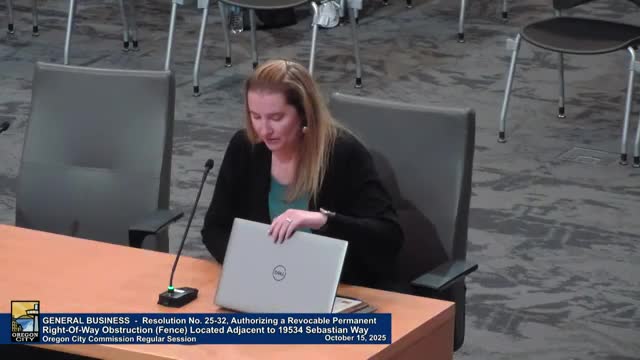
The Oregon City Commission voted unanimously on Oct. 15, 2025, to deny Resolution 25‑32, a request for a revocable right‑of‑way permit that would have allowed a property owner at 19534 Sebastian Way to restore a six‑foot cedar privacy fence that encroaches on city‑owned right‑of‑way.
Public works director Dana Webb told commissioners the fence sat much closer to public utilities than the applicant’s materials suggested and said fencing the area complicated access to valves and manholes used to operate and maintain the city’s water and sewer systems. Webb also said a second water line in that area is scheduled to start design this fiscal year as part of the WIFIA transmission main Phase 3 project and that construction would follow design work.
“The fence obstruction and the right of way does not provide a public benefit. It presents potential site‑line obstruction for vehicles exiting off of Sebastian Way onto Malala Avenue, and it creates maintenance issues,” Webb said, summarizing staff’s recommendation for denial.
The property owner, who identified himself as Steven Scott Cavierhill of 19534 Sebastian Way, told the commission the fence had stood in essentially the same location from about 2003 until it was removed in 2020 for the Malala Avenue streetscape project and that he bought the house in February 2007. He said the fence’s prior presence caused no safety, visibility or utility issues and asked the commission to grant the revocable permit so he could replace an eight‑foot slope‑exposed yard barrier that he said exposes his living areas to headlights and traffic noise.
“I’m simply I’m simply asking to restore a fence that stood safely for 17 years,” Cavierhill said. He also said he had already invested $6,800 in non‑refundable cedar materials based on earlier assurances from city staff that rebuilding would be allowed.
Commissioners expressed sympathy for the homeowner’s privacy concerns but repeatedly noted a legal and policy problem with allowing private use of public right‑of‑way. Commissioners also raised the difficulty of establishing a reliable method for tying city responses to a single facility, and staff explained the technical limits of attributing service calls to one spot when incidents occur nearby.
Staff and commissioners discussed alternatives including a formal variance process and adjustments through planning, but public works staff warned that granting an obstruction permit would complicate maintenance access to valves and manholes and would conflict with a planned water transmission project. Planning staff described the variance process as a Type 3 land use hearing typically decided by the Planning Commission and appealable to the City Commission; they noted variance criteria require showing a hardship and that the request be the minimum necessary to alleviate that hardship.
A motion to deny Resolution 25‑32 was made and seconded; a roll call recorded Commissioner Wilson, Commissioner Smith, Commissioner Marl, Commissioner Mitchell and Mayor McGrath voting in favor. The motion passed 5‑0.
Next steps discussed on the dais included advising the homeowner to consult the planning department about alternatives (for example, possible height adjustments or a formal variance) and staff follow‑up on the design schedule for the WIFIA transmission main.
Clarifying details recorded during the discussion: the fence was installed around 2003 and removed in 2020 during the Malala Avenue streetscape; the property was purchased by the current owner in February 2007; the owner reported a $6,800 non‑refundable investment in cedar fencing materials; public works staff identified valves and manholes within the right‑of‑way behind the property and said a second water line in the area will begin design within the current fiscal year, with roughly 12 months of design anticipated before construction.
The commission’s denial preserves unencumbered access to the city’s utility infrastructure and leaves property‑level privacy remedies or a planning variance as the homeowner’s potential alternatives.
Public works director Dana Webb told commissioners the fence sat much closer to public utilities than the applicant’s materials suggested and said fencing the area complicated access to valves and manholes used to operate and maintain the city’s water and sewer systems. Webb also said a second water line in that area is scheduled to start design this fiscal year as part of the WIFIA transmission main Phase 3 project and that construction would follow design work.
“The fence obstruction and the right of way does not provide a public benefit. It presents potential site‑line obstruction for vehicles exiting off of Sebastian Way onto Malala Avenue, and it creates maintenance issues,” Webb said, summarizing staff’s recommendation for denial.
The property owner, who identified himself as Steven Scott Cavierhill of 19534 Sebastian Way, told the commission the fence had stood in essentially the same location from about 2003 until it was removed in 2020 for the Malala Avenue streetscape project and that he bought the house in February 2007. He said the fence’s prior presence caused no safety, visibility or utility issues and asked the commission to grant the revocable permit so he could replace an eight‑foot slope‑exposed yard barrier that he said exposes his living areas to headlights and traffic noise.
“I’m simply I’m simply asking to restore a fence that stood safely for 17 years,” Cavierhill said. He also said he had already invested $6,800 in non‑refundable cedar materials based on earlier assurances from city staff that rebuilding would be allowed.
Commissioners expressed sympathy for the homeowner’s privacy concerns but repeatedly noted a legal and policy problem with allowing private use of public right‑of‑way. Commissioners also raised the difficulty of establishing a reliable method for tying city responses to a single facility, and staff explained the technical limits of attributing service calls to one spot when incidents occur nearby.
Staff and commissioners discussed alternatives including a formal variance process and adjustments through planning, but public works staff warned that granting an obstruction permit would complicate maintenance access to valves and manholes and would conflict with a planned water transmission project. Planning staff described the variance process as a Type 3 land use hearing typically decided by the Planning Commission and appealable to the City Commission; they noted variance criteria require showing a hardship and that the request be the minimum necessary to alleviate that hardship.
A motion to deny Resolution 25‑32 was made and seconded; a roll call recorded Commissioner Wilson, Commissioner Smith, Commissioner Marl, Commissioner Mitchell and Mayor McGrath voting in favor. The motion passed 5‑0.
Next steps discussed on the dais included advising the homeowner to consult the planning department about alternatives (for example, possible height adjustments or a formal variance) and staff follow‑up on the design schedule for the WIFIA transmission main.
Clarifying details recorded during the discussion: the fence was installed around 2003 and removed in 2020 during the Malala Avenue streetscape; the property was purchased by the current owner in February 2007; the owner reported a $6,800 non‑refundable investment in cedar fencing materials; public works staff identified valves and manholes within the right‑of‑way behind the property and said a second water line in the area will begin design within the current fiscal year, with roughly 12 months of design anticipated before construction.
The commission’s denial preserves unencumbered access to the city’s utility infrastructure and leaves property‑level privacy remedies or a planning variance as the homeowner’s potential alternatives.
View the Full Meeting & All Its Details
This article offers just a summary. Unlock complete video, transcripts, and insights as a Founder Member.
✓
Watch full, unedited meeting videos
✓
Search every word spoken in unlimited transcripts
✓
AI summaries & real-time alerts (all government levels)
✓
Permanent access to expanding government content
30-day money-back guarantee
