Portland council hears wide support for urban forest plan, adopts one equity amendment and postpones remaining changes
October 16, 2025 | Portland, Multnomah County, Oregon
This article was created by AI summarizing key points discussed. AI makes mistakes, so for full details and context, please refer to the video of the full meeting. Please report any errors so we can fix them. Report an error »
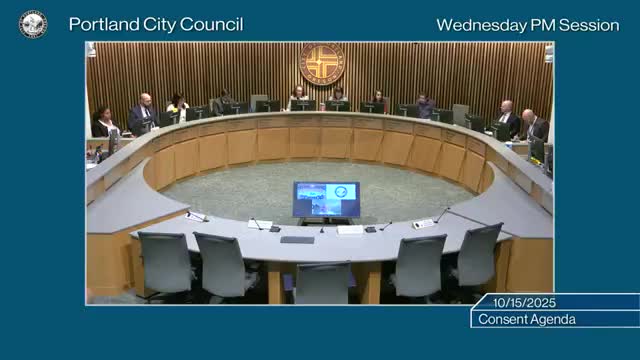
The Portland City Council on Oct. 15 took initial action on the Portland Urban Forest Plan, adopting one amendment aimed at expanding leaf-day services and pausing further votes after spirited debate about funding and legal authority.
The council opened a lengthy staff presentation on the plan, which staff described as a policy framework to prioritize tree preservation, expand planting and stewardship, improve equitable canopy distribution and use data tools to monitor progress. Craig Cook, council policy analyst, said the document before council was “document number 2025-351” and summarized committee action and three amendments recommended by the Climate Resilience and Land Use Committee.
Why it matters: Supporters say expanded tree canopy will reduce extreme heat, improve air and water quality and narrow long-standing canopy gaps east of I-205. Opponents and some council members warned the plan as amended could oblige the city to take on large ongoing costs without an identified permanent funding source or, in the case of sidewalk repairs, could conflict with the city charter.
Most testimony at council came from community groups, environmental nonprofits and public-health officials who urged adoption and faster action. Kina Rubin, director of Trees for Life Oregon, said the plan “sets ambitious citywide and geographically specific canopy targets” and asked the council to approve the plan.
“Residents of every district want relief from this financial burden” of tree maintenance, Noelle Studer Spivak of 350PDX told council, adding that two prior cost studies exist and a pilot program will deliver additional data. Micah Muskell of Bird Alliance of Oregon said the CRLU Committee strengthened the plan and urged the council to reject changes that would delay implementation.
Key debate: Councilors divided over amendments that would change language asking staff to “establish a plan by November 2027 to assume legal and financial responsibility for street trees” to less-committal language—asking instead for a report on cost and feasibility. Councilor Novick said he proposed the change to avoid signaling a permanent budgetary obligation when no financing mechanism had been identified. Councilor Dunphy proposed a separate set of equity-focused amendments that would require prioritized delivery in low-canopy, low-income neighborhoods (notably District 1), create a curb-tree program funding plan and establish a cross-bureau team to recommend potential permanent funding by March 2027.
City staff offered a range for annual operating cost if the city were to implement a comprehensive street-tree maintenance program: Urban Forestry staff said a program with inspection cycles and appropriate maintenance would run in the range of $15 million to $20 million a year, depending on service levels. Brian Lando, Urban Forestry, told council that estimate depends on level-of-service choices and that the plan assumes some continuing support from the Portland Clean Energy Fund for an initial period.
Actions and immediate outcome: Councilors agreed to limit debate to 20 minutes at one point to try to move business forward. During tonight’s session the council:
- Adopted Dunphy amendment 4, an amendment to expand access to the city’s leaf-day (street leaf-collection) program “including areas without curbs or sidewalks,” by recorded vote (amendment passed 10–2). Councilors Clark and another voted no. The amendment language was intended to ensure leaf-day expansion would not exclude neighborhoods that lack standard curbs and sidewalks.
- Deferred final votes on Dunphy amendments 1–3 (which included district-prioritized goals, a pilot requirement in District 1 and a phased approach to street-tree maintenance prioritizing low-canopy areas). Debate on those amendments was paused and the council postponed final action to a later meeting date.
What was not decided: The council did not adopt or reject the committee’s language directing the city to develop a plan by November 2027 to assume legal and financial responsibility for street trees; debate on that question remains open. Several councilors urged the administration to return with clearer cost estimates, funding options, and legal analysis about whether changing sidewalk responsibilities would require a charter amendment.
Implementation and next steps: Staff said some actions in the plan rely on existing or pledged Portland Clean Energy Fund resources that are allocated in five-year increments; other items will need additional resources. Councilor Dunphy requested that council direct staff to produce district-level performance metrics and to stand up a cross-service-area team led by the CFO to recommend funding approaches by March 2027. The council agreed to resume debate and votes on the remaining amendments and the underlying resolution at a future meeting later this month.
Ending: Support for the plan among community groups, public-health officials and conservation organizations was strong, but the council split over the timing and the scope of city financial responsibility. The council adopted a leaf-day access amendment tonight, asked for detailed cost and legal analysis, and deferred further implementation commitments while directing additional planning work to return to council.
The council opened a lengthy staff presentation on the plan, which staff described as a policy framework to prioritize tree preservation, expand planting and stewardship, improve equitable canopy distribution and use data tools to monitor progress. Craig Cook, council policy analyst, said the document before council was “document number 2025-351” and summarized committee action and three amendments recommended by the Climate Resilience and Land Use Committee.
Why it matters: Supporters say expanded tree canopy will reduce extreme heat, improve air and water quality and narrow long-standing canopy gaps east of I-205. Opponents and some council members warned the plan as amended could oblige the city to take on large ongoing costs without an identified permanent funding source or, in the case of sidewalk repairs, could conflict with the city charter.
Most testimony at council came from community groups, environmental nonprofits and public-health officials who urged adoption and faster action. Kina Rubin, director of Trees for Life Oregon, said the plan “sets ambitious citywide and geographically specific canopy targets” and asked the council to approve the plan.
“Residents of every district want relief from this financial burden” of tree maintenance, Noelle Studer Spivak of 350PDX told council, adding that two prior cost studies exist and a pilot program will deliver additional data. Micah Muskell of Bird Alliance of Oregon said the CRLU Committee strengthened the plan and urged the council to reject changes that would delay implementation.
Key debate: Councilors divided over amendments that would change language asking staff to “establish a plan by November 2027 to assume legal and financial responsibility for street trees” to less-committal language—asking instead for a report on cost and feasibility. Councilor Novick said he proposed the change to avoid signaling a permanent budgetary obligation when no financing mechanism had been identified. Councilor Dunphy proposed a separate set of equity-focused amendments that would require prioritized delivery in low-canopy, low-income neighborhoods (notably District 1), create a curb-tree program funding plan and establish a cross-bureau team to recommend potential permanent funding by March 2027.
City staff offered a range for annual operating cost if the city were to implement a comprehensive street-tree maintenance program: Urban Forestry staff said a program with inspection cycles and appropriate maintenance would run in the range of $15 million to $20 million a year, depending on service levels. Brian Lando, Urban Forestry, told council that estimate depends on level-of-service choices and that the plan assumes some continuing support from the Portland Clean Energy Fund for an initial period.
Actions and immediate outcome: Councilors agreed to limit debate to 20 minutes at one point to try to move business forward. During tonight’s session the council:
- Adopted Dunphy amendment 4, an amendment to expand access to the city’s leaf-day (street leaf-collection) program “including areas without curbs or sidewalks,” by recorded vote (amendment passed 10–2). Councilors Clark and another voted no. The amendment language was intended to ensure leaf-day expansion would not exclude neighborhoods that lack standard curbs and sidewalks.
- Deferred final votes on Dunphy amendments 1–3 (which included district-prioritized goals, a pilot requirement in District 1 and a phased approach to street-tree maintenance prioritizing low-canopy areas). Debate on those amendments was paused and the council postponed final action to a later meeting date.
What was not decided: The council did not adopt or reject the committee’s language directing the city to develop a plan by November 2027 to assume legal and financial responsibility for street trees; debate on that question remains open. Several councilors urged the administration to return with clearer cost estimates, funding options, and legal analysis about whether changing sidewalk responsibilities would require a charter amendment.
Implementation and next steps: Staff said some actions in the plan rely on existing or pledged Portland Clean Energy Fund resources that are allocated in five-year increments; other items will need additional resources. Councilor Dunphy requested that council direct staff to produce district-level performance metrics and to stand up a cross-service-area team led by the CFO to recommend funding approaches by March 2027. The council agreed to resume debate and votes on the remaining amendments and the underlying resolution at a future meeting later this month.
Ending: Support for the plan among community groups, public-health officials and conservation organizations was strong, but the council split over the timing and the scope of city financial responsibility. The council adopted a leaf-day access amendment tonight, asked for detailed cost and legal analysis, and deferred further implementation commitments while directing additional planning work to return to council.
View the Full Meeting & All Its Details
This article offers just a summary. Unlock complete video, transcripts, and insights as a Founder Member.
✓
Watch full, unedited meeting videos
✓
Search every word spoken in unlimited transcripts
✓
AI summaries & real-time alerts (all government levels)
✓
Permanent access to expanding government content
30-day money-back guarantee
