Consortium weighs funding pathways for contaminated private wells; USDA pilot, CDBG limits discussed
October 17, 2025 | Morrow County, Oregon
This article was created by AI summarizing key points discussed. AI makes mistakes, so for full details and context, please refer to the video of the full meeting. Please report any errors so we can fix them. Report an error »
Matt Jensen, managing director of the Clean Water Consortium (CWC) and Morrow County administrator, convened a follow-up meeting to discuss funding pathways for private (domestic) wells after preliminary project work identified widespread contamination and service gaps.
The consortium’s grant writer, Nick Cody, told members several established sources are technically eligible but logistically mismatched to the subgroup of private well owners the CWC hopes to reach, and the group voted to pursue a separate nonprofit-led USDA pilot as a near-term option.
Cody said the Community Development Block Grant (CDBG) housing-rehab program would not reliably target owners of domestic wells because the HUD inspection checklist routes repairs by preset priorities that usually place water supply low on the list. "So this one, unfortunately, I don't think is really gonna work," Cody said, describing the sequence of a-through-g priorities (sanitary facilities, food prep, refuse disposal, space/security, thermal environment, illumination/electricity, structure/materials, interior air quality) that must be addressed before water supply issues under current rules.
Cody also reviewed the CDBG public-works route — which can fund water-system extensions — and emphasized an affordability test the state applies to block-grant projects. He said the standard is 1.25% of a community's median household income divided by 12 (applied to a specified volume such as 7,500 gallons). Using local rate examples Cody reviewed, Boardman’s current average monthly water bills were low (he cited about $17–$25 in the examples he reviewed) and would have to rise substantially — the numbers discussed were in the $65–$90 range — to meet the affordability threshold required for construction funding through the block grant.
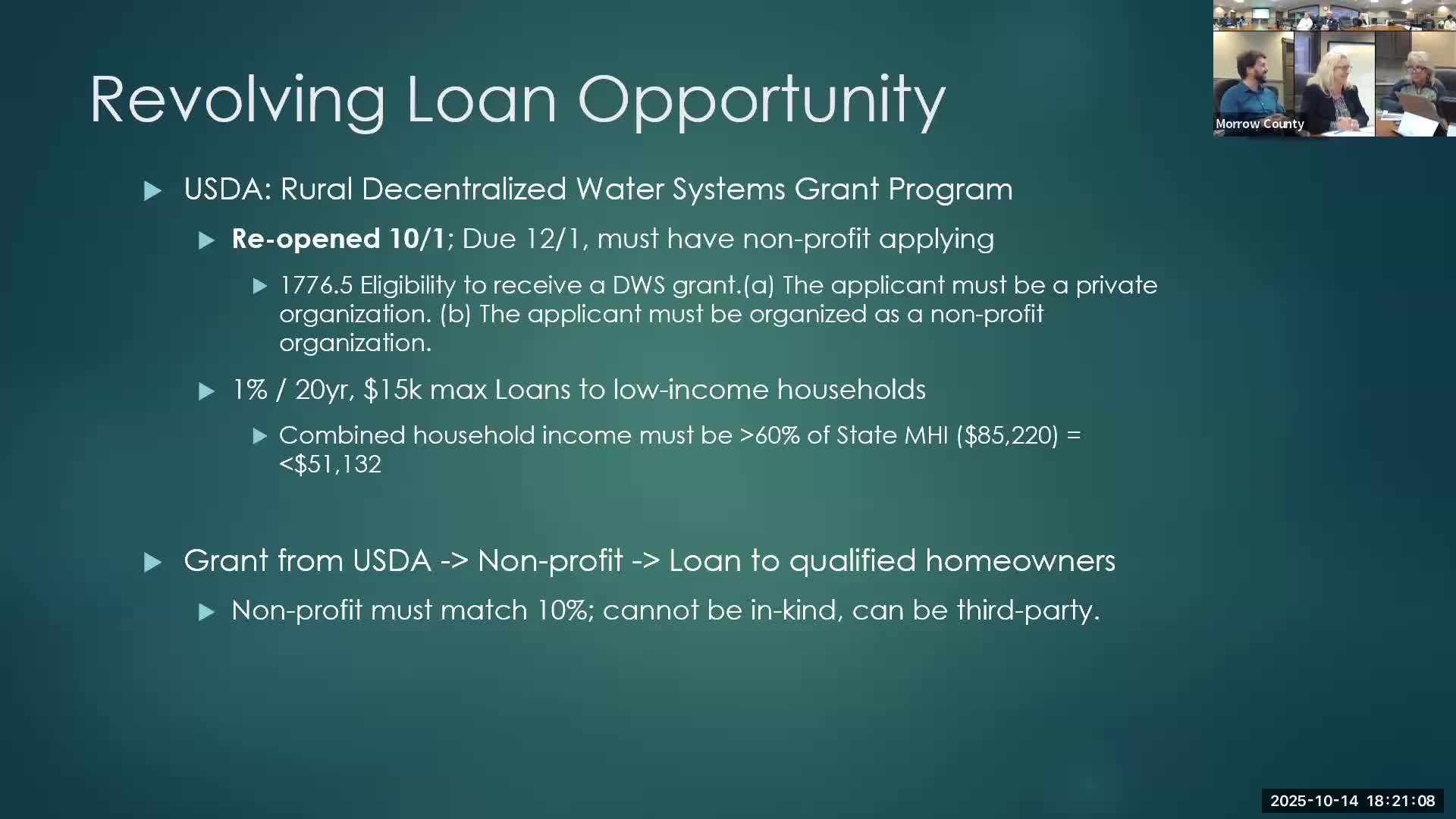
Because of those constraints, Cody highlighted a separate USDA decentralized water-system pilot the consortium could pursue now. Under that program a nonprofit applicant can receive a grant to capitalize a revolving loan fund; the nonprofit would make household loans of up to $15,000 at 1% interest over 20 years to qualifying low-income households, and the nonprofit must provide roughly a 10% match for the award. Cody said households would generally need combined household incomes below the low-income threshold (discussed in the meeting as roughly 60% of state median household income — about $51,000 in the example used) to qualify. He flagged other practical limits: the program’s national allocation is modest (participants estimated only a few million dollars nationwide), the application and underwriting paperwork are extensive, and a nonprofit partner with loan-administration capacity is required.
The consortium moved and passed a formal direction for staff to pursue a nonprofit partner for the USDA revolving-loan option. The motion was amended on the floor to add Matt Jensen as part of the outreach team; the amended motion carried. The consortium directed staff to (1) contact regional nonprofit partners such as GEODC to assess interest and capacity, (2) scope underwriting and match options the consortium could provide, and (3) return with a recommendation on whether to submit an application for the current funding window.
The consortium also discussed other possible pathways — including WRD grant options intended for drought- or wildfire-impacted wells, individual homeowner grants or loans, and pilot filtration or solar supply systems — and asked staff to continue exploring adaptable options and to prioritize outreach that identifies households likely to qualify. Cody recommended a pilot that pairs consultant help for applicants with a nonprofit administering funds so homeowners are not left to complete complex federal paperwork on their own.
Next steps: the CWC will contact prospective nonprofit partners and state agencies, scope the match and underwriting requirements, and return with a recommendation on whether to apply for the USDA pilot and how to structure a small pilot of homeowners that could be packaged for other funding sources.
The consortium’s grant writer, Nick Cody, told members several established sources are technically eligible but logistically mismatched to the subgroup of private well owners the CWC hopes to reach, and the group voted to pursue a separate nonprofit-led USDA pilot as a near-term option.
Cody said the Community Development Block Grant (CDBG) housing-rehab program would not reliably target owners of domestic wells because the HUD inspection checklist routes repairs by preset priorities that usually place water supply low on the list. "So this one, unfortunately, I don't think is really gonna work," Cody said, describing the sequence of a-through-g priorities (sanitary facilities, food prep, refuse disposal, space/security, thermal environment, illumination/electricity, structure/materials, interior air quality) that must be addressed before water supply issues under current rules.
Cody also reviewed the CDBG public-works route — which can fund water-system extensions — and emphasized an affordability test the state applies to block-grant projects. He said the standard is 1.25% of a community's median household income divided by 12 (applied to a specified volume such as 7,500 gallons). Using local rate examples Cody reviewed, Boardman’s current average monthly water bills were low (he cited about $17–$25 in the examples he reviewed) and would have to rise substantially — the numbers discussed were in the $65–$90 range — to meet the affordability threshold required for construction funding through the block grant.
Because of those constraints, Cody highlighted a separate USDA decentralized water-system pilot the consortium could pursue now. Under that program a nonprofit applicant can receive a grant to capitalize a revolving loan fund; the nonprofit would make household loans of up to $15,000 at 1% interest over 20 years to qualifying low-income households, and the nonprofit must provide roughly a 10% match for the award. Cody said households would generally need combined household incomes below the low-income threshold (discussed in the meeting as roughly 60% of state median household income — about $51,000 in the example used) to qualify. He flagged other practical limits: the program’s national allocation is modest (participants estimated only a few million dollars nationwide), the application and underwriting paperwork are extensive, and a nonprofit partner with loan-administration capacity is required.
The consortium moved and passed a formal direction for staff to pursue a nonprofit partner for the USDA revolving-loan option. The motion was amended on the floor to add Matt Jensen as part of the outreach team; the amended motion carried. The consortium directed staff to (1) contact regional nonprofit partners such as GEODC to assess interest and capacity, (2) scope underwriting and match options the consortium could provide, and (3) return with a recommendation on whether to submit an application for the current funding window.
The consortium also discussed other possible pathways — including WRD grant options intended for drought- or wildfire-impacted wells, individual homeowner grants or loans, and pilot filtration or solar supply systems — and asked staff to continue exploring adaptable options and to prioritize outreach that identifies households likely to qualify. Cody recommended a pilot that pairs consultant help for applicants with a nonprofit administering funds so homeowners are not left to complete complex federal paperwork on their own.
Next steps: the CWC will contact prospective nonprofit partners and state agencies, scope the match and underwriting requirements, and return with a recommendation on whether to apply for the USDA pilot and how to structure a small pilot of homeowners that could be packaged for other funding sources.
View the Full Meeting & All Its Details
This article offers just a summary. Unlock complete video, transcripts, and insights as a Founder Member.
✓
Watch full, unedited meeting videos
✓
Search every word spoken in unlimited transcripts
✓
AI summaries & real-time alerts (all government levels)
✓
Permanent access to expanding government content
30-day money-back guarantee
