Experts urge dedicated nonfatal-shooting units after Saint Paul model boosts clearance rates
October 02, 2025 | Minneapolis City, Hennepin County, Minnesota
This article was created by AI summarizing key points discussed. AI makes mistakes, so for full details and context, please refer to the video of the full meeting. Please report any errors so we can fix them. Report an error »
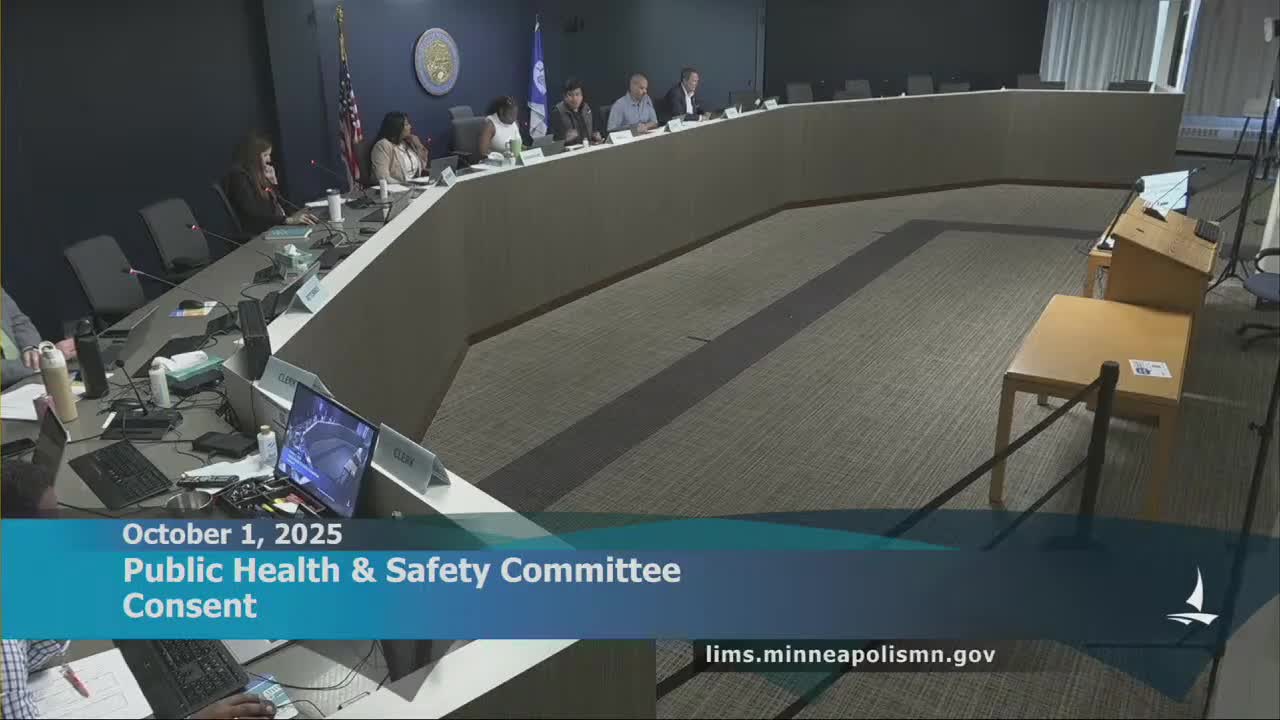
Experts from the Minnesota Justice Research Center, independent law-enforcement analysts and Ramsey County officials told the Public Health and Safety Committee on Oct. 1 that Minneapolis should consider a dedicated nonfatal-shooting investigative unit modeled on Saint Paul and Denver.
Justin Terrell, executive director of the Minnesota Justice Research Center, introduced presenters from the center and outside partners and said the organization's research shows clearance rates for nonfatal shootings are low nationwide and can rise when teams of police investigators, prosecutors and crime analysts are dedicated to those cases.
Dr. Will Cooley of the Minnesota Justice Research Center said that, nationally, nonfatal-shooting clearance rates have fallen and that solving those cases is labor- and resource-intensive. He gave two statistics from Minneapolis: the department solved about 65% of homicides but only about 23% of nonfatal shootings in recent data, and he urged investment in investigators, crime analysts and training.
David Zimmer, a former homicide detective who now serves as Public Safety Policy Fellow at the Center of the American Experiment, summarized operational best practices: create a standalone unit to prioritize nonfatal shootings, respond to them with the same urgency as homicides, and staff the unit with hand-picked investigators who have experience in family violence, sexual assault, juvenile, or narcotics cases. "Improving solve rates not only enhances accountability of offenders, but it enhances credibility in the justice system and builds community trust in that very system," Zimmer said.
Ramsey County Attorney John Choi described Saint Paul's implementation after a study visit to Denver. Choi said Saint Paul formed a standalone investigative unit, assigned a prosecutor to work alongside investigators from the beginning, and used county and municipal allocations to support forensic testing, overtime and a victim-witness emergency fund. Choi said the combined effort helped raise Saint Paul's clearance rate from about 37% in 2023 to roughly 70.5% in 2024; he also said Saint Paul reported reductions in shots-fired incidents and homicides in 2025 after the program started.
Choi described a county-administered victim-witness emergency fund that allocated $800,000 total, disbursed at $200,000 per year over four years, and has been used to assist victims with emergency relocation and safety needs. He also said Ramsey County used state allocations to backfill forensic testing and to add investigators.
Presenters and council members discussed party-line and implementation issues. Key clarifications and numbers presented or discussed in the meeting include:
- Minneapolis 2024 nonfatal-shooting clearance rate cited at about 22.6% (speaker: David Zimmer).
- Saint Paul clearance improvement cited from 37% to roughly 70.5% between 2023 and 2024 (speaker: John Choi).
- Denver's dedicated unit saw a clearance rate rise from about 39% to 65% within seven months (speaker: Will Cooley).
- Ramsey County victim-witness emergency fund: $800,000 total ($200,000 per year); used for relocation and safety supports; about $550,000 spent to date (speaker: John Choi).
- Recommended investigator caseloads and staffing: manageable caseloads (e.g., 5 homicides per investigator equivalent), and a projected need of dozens of investigators to reach a major reduction in nonfatal shootings (presenters provided approximate modeling rather than a firm budget).
Council members asked about definitional consistency (what counts as a cleared or solved case), existing MPD efforts with the National Public Safety Partnership, legal limits on civilian investigators, and whether the state grant proposal (referred to in testimony as HF 02/1942 and related bills discussed at the legislature) could provide funding. Presenters and council members stressed that clearance definitions vary between departments and urged the council to adopt a clear local definition before benchmarking.
Several council members expressed support for pursuing state grant funding and for local budgeting actions to expand investigative capacity; Vice Chair Wansley noted the council had previously funded five civilian investigator positions and urged mayoral and administrative cooperation to fill those roles.
At the conclusion of the session the chair asked the clerk to receive and file the presenters' materials and the committee discussion for the record. The session included multiple follow-up requests for staff to explore budget options, technical definitions of clearance rates, and partnerships with Ramsey County and state legislators for funding.
Justin Terrell, executive director of the Minnesota Justice Research Center, introduced presenters from the center and outside partners and said the organization's research shows clearance rates for nonfatal shootings are low nationwide and can rise when teams of police investigators, prosecutors and crime analysts are dedicated to those cases.
Dr. Will Cooley of the Minnesota Justice Research Center said that, nationally, nonfatal-shooting clearance rates have fallen and that solving those cases is labor- and resource-intensive. He gave two statistics from Minneapolis: the department solved about 65% of homicides but only about 23% of nonfatal shootings in recent data, and he urged investment in investigators, crime analysts and training.
David Zimmer, a former homicide detective who now serves as Public Safety Policy Fellow at the Center of the American Experiment, summarized operational best practices: create a standalone unit to prioritize nonfatal shootings, respond to them with the same urgency as homicides, and staff the unit with hand-picked investigators who have experience in family violence, sexual assault, juvenile, or narcotics cases. "Improving solve rates not only enhances accountability of offenders, but it enhances credibility in the justice system and builds community trust in that very system," Zimmer said.
Ramsey County Attorney John Choi described Saint Paul's implementation after a study visit to Denver. Choi said Saint Paul formed a standalone investigative unit, assigned a prosecutor to work alongside investigators from the beginning, and used county and municipal allocations to support forensic testing, overtime and a victim-witness emergency fund. Choi said the combined effort helped raise Saint Paul's clearance rate from about 37% in 2023 to roughly 70.5% in 2024; he also said Saint Paul reported reductions in shots-fired incidents and homicides in 2025 after the program started.
Choi described a county-administered victim-witness emergency fund that allocated $800,000 total, disbursed at $200,000 per year over four years, and has been used to assist victims with emergency relocation and safety needs. He also said Ramsey County used state allocations to backfill forensic testing and to add investigators.
Presenters and council members discussed party-line and implementation issues. Key clarifications and numbers presented or discussed in the meeting include:
- Minneapolis 2024 nonfatal-shooting clearance rate cited at about 22.6% (speaker: David Zimmer).
- Saint Paul clearance improvement cited from 37% to roughly 70.5% between 2023 and 2024 (speaker: John Choi).
- Denver's dedicated unit saw a clearance rate rise from about 39% to 65% within seven months (speaker: Will Cooley).
- Ramsey County victim-witness emergency fund: $800,000 total ($200,000 per year); used for relocation and safety supports; about $550,000 spent to date (speaker: John Choi).
- Recommended investigator caseloads and staffing: manageable caseloads (e.g., 5 homicides per investigator equivalent), and a projected need of dozens of investigators to reach a major reduction in nonfatal shootings (presenters provided approximate modeling rather than a firm budget).
Council members asked about definitional consistency (what counts as a cleared or solved case), existing MPD efforts with the National Public Safety Partnership, legal limits on civilian investigators, and whether the state grant proposal (referred to in testimony as HF 02/1942 and related bills discussed at the legislature) could provide funding. Presenters and council members stressed that clearance definitions vary between departments and urged the council to adopt a clear local definition before benchmarking.
Several council members expressed support for pursuing state grant funding and for local budgeting actions to expand investigative capacity; Vice Chair Wansley noted the council had previously funded five civilian investigator positions and urged mayoral and administrative cooperation to fill those roles.
At the conclusion of the session the chair asked the clerk to receive and file the presenters' materials and the committee discussion for the record. The session included multiple follow-up requests for staff to explore budget options, technical definitions of clearance rates, and partnerships with Ramsey County and state legislators for funding.
View the Full Meeting & All Its Details
This article offers just a summary. Unlock complete video, transcripts, and insights as a Founder Member.
✓
Watch full, unedited meeting videos
✓
Search every word spoken in unlimited transcripts
✓
AI summaries & real-time alerts (all government levels)
✓
Permanent access to expanding government content
30-day money-back guarantee
