Commission tables final vote on 1410 Wilmot Avenue rezoning after neighbor concerns
September 08, 2025 | Panama City, Bay County, Florida
This article was created by AI summarizing key points discussed. AI makes mistakes, so for full details and context, please refer to the video of the full meeting. Please report any errors so we can fix them. Report an error »
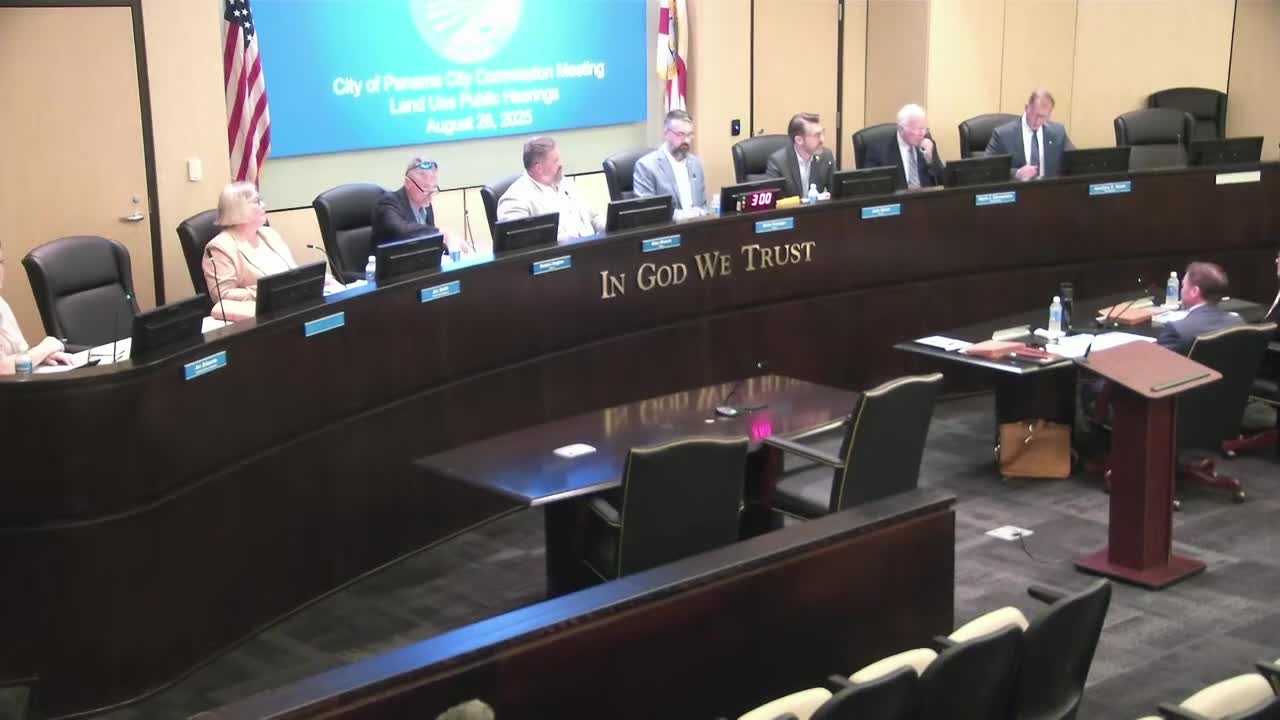
The Panama City Commission on Aug. 26 tabled the second-and-final public hearing on Ordinance 32 76, a proposed rezoning of property at 1410 Wilmot Avenue (Parcel ID 29666-000-00), after commissioners and staff reported lingering neighbor concerns about parking and potential commercial encroachment.
Staff had recommended approval and said the Planning Board had unanimously supported the change. The property contains an old church building and a single-family home on one parcel; the applicant had requested a zoning change to Neighborhood General (NG). During discussion commissioners and staff reviewed a recent neighborhood meeting and highlighted unresolved questions about whether the parcel could later be subdivided and how required buffering would be applied.
Director of Development Services Michael Fuller said staff had met with the owner and neighbors and that the parcel currently is a single lot with an old church building and a single-family home. He advised that, while a theoretical subdivision is possible, parking constraints would make division difficult. Fuller also explained the local buffering requirement between single-family and multi-family uses: a five-foot width and at least six feet in height.
Commissioners expressed mixed views: one commissioner said the church building "absolutely should be commercial" while noting the adjacent single-family home and surrounding neighborhood might best remain residential. With the applicant absent, Commissioner Janice Lucas moved to table the item so staff could confer further with the applicant and neighbors; the motion passed by roll call 4-0.
Action taken: Motion to table the second-and-final public hearing on Ordinance 32 76 was approved 4-0; staff will follow up with the applicant and bring the item back at the next meeting.
Clarifying details captured in the hearing include the parcel ID (29666-000-00), the buffering requirement (five feet wide, at least six feet tall), and staff’s assessment that subdividing the parcel is possible in theory but would be difficult because the entire lot would likely be needed for parking.
Staff had recommended approval and said the Planning Board had unanimously supported the change. The property contains an old church building and a single-family home on one parcel; the applicant had requested a zoning change to Neighborhood General (NG). During discussion commissioners and staff reviewed a recent neighborhood meeting and highlighted unresolved questions about whether the parcel could later be subdivided and how required buffering would be applied.
Director of Development Services Michael Fuller said staff had met with the owner and neighbors and that the parcel currently is a single lot with an old church building and a single-family home. He advised that, while a theoretical subdivision is possible, parking constraints would make division difficult. Fuller also explained the local buffering requirement between single-family and multi-family uses: a five-foot width and at least six feet in height.
Commissioners expressed mixed views: one commissioner said the church building "absolutely should be commercial" while noting the adjacent single-family home and surrounding neighborhood might best remain residential. With the applicant absent, Commissioner Janice Lucas moved to table the item so staff could confer further with the applicant and neighbors; the motion passed by roll call 4-0.
Action taken: Motion to table the second-and-final public hearing on Ordinance 32 76 was approved 4-0; staff will follow up with the applicant and bring the item back at the next meeting.
Clarifying details captured in the hearing include the parcel ID (29666-000-00), the buffering requirement (five feet wide, at least six feet tall), and staff’s assessment that subdividing the parcel is possible in theory but would be difficult because the entire lot would likely be needed for parking.
View the Full Meeting & All Its Details
This article offers just a summary. Unlock complete video, transcripts, and insights as a Founder Member.
✓
Watch full, unedited meeting videos
✓
Search every word spoken in unlimited transcripts
✓
AI summaries & real-time alerts (all government levels)
✓
Permanent access to expanding government content
30-day money-back guarantee
