State audit office: audits of public education rising; reports flag knowledge, controls and data-quality gaps
September 07, 2024 | Utah State Board of Education, Utah Education, State Agencies, Organizations, Utah Executive Branch, Utah
This article was created by AI summarizing key points discussed. AI makes mistakes, so for full details and context, please refer to the video of the full meeting. Please report any errors so we can fix them. Report an error »
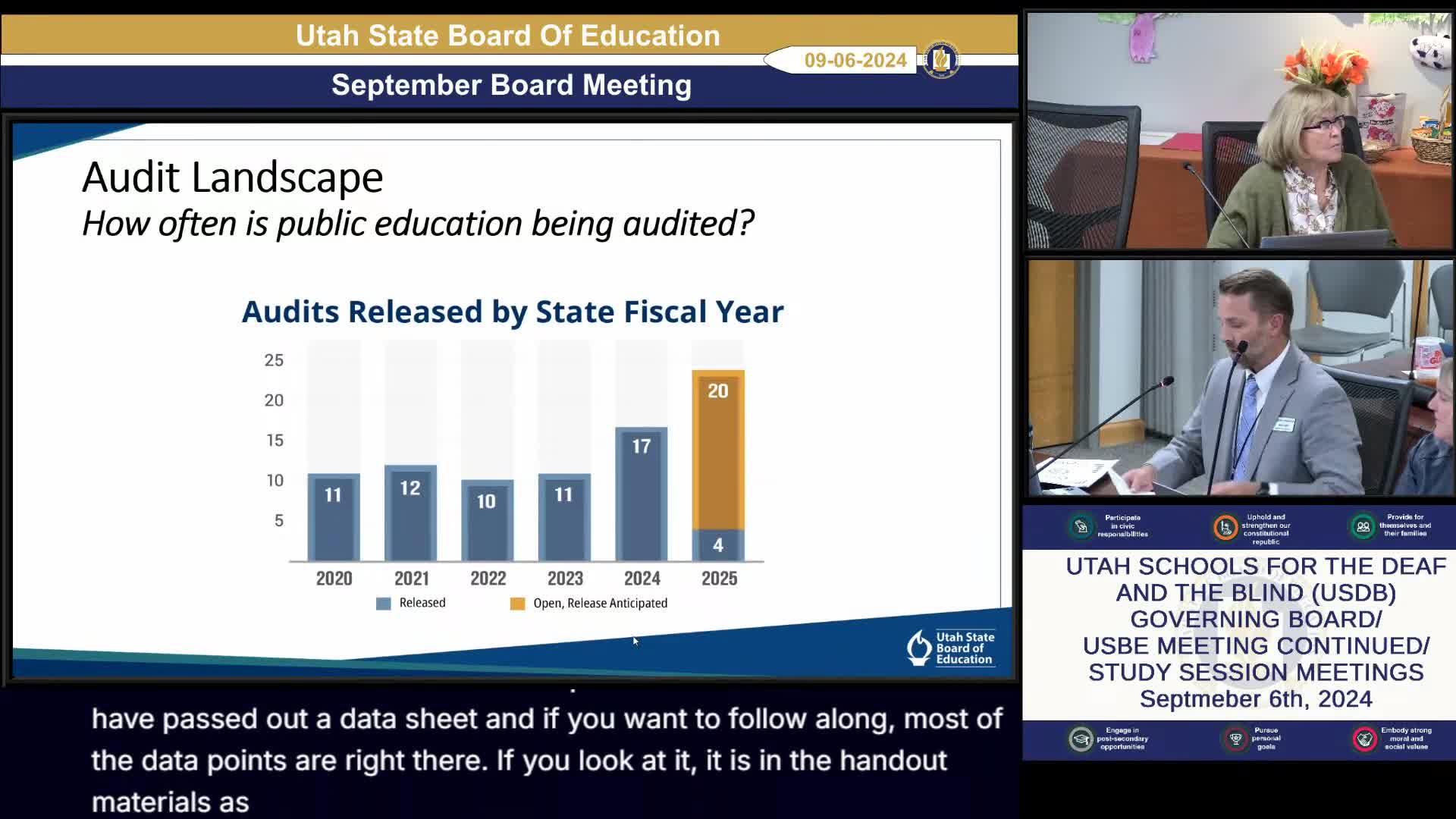
The Utah State Board of Education received a high-level briefing from its internal audit office on trends across public-education audits, with staff saying the number of audits has risen and that recurring themes — staff knowledge, written controls and data quality — appear in multiple reports.
Debbie Davis, the board’s chief audit executive, told members the audit office reviewed roughly 92 audits issued over the last five years and identified about 335 recommendations directed at state and local education entities. The board was told roughly two-thirds of audit recommendations in that set were directed to the State Board of Education for action or coordination with local education agencies and the legislature.
Audit staff said the number of public-education audit reports released in 2024 rose markedly versus the prior four-year average. “From fiscal years 2020 through 2023 there was an average of about 11 audit reports released per year,” the internal audit briefing stated; “in 2024 there was a 55% increase” in released reports. Staff also reported that a portion of audits remain in corrective action status for long periods: audits in corrective action averaged about 951 days open in the sample cited.
Internal auditors categorized recurring findings into three themes. First, competence: audits repeatedly found personnel or offices unfamiliar with applicable rules or lacking experience in required processes. Second, policies and procedures: auditors found either missing written procedures or existing procedures that were not implemented and monitored. Third, data quality: auditors frequently documented mismatches between local records and state submissions, including cases where student exit dates or days-attended did not match between local systems and the statewide data repository.
Audit staff emphasized the implications for policy and oversight. Deputy audit executive Kevin John pointed out that poor data quality can distort policy decisions and funding calculations and urged the board to treat data reliability as a priority for any evaluation of statewide programs.
Board members asked whether the audit activity was unusually concentrated in education compared with other state agencies; audit staff said education is receiving more audit activity from multiple external audit shops and that legislative priorities have driven some of the volume. Staff also said they actively coordinate with the Office of the State Auditor and the Office of the Legislative Auditor General to minimize duplication when feasible.
The briefing closed with a call for open, non-judgmental questions that can drive corrective action: auditors framed audits as tools to identify where to “know better, do better,” and offered to provide full reports and additional context to any board members who asked.
Ending: Audit staff offered to provide the full set of cited audit reports and to meet with members who want deeper, item-level analysis.
Debbie Davis, the board’s chief audit executive, told members the audit office reviewed roughly 92 audits issued over the last five years and identified about 335 recommendations directed at state and local education entities. The board was told roughly two-thirds of audit recommendations in that set were directed to the State Board of Education for action or coordination with local education agencies and the legislature.
Audit staff said the number of public-education audit reports released in 2024 rose markedly versus the prior four-year average. “From fiscal years 2020 through 2023 there was an average of about 11 audit reports released per year,” the internal audit briefing stated; “in 2024 there was a 55% increase” in released reports. Staff also reported that a portion of audits remain in corrective action status for long periods: audits in corrective action averaged about 951 days open in the sample cited.
Internal auditors categorized recurring findings into three themes. First, competence: audits repeatedly found personnel or offices unfamiliar with applicable rules or lacking experience in required processes. Second, policies and procedures: auditors found either missing written procedures or existing procedures that were not implemented and monitored. Third, data quality: auditors frequently documented mismatches between local records and state submissions, including cases where student exit dates or days-attended did not match between local systems and the statewide data repository.
Audit staff emphasized the implications for policy and oversight. Deputy audit executive Kevin John pointed out that poor data quality can distort policy decisions and funding calculations and urged the board to treat data reliability as a priority for any evaluation of statewide programs.
Board members asked whether the audit activity was unusually concentrated in education compared with other state agencies; audit staff said education is receiving more audit activity from multiple external audit shops and that legislative priorities have driven some of the volume. Staff also said they actively coordinate with the Office of the State Auditor and the Office of the Legislative Auditor General to minimize duplication when feasible.
The briefing closed with a call for open, non-judgmental questions that can drive corrective action: auditors framed audits as tools to identify where to “know better, do better,” and offered to provide full reports and additional context to any board members who asked.
Ending: Audit staff offered to provide the full set of cited audit reports and to meet with members who want deeper, item-level analysis.
Don't Miss a Word: See the Full Meeting!
Go beyond summaries. Unlock every video, transcript, and key insight with a Founder Membership.
✓
Get instant access to full meeting videos
✓
Search and clip any phrase from complete transcripts
✓
Receive AI-powered summaries & custom alerts
✓
Enjoy lifetime, unrestricted access to government data
30-day money-back guarantee
