San Francisco implements Care Court for adults with schizophrenia diagnosis under SB 1338
May 07, 2024 | San Francisco City, San Francisco County, California
This article was created by AI summarizing key points discussed. AI makes mistakes, so for full details and context, please refer to the video of the full meeting. Please report any errors so we can fix them. Report an error »
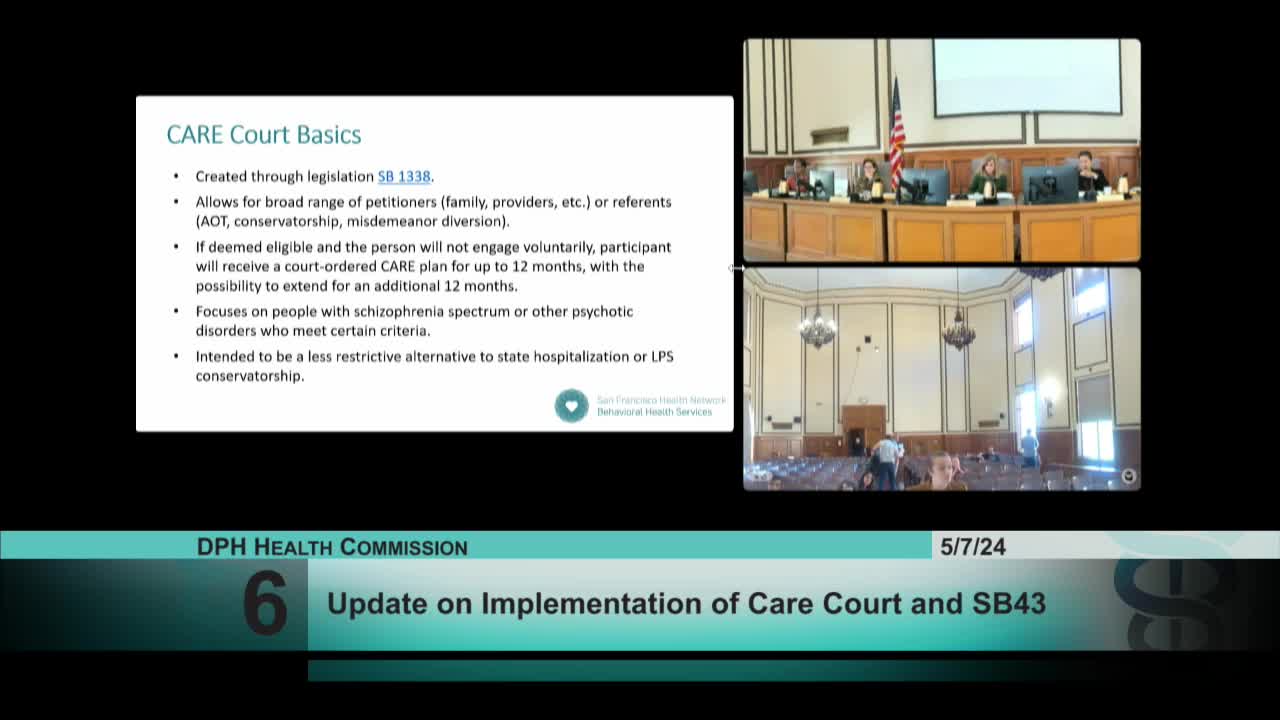
Care Court, a groundbreaking initiative in San Francisco, is set to transform how the city addresses mental health crises, particularly for individuals diagnosed with schizophrenia. Launched in October 2023, this program allows a diverse range of petitioners—including family members, first responders, and treatment providers—to file petitions directly with the court, aiming to facilitate access to necessary treatment for those struggling with severe mental illness.
The program is designed for adults who are not clinically stabilized and are unlikely to survive safely in the community without court intervention. If deemed appropriate by a judge, individuals can be ordered to participate in treatment for up to 24 months. This approach is intended to serve as an upstream solution, ideally preventing the need for more restrictive measures like conservatorship.
One of the unique aspects of Care Court is its inclusivity in who can initiate petitions. This flexibility is crucial, as it empowers families and professionals to seek help for individuals who may not recognize their need for treatment. The program has already seen significant engagement, with 75 cases processed through a dedicated consultation line since its inception.
However, the process is not without its challenges. The timeline from petition filing to potential court order can take at least four and a half months, which may delay urgent interventions. Additionally, while the court can order treatment, there are no enforcement mechanisms to compel compliance, relying instead on the authority of the court to encourage participation.
The meeting also highlighted the distinctions between Care Court, assisted outpatient treatment, and conservatorship. Care Court is positioned as a first step for those not engaging in voluntary services, while assisted outpatient treatment requires a history of negative outcomes. Conservatorship represents the most restrictive level of care, necessitating a finding of grave disability.
As the program evolves, it aims to address the complexities of mental health treatment in the community, ensuring that individuals receive the support they need while navigating the legal system. The city is committed to refining this initiative, with ongoing discussions about its implementation and effectiveness expected in future meetings.
The program is designed for adults who are not clinically stabilized and are unlikely to survive safely in the community without court intervention. If deemed appropriate by a judge, individuals can be ordered to participate in treatment for up to 24 months. This approach is intended to serve as an upstream solution, ideally preventing the need for more restrictive measures like conservatorship.
One of the unique aspects of Care Court is its inclusivity in who can initiate petitions. This flexibility is crucial, as it empowers families and professionals to seek help for individuals who may not recognize their need for treatment. The program has already seen significant engagement, with 75 cases processed through a dedicated consultation line since its inception.
However, the process is not without its challenges. The timeline from petition filing to potential court order can take at least four and a half months, which may delay urgent interventions. Additionally, while the court can order treatment, there are no enforcement mechanisms to compel compliance, relying instead on the authority of the court to encourage participation.
The meeting also highlighted the distinctions between Care Court, assisted outpatient treatment, and conservatorship. Care Court is positioned as a first step for those not engaging in voluntary services, while assisted outpatient treatment requires a history of negative outcomes. Conservatorship represents the most restrictive level of care, necessitating a finding of grave disability.
As the program evolves, it aims to address the complexities of mental health treatment in the community, ensuring that individuals receive the support they need while navigating the legal system. The city is committed to refining this initiative, with ongoing discussions about its implementation and effectiveness expected in future meetings.
Don't Miss a Word: See the Full Meeting!
Go beyond summaries. Unlock every video, transcript, and key insight with a Founder Membership.
✓
Get instant access to full meeting videos
✓
Search and clip any phrase from complete transcripts
✓
Receive AI-powered summaries & custom alerts
✓
Enjoy lifetime, unrestricted access to government data
30-day money-back guarantee
