San Francisco hearing explores funding options for ambitious climate action plan
March 15, 2023 | San Francisco County, California
This article was created by AI summarizing key points discussed. AI makes mistakes, so for full details and context, please refer to the video of the full meeting. Please report any errors so we can fix them. Report an error »
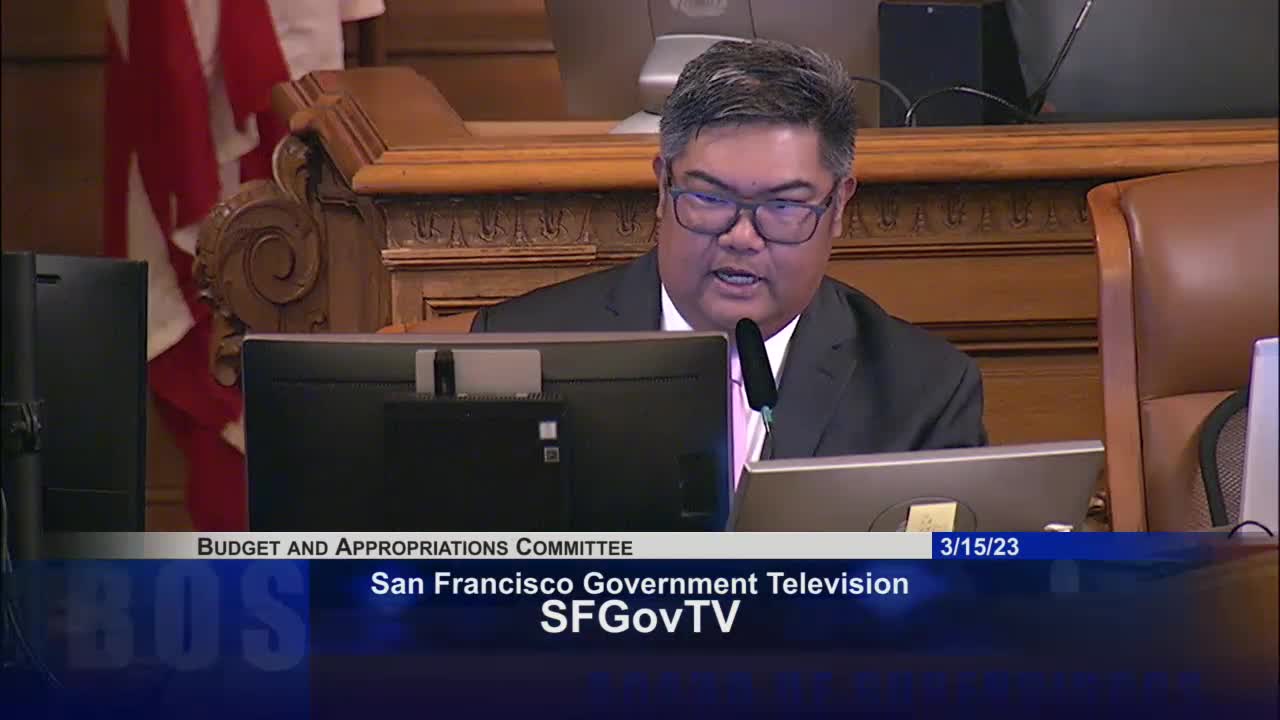
The San Francisco County Budget and Appropriations Committee convened on July 4, 2025, to discuss critical funding for the city's climate action initiatives. The meeting focused on a report detailing the financial implications of the city's climate action plan, which aims for net-zero emissions by 2040.
Vice Chair Mandelmann opened the session by highlighting the city's commitment to addressing climate change, referencing a 2019 resolution that declared a climate emergency. He emphasized the need for equitable funding mechanisms to support the ambitious goals outlined in the climate action plan. The report presented by the Berkeley Center for Law, Energy, and the Environment provided a comprehensive analysis of potential costs, estimating implementation could range from $2.3 billion to $22 billion.
Tyrone Joo, acting director of the Department of the Environment, underscored the importance of transitioning to sustainable practices, noting that the majority of the city’s emissions stem from buildings and transportation. He expressed gratitude for the funding that enabled the report's creation, which serves as a foundational step in identifying revenue sources for climate initiatives.
Cindy Comerford, Climate Program Manager, detailed the report's findings, which included recommendations for general obligation bonds and other funding strategies. The report indicated strong public support for climate action, with 83% of residents concerned about climate change impacts in the next five years.
Ted Lam, a senior researcher at the Berkeley Center, outlined various revenue generation strategies, including general obligation bonds for building decarbonization and transportation improvements. He noted the necessity of prioritizing equity in funding allocations to ensure that vulnerable communities benefit from climate investments.
Brian Strong from the Office of Resilience and Capital Planning discussed the constraints of the city's capital plan, emphasizing the need for a balanced approach to funding amidst competing infrastructure demands. He highlighted the importance of integrating climate action into the broader capital planning process.
Public comments reflected a strong desire for immediate action and funding for climate initiatives. Many speakers urged the committee to prioritize equitable funding mechanisms and to consider the urgent need for a climate bond on the 2024 ballot.
The meeting concluded with a commitment to further explore the report's recommendations and to engage in ongoing discussions about funding strategies for the city's climate action plan. The committee acknowledged the urgency of the climate crisis and the need for innovative solutions to meet the city's ambitious sustainability goals.
Vice Chair Mandelmann opened the session by highlighting the city's commitment to addressing climate change, referencing a 2019 resolution that declared a climate emergency. He emphasized the need for equitable funding mechanisms to support the ambitious goals outlined in the climate action plan. The report presented by the Berkeley Center for Law, Energy, and the Environment provided a comprehensive analysis of potential costs, estimating implementation could range from $2.3 billion to $22 billion.
Tyrone Joo, acting director of the Department of the Environment, underscored the importance of transitioning to sustainable practices, noting that the majority of the city’s emissions stem from buildings and transportation. He expressed gratitude for the funding that enabled the report's creation, which serves as a foundational step in identifying revenue sources for climate initiatives.
Cindy Comerford, Climate Program Manager, detailed the report's findings, which included recommendations for general obligation bonds and other funding strategies. The report indicated strong public support for climate action, with 83% of residents concerned about climate change impacts in the next five years.
Ted Lam, a senior researcher at the Berkeley Center, outlined various revenue generation strategies, including general obligation bonds for building decarbonization and transportation improvements. He noted the necessity of prioritizing equity in funding allocations to ensure that vulnerable communities benefit from climate investments.
Brian Strong from the Office of Resilience and Capital Planning discussed the constraints of the city's capital plan, emphasizing the need for a balanced approach to funding amidst competing infrastructure demands. He highlighted the importance of integrating climate action into the broader capital planning process.
Public comments reflected a strong desire for immediate action and funding for climate initiatives. Many speakers urged the committee to prioritize equitable funding mechanisms and to consider the urgent need for a climate bond on the 2024 ballot.
The meeting concluded with a commitment to further explore the report's recommendations and to engage in ongoing discussions about funding strategies for the city's climate action plan. The committee acknowledged the urgency of the climate crisis and the need for innovative solutions to meet the city's ambitious sustainability goals.
View the Full Meeting & All Its Details
This article offers just a summary. Unlock complete video, transcripts, and insights as a Founder Member.
✓
Watch full, unedited meeting videos
✓
Search every word spoken in unlimited transcripts
✓
AI summaries & real-time alerts (all government levels)
✓
Permanent access to expanding government content
30-day money-back guarantee
