San Francisco reviews Mills Act for historic properties' equity and accessibility concerns
January 04, 2023 | San Francisco City, San Francisco County, California
This article was created by AI summarizing key points discussed. AI makes mistakes, so for full details and context, please refer to the video of the full meeting. Please report any errors so we can fix them. Report an error »
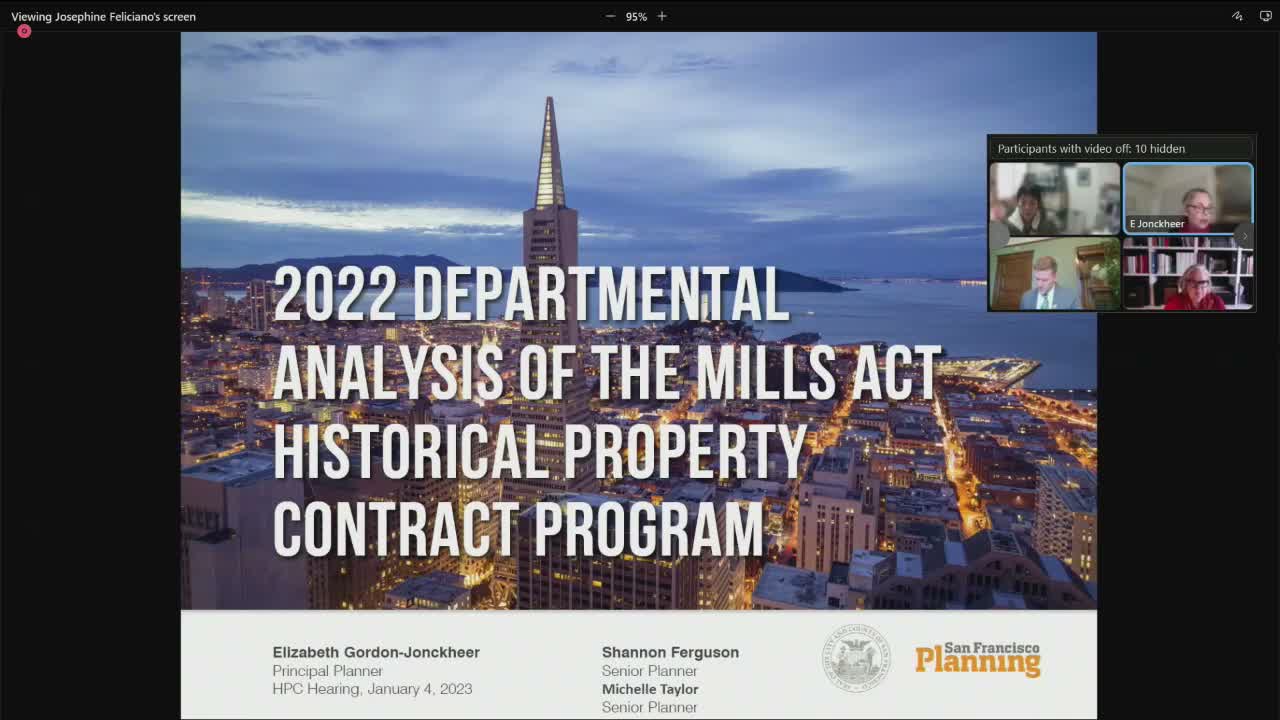
San Francisco's Historic Preservation Commission is set to undertake a comprehensive review of the Mills Act program, aimed at addressing concerns over fairness and equity in its implementation. The Mills Act, a state law that allows local governments to offer property tax reductions to owners of qualified historic properties, currently has 45 active contracts in the city. However, the program has faced scrutiny for its uneven distribution, particularly regarding racial and social equity.
During a recent meeting, officials highlighted that the benefits of the Mills Act are not equally accessible to all property owners. The program disproportionately favors those who have purchased properties within the last decade, leaving long-term owners at a disadvantage. Additionally, properties must be formally listed on local, state, or national historic registers to qualify, which excludes many significant buildings in underrepresented neighborhoods.
The commission's review will include an analysis of barriers preventing broader participation in the program, particularly for communities historically marginalized in preservation efforts. The department plans to engage with local groups and assess the distribution of Mills Act contracts across different supervisorial districts, revealing disparities that may reflect broader social inequities.
In the coming year, the department aims to develop recommendations to make the Mills Act more accessible, particularly for low-opportunity neighborhoods. This initiative aligns with the city's broader goals of promoting equity and inclusion in historic preservation efforts.
As the commission moves forward with this review, stakeholders and community members are encouraged to participate in discussions to ensure that the benefits of the Mills Act are equitably shared among all San Francisco residents.
During a recent meeting, officials highlighted that the benefits of the Mills Act are not equally accessible to all property owners. The program disproportionately favors those who have purchased properties within the last decade, leaving long-term owners at a disadvantage. Additionally, properties must be formally listed on local, state, or national historic registers to qualify, which excludes many significant buildings in underrepresented neighborhoods.
The commission's review will include an analysis of barriers preventing broader participation in the program, particularly for communities historically marginalized in preservation efforts. The department plans to engage with local groups and assess the distribution of Mills Act contracts across different supervisorial districts, revealing disparities that may reflect broader social inequities.
In the coming year, the department aims to develop recommendations to make the Mills Act more accessible, particularly for low-opportunity neighborhoods. This initiative aligns with the city's broader goals of promoting equity and inclusion in historic preservation efforts.
As the commission moves forward with this review, stakeholders and community members are encouraged to participate in discussions to ensure that the benefits of the Mills Act are equitably shared among all San Francisco residents.
View the Full Meeting & All Its Details
This article offers just a summary. Unlock complete video, transcripts, and insights as a Founder Member.
✓
Watch full, unedited meeting videos
✓
Search every word spoken in unlimited transcripts
✓
AI summaries & real-time alerts (all government levels)
✓
Permanent access to expanding government content
30-day money-back guarantee
