Arkansas Executive Committee reviews funding stability for public school health insurance program
February 06, 2024 | EDUCATION COMMITTEE - SENATE, Senate, Committees, Legislative, Arkansas
This article was created by AI summarizing key points discussed. AI makes mistakes, so for full details and context, please refer to the video of the full meeting. Please report any errors so we can fix them. Report an error »
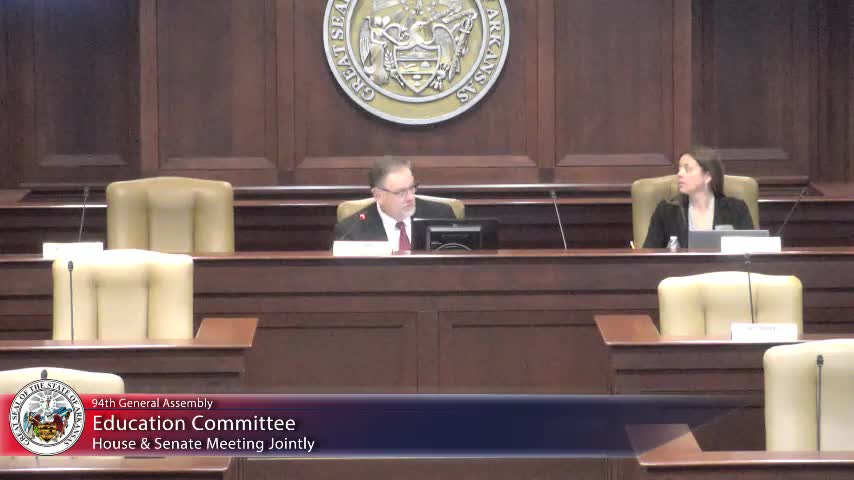
The Arkansas Senate Education Committee convened on February 6, 2024, to discuss critical updates regarding the State Public School Employee Life and Health Insurance Program (PSE). The meeting highlighted significant legislative actions aimed at ensuring the program's financial stability and long-term viability.
Jill Thayer from the Bureau of Legislative Research provided an overview of recent legislative changes that have shaped the PSE funding landscape. Since 2013, the General Assembly has focused on addressing solvency issues within the program, which encompasses both public school and state employee health insurance plans. Key legislative actions taken in 2022 included the establishment of a legislative oversight framework and the transfer of powers from the Employee Benefits Division (EBD) board to the Board of Finance. These changes were designed to enhance accountability and ensure that funding decisions align with the program's financial health.
Patrick Klein, an actuary with the Segal Group, presented an analysis of the PSE funding adequacy. He reported that while the program currently enjoys a strong financial position, with projected assets of $265.7 million for 2024, there are concerns about future sustainability. Klein emphasized that without strategic adjustments to funding, the program could face deficits as early as 2025. He outlined various funding scenarios, indicating that simply maintaining current funding levels would lead to a significant financial shortfall by 2028.
The committee discussed the importance of aligning revenue with rising expenses, particularly through adjustments to the minimum district contributions and Department of Education funding. Klein suggested that a gradual increase in these contributions, indexed to medical cost inflation, could help stabilize the program's finances. However, he cautioned that even with these adjustments, the program might still face challenges if expenses continue to outpace revenue.
The discussions underscored the need for proactive measures to ensure that the PSE program remains solvent and capable of providing affordable health benefits to Arkansas's public school employees. As the committee moves forward, the focus will be on implementing strategic funding solutions that address both immediate and long-term financial challenges, ultimately benefiting educators and their families across the state.
Jill Thayer from the Bureau of Legislative Research provided an overview of recent legislative changes that have shaped the PSE funding landscape. Since 2013, the General Assembly has focused on addressing solvency issues within the program, which encompasses both public school and state employee health insurance plans. Key legislative actions taken in 2022 included the establishment of a legislative oversight framework and the transfer of powers from the Employee Benefits Division (EBD) board to the Board of Finance. These changes were designed to enhance accountability and ensure that funding decisions align with the program's financial health.
Patrick Klein, an actuary with the Segal Group, presented an analysis of the PSE funding adequacy. He reported that while the program currently enjoys a strong financial position, with projected assets of $265.7 million for 2024, there are concerns about future sustainability. Klein emphasized that without strategic adjustments to funding, the program could face deficits as early as 2025. He outlined various funding scenarios, indicating that simply maintaining current funding levels would lead to a significant financial shortfall by 2028.
The committee discussed the importance of aligning revenue with rising expenses, particularly through adjustments to the minimum district contributions and Department of Education funding. Klein suggested that a gradual increase in these contributions, indexed to medical cost inflation, could help stabilize the program's finances. However, he cautioned that even with these adjustments, the program might still face challenges if expenses continue to outpace revenue.
The discussions underscored the need for proactive measures to ensure that the PSE program remains solvent and capable of providing affordable health benefits to Arkansas's public school employees. As the committee moves forward, the focus will be on implementing strategic funding solutions that address both immediate and long-term financial challenges, ultimately benefiting educators and their families across the state.
Don't Miss a Word: See the Full Meeting!
Go beyond summaries. Unlock every video, transcript, and key insight with a Founder Membership.
✓
Get instant access to full meeting videos
✓
Search and clip any phrase from complete transcripts
✓
Receive AI-powered summaries & custom alerts
✓
Enjoy lifetime, unrestricted access to government data
30-day money-back guarantee
