Westland City Council addresses wildlife feeding and enforcement challenges
December 02, 2024 | West Linn, Clackamas County, Oregon
This article was created by AI summarizing key points discussed. AI makes mistakes, so for full details and context, please refer to the video of the full meeting. Please report any errors so we can fix them. Report an error »
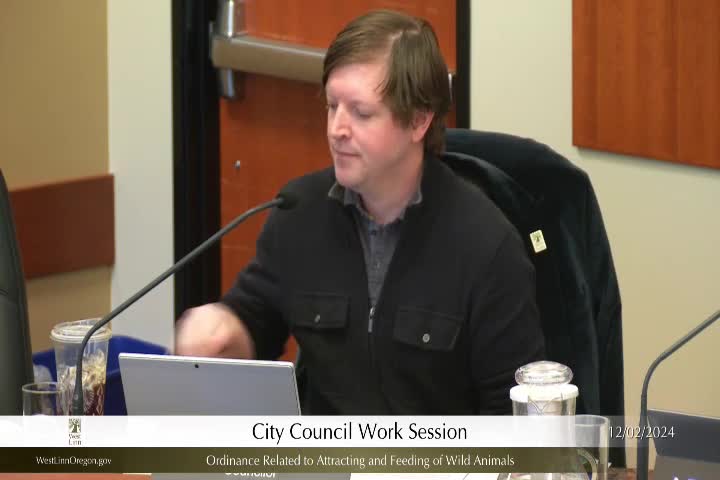
The West Linn City Council held a work session on December 2, 2024, focusing on wildlife management and enforcement of local ordinances. A significant portion of the discussion centered around the challenges posed by residents feeding wild animals, particularly skunks, which has led to increased complaints from the community.
Council members expressed concerns about the effectiveness of current enforcement measures. The city’s code includes classifications of violations, with Class A violations carrying a presumptive fine of $440. However, the enforcement process relies heavily on judicial discretion, which can lead to leniency in penalties. Councilor Bryke highlighted the need for a more effective approach, noting that repeated violations often result in minimal consequences, as fines alone may not deter problematic behavior.
The council discussed the impact of feeding wildlife, particularly skunks, which have become a nuisance in certain neighborhoods. Reports indicated that residents have observed a growing population of skunks, attributed to their reliance on human-provided food sources. This situation has raised concerns about public health and safety, as pets have been affected and the odor from skunks has become a significant issue for families.
Council members acknowledged that many residents may not understand the implications of their actions on their neighbors and emphasized the need for community education. They debated the necessity of introducing a new ordinance to address these issues, with some members suggesting that existing measures may not be sufficient to manage the problem effectively.
The discussion concluded with a consensus that while the goal is not to punish residents for normal wildlife interactions, there is a responsibility to address egregious cases that disrupt community harmony. The council plans to explore potential legislative solutions to better manage wildlife feeding and enhance compliance with local regulations.
Council members expressed concerns about the effectiveness of current enforcement measures. The city’s code includes classifications of violations, with Class A violations carrying a presumptive fine of $440. However, the enforcement process relies heavily on judicial discretion, which can lead to leniency in penalties. Councilor Bryke highlighted the need for a more effective approach, noting that repeated violations often result in minimal consequences, as fines alone may not deter problematic behavior.
The council discussed the impact of feeding wildlife, particularly skunks, which have become a nuisance in certain neighborhoods. Reports indicated that residents have observed a growing population of skunks, attributed to their reliance on human-provided food sources. This situation has raised concerns about public health and safety, as pets have been affected and the odor from skunks has become a significant issue for families.
Council members acknowledged that many residents may not understand the implications of their actions on their neighbors and emphasized the need for community education. They debated the necessity of introducing a new ordinance to address these issues, with some members suggesting that existing measures may not be sufficient to manage the problem effectively.
The discussion concluded with a consensus that while the goal is not to punish residents for normal wildlife interactions, there is a responsibility to address egregious cases that disrupt community harmony. The council plans to explore potential legislative solutions to better manage wildlife feeding and enhance compliance with local regulations.
Don't Miss a Word: See the Full Meeting!
Go beyond summaries. Unlock every video, transcript, and key insight with a Founder Membership.
✓
Get instant access to full meeting videos
✓
Search and clip any phrase from complete transcripts
✓
Receive AI-powered summaries & custom alerts
✓
Enjoy lifetime, unrestricted access to government data
30-day money-back guarantee
