Multnomah County unveils comprehensive eviction prevention strategy amid rising housing instability
May 11, 2024 | Multnomah County, Oregon
This article was created by AI summarizing key points discussed. AI makes mistakes, so for full details and context, please refer to the video of the full meeting. Please report any errors so we can fix them. Report an error »
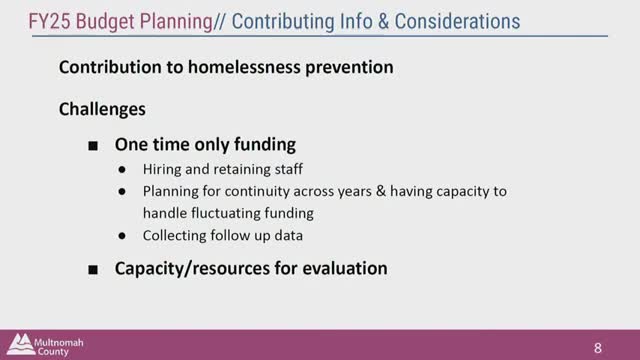
The Multnomah County Board held a briefing on May 11, 2024, focusing on eviction prevention and emergency rent assistance as critical components of the homelessness prevention continuum. The meeting highlighted the challenges faced in these areas, particularly the reliance on one-time funding, which complicates service continuity and staff retention.
The discussion began with an overview of a new federal framework for homelessness prevention released by the U.S. Interagency Council on Homelessness. This framework emphasizes that homelessness results from failures across multiple systems, including health services, justice, education, and employment. The county's approach aligns with this framework, advocating for a collaborative effort across various sectors to effectively address homelessness.
Rachel, a representative from the housing stability team, presented the fiscal year 2025 eviction prevention and housing services. She outlined a holistic approach that includes access to information for tenants, legal advocacy, and emergency rent assistance. The county currently has approximately $16.3 million available for emergency rent assistance, aiming to support around 35,100 households.
The briefing also addressed the economic challenges impacting low-income renters in Multnomah County. Rising rents, stagnant wages, and increased utility costs were identified as significant factors contributing to financial instability. Recent data indicated that 11.23% of Oregon tenants reported being behind on rent, a notable increase from previous surveys.
Becky Strauss from the Oregon Law Center provided insights into the legal landscape surrounding evictions. She reported a rise in non-payment filings in Multnomah County, which have exceeded pre-pandemic levels. However, new state protections have improved outcomes for tenants, with dismissal rates for eviction cases increasing significantly.
The meeting concluded with a recognition of the growing demand for emergency rent assistance and the need for ongoing support for tenants facing eviction. The board acknowledged the importance of addressing these challenges to prevent homelessness and ensure housing stability for vulnerable populations in the county. The discussions underscored the necessity for continued investment and collaboration among various stakeholders to effectively tackle the complex issue of housing insecurity.
The discussion began with an overview of a new federal framework for homelessness prevention released by the U.S. Interagency Council on Homelessness. This framework emphasizes that homelessness results from failures across multiple systems, including health services, justice, education, and employment. The county's approach aligns with this framework, advocating for a collaborative effort across various sectors to effectively address homelessness.
Rachel, a representative from the housing stability team, presented the fiscal year 2025 eviction prevention and housing services. She outlined a holistic approach that includes access to information for tenants, legal advocacy, and emergency rent assistance. The county currently has approximately $16.3 million available for emergency rent assistance, aiming to support around 35,100 households.
The briefing also addressed the economic challenges impacting low-income renters in Multnomah County. Rising rents, stagnant wages, and increased utility costs were identified as significant factors contributing to financial instability. Recent data indicated that 11.23% of Oregon tenants reported being behind on rent, a notable increase from previous surveys.
Becky Strauss from the Oregon Law Center provided insights into the legal landscape surrounding evictions. She reported a rise in non-payment filings in Multnomah County, which have exceeded pre-pandemic levels. However, new state protections have improved outcomes for tenants, with dismissal rates for eviction cases increasing significantly.
The meeting concluded with a recognition of the growing demand for emergency rent assistance and the need for ongoing support for tenants facing eviction. The board acknowledged the importance of addressing these challenges to prevent homelessness and ensure housing stability for vulnerable populations in the county. The discussions underscored the necessity for continued investment and collaboration among various stakeholders to effectively tackle the complex issue of housing insecurity.
Don't Miss a Word: See the Full Meeting!
Go beyond summaries. Unlock every video, transcript, and key insight with a Founder Membership.
✓
Get instant access to full meeting videos
✓
Search and clip any phrase from complete transcripts
✓
Receive AI-powered summaries & custom alerts
✓
Enjoy lifetime, unrestricted access to government data
30-day money-back guarantee
