Broadband Study Reveals Urgent Need for Digital Equity
August 28, 2024 | Barnstable County, Massachusetts
This article was created by AI summarizing key points discussed. AI makes mistakes, so for full details and context, please refer to the video of the full meeting. Please report any errors so we can fix them. Report an error »
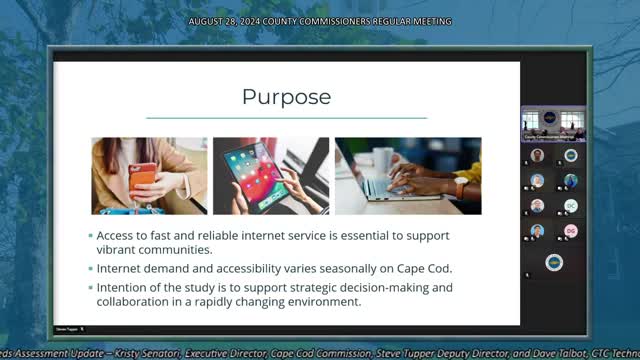
In a recent government meeting, officials discussed a comprehensive study aimed at addressing broadband challenges in the region, highlighting critical issues such as service availability, affordability, and digital equity. The study, which included both quantitative and qualitative data, revealed that while 99.57% of Cape residents are reported to have access to broadband, the reality is more complex, with many facing high costs and limited competition.
Key findings indicated that 85% of available broadband services require subscriptions costing $200 or more per month, raising concerns about affordability. The lack of competition, with most residents relying on a single provider, exacerbates this issue. Officials emphasized the need for strategic investments in broadband infrastructure, particularly fiber deployment, which remains significantly low in the region—only 1.9% of addresses have access to fiber compared to 46% statewide.
The meeting also addressed the seasonal degradation of service, noting that many residents experience slowdowns during peak summer months. This issue, coupled with the unique challenges faced by low-income households and specific demographics such as English language learners and the elderly, underscores the importance of digital equity initiatives.
Officials discussed potential funding opportunities for municipalities to enhance broadband access, including a recent grant awarded to Verizon for fiber expansion in seven towns. This development is seen as a significant step towards improving competition and service quality in the region.
The meeting concluded with a call for municipalities to consider various deployment strategies and to actively engage with service providers to foster a more competitive broadband environment. As the landscape evolves, officials expressed optimism about future improvements in broadband access and affordability for Cape residents.
Key findings indicated that 85% of available broadband services require subscriptions costing $200 or more per month, raising concerns about affordability. The lack of competition, with most residents relying on a single provider, exacerbates this issue. Officials emphasized the need for strategic investments in broadband infrastructure, particularly fiber deployment, which remains significantly low in the region—only 1.9% of addresses have access to fiber compared to 46% statewide.
The meeting also addressed the seasonal degradation of service, noting that many residents experience slowdowns during peak summer months. This issue, coupled with the unique challenges faced by low-income households and specific demographics such as English language learners and the elderly, underscores the importance of digital equity initiatives.
Officials discussed potential funding opportunities for municipalities to enhance broadband access, including a recent grant awarded to Verizon for fiber expansion in seven towns. This development is seen as a significant step towards improving competition and service quality in the region.
The meeting concluded with a call for municipalities to consider various deployment strategies and to actively engage with service providers to foster a more competitive broadband environment. As the landscape evolves, officials expressed optimism about future improvements in broadband access and affordability for Cape residents.
Don't Miss a Word: See the Full Meeting!
Go beyond summaries. Unlock every video, transcript, and key insight with a Founder Membership.
✓
Get instant access to full meeting videos
✓
Search and clip any phrase from complete transcripts
✓
Receive AI-powered summaries & custom alerts
✓
Enjoy lifetime, unrestricted access to government data
30-day money-back guarantee
