Emergency alerts surge as communities embrace new notification system
August 28, 2024 | Tompkins County, New York
This article was created by AI summarizing key points discussed. AI makes mistakes, so for full details and context, please refer to the video of the full meeting. Please report any errors so we can fix them. Report an error »
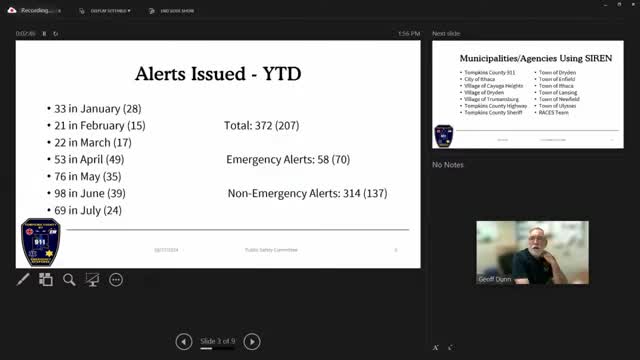
In a recent government meeting, officials reported a significant increase in non-emergency alerts issued from January to July this year, totaling 372 compared to 207 during the same period last year. While emergency alerts saw a decline, the rise in non-emergency notifications indicates a broader use of the alert system for community information and updates. This shift is attributed to a doubling in the number of municipalities and agencies utilizing the Siren alert system, with notable contributions from the sheriff's office, which has enhanced internal communications.
The meeting highlighted the effectiveness of the alert system, particularly during June, when 98 alerts were issued due to roadwork and severe weather conditions. Officials emphasized the importance of these notifications for community safety and awareness.
Additionally, the meeting provided an update on the Citizen Preparedness Corps trainings, which are conducted bi-monthly in collaboration with the New York National Guard and the Division of Homeland Security. These sessions have attracted consistent attendance, with around 40 to 50 participants per session. The next training is scheduled for September 14, coinciding with the Airport Day and Preparedness Expo, aiming to engage the community further.
Officials also discussed the integration of alert systems at Cornell University, which operates its own alert platform, Cornell Alert, while encouraging students to register for the local Siren system. This collaboration is seen as a way to enhance community safety, with an estimated 20,000 individuals in the Cornell community contributing to a well-informed population.
Overall, the meeting underscored the growing reliance on alert systems for both emergency and non-emergency communications, reflecting a proactive approach to community engagement and safety preparedness.
The meeting highlighted the effectiveness of the alert system, particularly during June, when 98 alerts were issued due to roadwork and severe weather conditions. Officials emphasized the importance of these notifications for community safety and awareness.
Additionally, the meeting provided an update on the Citizen Preparedness Corps trainings, which are conducted bi-monthly in collaboration with the New York National Guard and the Division of Homeland Security. These sessions have attracted consistent attendance, with around 40 to 50 participants per session. The next training is scheduled for September 14, coinciding with the Airport Day and Preparedness Expo, aiming to engage the community further.
Officials also discussed the integration of alert systems at Cornell University, which operates its own alert platform, Cornell Alert, while encouraging students to register for the local Siren system. This collaboration is seen as a way to enhance community safety, with an estimated 20,000 individuals in the Cornell community contributing to a well-informed population.
Overall, the meeting underscored the growing reliance on alert systems for both emergency and non-emergency communications, reflecting a proactive approach to community engagement and safety preparedness.
View the Full Meeting & All Its Details
This article offers just a summary. Unlock complete video, transcripts, and insights as a Founder Member.
✓
Watch full, unedited meeting videos
✓
Search every word spoken in unlimited transcripts
✓
AI summaries & real-time alerts (all government levels)
✓
Permanent access to expanding government content
30-day money-back guarantee
