Funding surge set to transform arts education in schools
July 26, 2024 | Riverside Unified, School Districts, California
This article was created by AI summarizing key points discussed. AI makes mistakes, so for full details and context, please refer to the video of the full meeting. Please report any errors so we can fix them. Report an error »
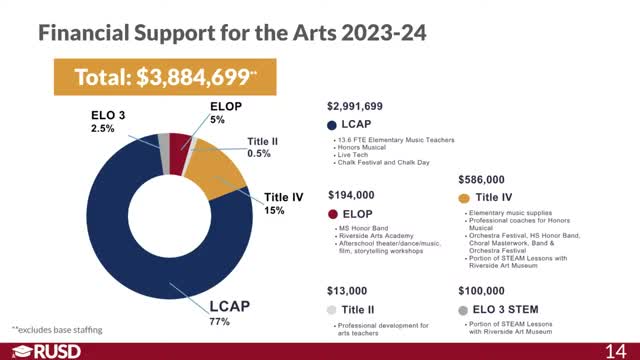
In a recent government meeting, officials outlined significant developments in the arts education funding and programming for the upcoming school year, emphasizing a commitment to enhancing student experiences through a robust arts plan. The district reported a total expenditure of $3.9 million on arts initiatives for the current year, with 77% of funding sourced from the Local Control Accountability Plan (LCAP) and 15% from Title IV federal funds. These funds support various programs, including elementary music education and performance opportunities.
The meeting highlighted the anticipated impact of Proposition 28, a voter-approved initiative aimed at providing dedicated annual funding for arts programs in California public schools. This initiative is expected to significantly increase the district's arts budget by 276% for the 2024-2025 school year, allowing for the hiring of new arts staff and the expansion of programs. Notably, 80% of the funding must be allocated to new personnel, which officials believe will alleviate the burden on existing classroom teachers.
The district's arts plan, which serves as a guiding framework for schools, will be implemented in the upcoming school year, focusing on site-specific plans that aim to provide more arts opportunities for students. The meeting also addressed the importance of vertical articulation in arts education, ensuring that students receive a continuous and progressive arts education from elementary through high school.
Community feedback was solicited, with one attendee emphasizing the need for earlier exposure to arts education, particularly for historically marginalized communities. The speaker expressed concern that the proposed 30 minutes of weekly music instruction for younger students may not be sufficient to engage them fully in the arts, suggesting that more comprehensive programs could help address issues of attendance and discipline within schools.
As the district prepares to revise its arts plan, officials are committed to gathering input from various stakeholders to ensure the plan remains relevant and effective in meeting the needs of students and the community. The timeline for revisions includes feedback sessions from August to December, with recommendations expected to be presented in February.
The meeting highlighted the anticipated impact of Proposition 28, a voter-approved initiative aimed at providing dedicated annual funding for arts programs in California public schools. This initiative is expected to significantly increase the district's arts budget by 276% for the 2024-2025 school year, allowing for the hiring of new arts staff and the expansion of programs. Notably, 80% of the funding must be allocated to new personnel, which officials believe will alleviate the burden on existing classroom teachers.
The district's arts plan, which serves as a guiding framework for schools, will be implemented in the upcoming school year, focusing on site-specific plans that aim to provide more arts opportunities for students. The meeting also addressed the importance of vertical articulation in arts education, ensuring that students receive a continuous and progressive arts education from elementary through high school.
Community feedback was solicited, with one attendee emphasizing the need for earlier exposure to arts education, particularly for historically marginalized communities. The speaker expressed concern that the proposed 30 minutes of weekly music instruction for younger students may not be sufficient to engage them fully in the arts, suggesting that more comprehensive programs could help address issues of attendance and discipline within schools.
As the district prepares to revise its arts plan, officials are committed to gathering input from various stakeholders to ensure the plan remains relevant and effective in meeting the needs of students and the community. The timeline for revisions includes feedback sessions from August to December, with recommendations expected to be presented in February.
Don't Miss a Word: See the Full Meeting!
Go beyond summaries. Unlock every video, transcript, and key insight with a Founder Membership.
✓
Get instant access to full meeting videos
✓
Search and clip any phrase from complete transcripts
✓
Receive AI-powered summaries & custom alerts
✓
Enjoy lifetime, unrestricted access to government data
30-day money-back guarantee
