Experts Warn of Risks in Dexamethasone Use for CAR T Therapy
June 07, 2024 | California Institute for Regenerative Medicine, Boards and Commissions, Executive, California
This article was created by AI summarizing key points discussed. AI makes mistakes, so for full details and context, please refer to the video of the full meeting. Please report any errors so we can fix them. Report an error »
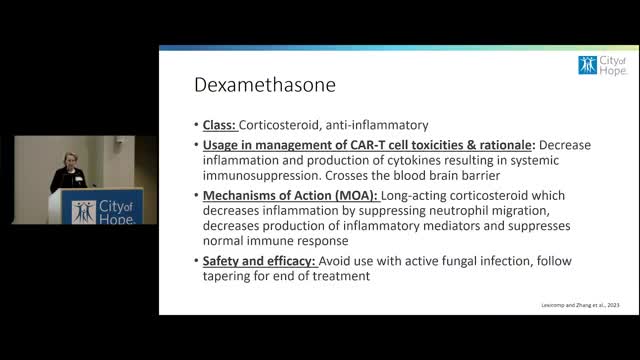
In a recent government meeting focused on advancements in CAR T cell therapy, experts discussed the critical role of dexamethasone, a corticosteroid, in managing treatment-related toxicities. Dexamethasone is recognized as the gold standard for addressing cytokine release syndrome (CRS), particularly in cases resistant to anti-cytokine therapies. However, its use is approached with caution due to potential adverse effects on the genetically modified CAR T cells.
The meeting highlighted the importance of balancing the treatment of inflammation and cytokine production with the risk of systemic immunosuppression. Dexamethasone's ability to cross the blood-brain barrier and its long-acting properties make it effective in reducing inflammation, but it also suppresses neutrophil migration and the normal immune response. This necessitates careful monitoring to avoid severe infections that could lead to poor patient outcomes.
Recommendations were made to avoid dexamethasone in patients with active fungal infections, and the need for a tapering schedule at the end of treatment was emphasized to prevent abrupt cessation of the drug. For patients experiencing grade 2 and grade 3 immune effector cell-associated neurotoxicity syndrome (ICANS), specific dosing guidelines were discussed, with a common recommendation of 10 milligrams every 6 to 8 hours for grade 3 ICANS to prevent progression to potentially fatal grade 4 ICANS.
The meeting also addressed the side effects associated with steroid therapy, including hyperglycemia, weight gain, and increased infection risk, suggesting prophylactic measures such as H2 blockers or proton pump inhibitors for patients on prolonged steroid regimens. Additionally, the risk of cataracts and increased appetite were noted as long-term considerations.
In cases of grade 4 ICANS, the recommended treatment escalates to methylprednisolone at a high dose to mitigate the risk of irreversible damage from cerebral edema. The discussion underscored the need for caution in administering steroids to geriatric patients due to heightened risks of psychosis and potential drug interactions.
The meeting concluded with a brief mention of tocilizumab, originally approved for juvenile rheumatoid arthritis, indicating ongoing exploration of its applications in the context of CAR T cell therapy. The insights shared during the meeting reflect the complexities of managing CAR T cell therapy side effects while striving to maintain treatment efficacy.
The meeting highlighted the importance of balancing the treatment of inflammation and cytokine production with the risk of systemic immunosuppression. Dexamethasone's ability to cross the blood-brain barrier and its long-acting properties make it effective in reducing inflammation, but it also suppresses neutrophil migration and the normal immune response. This necessitates careful monitoring to avoid severe infections that could lead to poor patient outcomes.
Recommendations were made to avoid dexamethasone in patients with active fungal infections, and the need for a tapering schedule at the end of treatment was emphasized to prevent abrupt cessation of the drug. For patients experiencing grade 2 and grade 3 immune effector cell-associated neurotoxicity syndrome (ICANS), specific dosing guidelines were discussed, with a common recommendation of 10 milligrams every 6 to 8 hours for grade 3 ICANS to prevent progression to potentially fatal grade 4 ICANS.
The meeting also addressed the side effects associated with steroid therapy, including hyperglycemia, weight gain, and increased infection risk, suggesting prophylactic measures such as H2 blockers or proton pump inhibitors for patients on prolonged steroid regimens. Additionally, the risk of cataracts and increased appetite were noted as long-term considerations.
In cases of grade 4 ICANS, the recommended treatment escalates to methylprednisolone at a high dose to mitigate the risk of irreversible damage from cerebral edema. The discussion underscored the need for caution in administering steroids to geriatric patients due to heightened risks of psychosis and potential drug interactions.
The meeting concluded with a brief mention of tocilizumab, originally approved for juvenile rheumatoid arthritis, indicating ongoing exploration of its applications in the context of CAR T cell therapy. The insights shared during the meeting reflect the complexities of managing CAR T cell therapy side effects while striving to maintain treatment efficacy.
Don't Miss a Word: See the Full Meeting!
Go beyond summaries. Unlock every video, transcript, and key insight with a Founder Membership.
✓
Get instant access to full meeting videos
✓
Search and clip any phrase from complete transcripts
✓
Receive AI-powered summaries & custom alerts
✓
Enjoy lifetime, unrestricted access to government data
30-day money-back guarantee
