Framingham moves to ban toxic single use black plastic
June 01, 2024 | Framingham City, Middlesex County, Massachusetts
This article was created by AI summarizing key points discussed. AI makes mistakes, so for full details and context, please refer to the video of the full meeting. Please report any errors so we can fix them. Report an error »
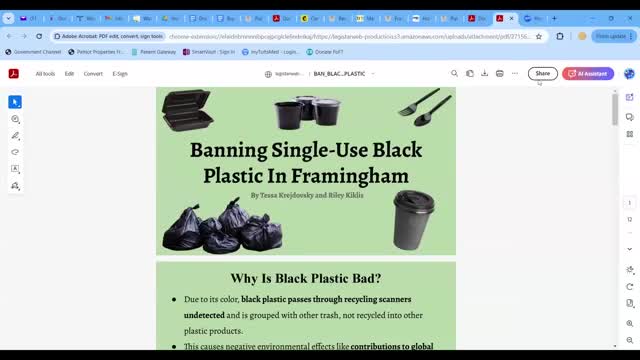
Framingham officials are considering a ban on single-use black plastic products, a move aimed at addressing significant environmental and health concerns associated with this type of plastic. The pigment carbon black used in black plastic renders it non-recyclable, as it cannot be detected by recycling scanners. Consequently, black plastic often ends up in landfills or incinerators, contributing to global warming, air pollution, and ecosystem contamination.
The dangers of black plastic extend beyond environmental issues; it can contain heavy metals such as lead, cadmium, and mercury, which pose serious health risks to humans and wildlife. Studies have indicated that black plastic products, commonly used for food packaging, may be toxic and carcinogenic, raising alarms about their impact on public health.
In response to these challenges, city officials propose an ordinance to prohibit the sale and use of single-use black plastic products. This initiative draws inspiration from a similar ban enacted in Newton, Massachusetts, which successfully collaborated with local businesses to transition away from non-reusable black plastic cutlery and containers. The Newton ordinance, implemented in March, focused on minimizing economic impacts while promoting environmental sustainability.
Framingham's proposed ban aims to facilitate communication with local businesses to ease the transition and ensure that alternatives are available. The ordinance would specifically target black plastic, while also addressing other harmful plastics like Styrofoam and nip bottles. By removing black plastic from the waste stream, the city hopes to improve recycling rates and reduce contamination in recycling facilities, ultimately leading to a cleaner and more efficient recycling process.
The initiative reflects a growing recognition of the need to detoxify the environment and safeguard public health, positioning Framingham as a proactive community in the fight against plastic pollution.
The dangers of black plastic extend beyond environmental issues; it can contain heavy metals such as lead, cadmium, and mercury, which pose serious health risks to humans and wildlife. Studies have indicated that black plastic products, commonly used for food packaging, may be toxic and carcinogenic, raising alarms about their impact on public health.
In response to these challenges, city officials propose an ordinance to prohibit the sale and use of single-use black plastic products. This initiative draws inspiration from a similar ban enacted in Newton, Massachusetts, which successfully collaborated with local businesses to transition away from non-reusable black plastic cutlery and containers. The Newton ordinance, implemented in March, focused on minimizing economic impacts while promoting environmental sustainability.
Framingham's proposed ban aims to facilitate communication with local businesses to ease the transition and ensure that alternatives are available. The ordinance would specifically target black plastic, while also addressing other harmful plastics like Styrofoam and nip bottles. By removing black plastic from the waste stream, the city hopes to improve recycling rates and reduce contamination in recycling facilities, ultimately leading to a cleaner and more efficient recycling process.
The initiative reflects a growing recognition of the need to detoxify the environment and safeguard public health, positioning Framingham as a proactive community in the fight against plastic pollution.
Don't Miss a Word: See the Full Meeting!
Go beyond summaries. Unlock every video, transcript, and key insight with a Founder Membership.
✓
Get instant access to full meeting videos
✓
Search and clip any phrase from complete transcripts
✓
Receive AI-powered summaries & custom alerts
✓
Enjoy lifetime, unrestricted access to government data
30-day money-back guarantee
