Water Crisis Sparks Urgent Call for Strategic Management
August 26, 2024 | Lake County, Colorado
This article was created by AI summarizing key points discussed. AI makes mistakes, so for full details and context, please refer to the video of the full meeting. Please report any errors so we can fix them. Report an error »
In a recent government meeting, officials discussed critical water management strategies amid growing concerns over limited water resources in the region. The conversation highlighted the challenges posed by increasing density in areas like E Hill, where existing infrastructure may not support additional development without adequate water supply.
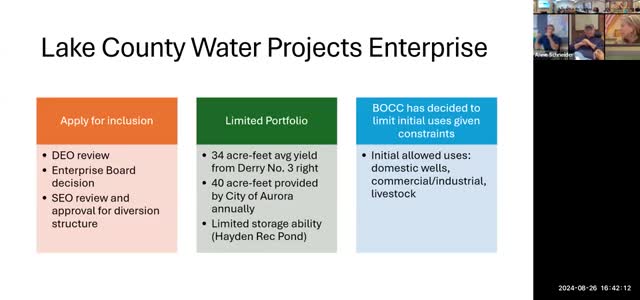
Officials noted that the current water portfolio is constrained, relying on a single ditch right that yields an average of 34 acre-feet of water annually, supplemented by a partnership with the City of Aurora, which provides an additional 40 acre-feet. This partnership is deemed secure, but the variability of ditch water based on snowpack raises concerns about future supply stability.
The meeting also addressed the potential use of Hayden Pond, a recreational asset that could serve as a water storage facility. However, officials emphasized the ecological implications of draining the pond, which could harm local fish populations. A proposed solution involves a water exchange agreement with Aurora, allowing for a balance in water levels while maintaining the pond's recreational value.
As the region grapples with water scarcity, the Board of County Commissioners (BOCC) has decided to limit initial water uses to new domestic wells, commercial and industrial applications, and livestock use. This cautious approach aims to manage demand effectively until more data on water availability and usage patterns can be gathered.
The discussion also touched on the complexities of well classifications, with officials clarifying distinctions between domestic and in-house use wells. The BOCC has prohibited irrigation to conserve water, recognizing that outdoor watering significantly reduces the amount of water that returns to the local ecosystem.
To enhance compliance and monitoring, officials proposed implementing remotely readable flow meters on all wells within the water management plan. This technology aims to improve accuracy in water use reporting and facilitate better management of the limited water resources available.
Overall, the meeting underscored the urgent need for strategic water management as the region faces increasing demand and environmental challenges. The decisions made will shape the future of water use and conservation efforts in the area.
Officials noted that the current water portfolio is constrained, relying on a single ditch right that yields an average of 34 acre-feet of water annually, supplemented by a partnership with the City of Aurora, which provides an additional 40 acre-feet. This partnership is deemed secure, but the variability of ditch water based on snowpack raises concerns about future supply stability.
The meeting also addressed the potential use of Hayden Pond, a recreational asset that could serve as a water storage facility. However, officials emphasized the ecological implications of draining the pond, which could harm local fish populations. A proposed solution involves a water exchange agreement with Aurora, allowing for a balance in water levels while maintaining the pond's recreational value.
As the region grapples with water scarcity, the Board of County Commissioners (BOCC) has decided to limit initial water uses to new domestic wells, commercial and industrial applications, and livestock use. This cautious approach aims to manage demand effectively until more data on water availability and usage patterns can be gathered.
The discussion also touched on the complexities of well classifications, with officials clarifying distinctions between domestic and in-house use wells. The BOCC has prohibited irrigation to conserve water, recognizing that outdoor watering significantly reduces the amount of water that returns to the local ecosystem.
To enhance compliance and monitoring, officials proposed implementing remotely readable flow meters on all wells within the water management plan. This technology aims to improve accuracy in water use reporting and facilitate better management of the limited water resources available.
Overall, the meeting underscored the urgent need for strategic water management as the region faces increasing demand and environmental challenges. The decisions made will shape the future of water use and conservation efforts in the area.
Don't Miss a Word: See the Full Meeting!
Go beyond summaries. Unlock every video, transcript, and key insight with a Founder Membership.
✓
Get instant access to full meeting videos
✓
Search and clip any phrase from complete transcripts
✓
Receive AI-powered summaries & custom alerts
✓
Enjoy lifetime, unrestricted access to government data
30-day money-back guarantee
