Budget Challenges Loom as Enrollment Declines
August 02, 2024 | Olathe, School Boards, Kansas
This article was created by AI summarizing key points discussed. AI makes mistakes, so for full details and context, please refer to the video of the full meeting. Please report any errors so we can fix them. Report an error »
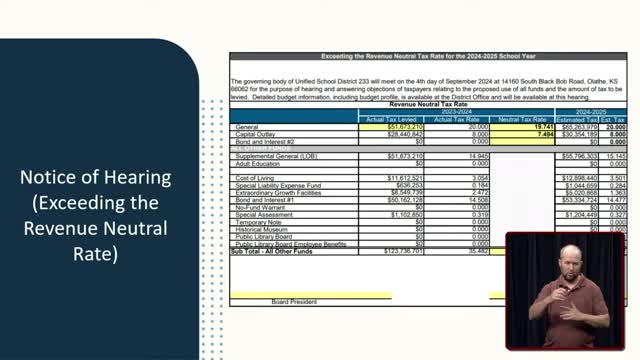
In a recent government meeting, key discussions centered around the budget for the upcoming fiscal year, highlighting significant changes in funding sources and enrollment projections for the district. The budget is primarily driven by full-time equivalent (FTE) student enrollment, which is projected to decline by approximately 193 students, bringing the total to 27,515. This decline has prompted the district to adopt a two-year average for funding calculations, as opposed to estimating based on current enrollment figures.
The meeting revealed that base aid for student excellence will increase by $90, bringing it to $5,378 per student. This increase is seen as a positive development amidst the challenges posed by declining enrollment and inflationary pressures. The district's legal maximum budget has also risen to $332 million, reflecting a $21 million increase from the previous year, which is attributed to the growth in base aid and the need to retain and attract staff.
A notable point of discussion was the Board of Tax Appeals (BOTA) funding, which has significantly decreased due to slowing growth in new facilities. The district anticipates a drop in available BOTA funds from $6 million this year to just $1.5 million next year, indicating a shift away from reliance on this funding source.
The meeting also addressed the implications of mill rates on local taxes. While the overall mill rate is proposed to decrease slightly, property evaluations may lead to higher taxes for residents. The district's reliance on commercial property is low, with only 29% of property being commercial, which affects the overall tax rate and funding capabilities compared to neighboring districts.
In conclusion, the meeting underscored the district's strategic approach to budgeting amidst declining enrollment and changing funding landscapes, emphasizing the importance of maximizing available resources to support educational needs while navigating the complexities of local taxation.
The meeting revealed that base aid for student excellence will increase by $90, bringing it to $5,378 per student. This increase is seen as a positive development amidst the challenges posed by declining enrollment and inflationary pressures. The district's legal maximum budget has also risen to $332 million, reflecting a $21 million increase from the previous year, which is attributed to the growth in base aid and the need to retain and attract staff.
A notable point of discussion was the Board of Tax Appeals (BOTA) funding, which has significantly decreased due to slowing growth in new facilities. The district anticipates a drop in available BOTA funds from $6 million this year to just $1.5 million next year, indicating a shift away from reliance on this funding source.
The meeting also addressed the implications of mill rates on local taxes. While the overall mill rate is proposed to decrease slightly, property evaluations may lead to higher taxes for residents. The district's reliance on commercial property is low, with only 29% of property being commercial, which affects the overall tax rate and funding capabilities compared to neighboring districts.
In conclusion, the meeting underscored the district's strategic approach to budgeting amidst declining enrollment and changing funding landscapes, emphasizing the importance of maximizing available resources to support educational needs while navigating the complexities of local taxation.
Don't Miss a Word: See the Full Meeting!
Go beyond summaries. Unlock every video, transcript, and key insight with a Founder Membership.
✓
Get instant access to full meeting videos
✓
Search and clip any phrase from complete transcripts
✓
Receive AI-powered summaries & custom alerts
✓
Enjoy lifetime, unrestricted access to government data
30-day money-back guarantee
