City plans bold changes to tackle traffic and safety issues
August 29, 2024 | Sammamish City, King County, Washington
This article was created by AI summarizing key points discussed. AI makes mistakes, so for full details and context, please refer to the video of the full meeting. Please report any errors so we can fix them. Report an error »
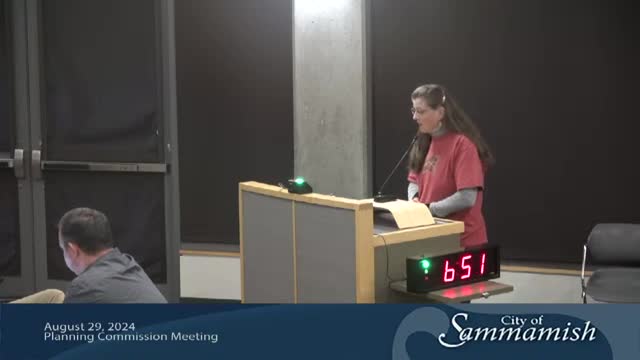
During a recent government meeting, significant discussions centered on land use and its impact on transportation in the community. A key speaker emphasized that the development of new housing and town centers directly influences traffic patterns, suggesting that without new construction, the community would face fiscal challenges in maintaining existing services.
The speaker expressed support for proposed changes in the Transportation Master Plan (TMP), particularly those outlined by a consultant named Paul Stickney. They highlighted the importance of addressing deficiencies in the current infrastructure, such as sidewalk gaps, to enhance walkability and safety for residents, especially near schools.
Concerns were raised about the numerous dead-end cul-de-sacs in the area, which could hinder emergency access. The speaker advocated for better connectivity between neighborhoods and the integration of utility corridors into community planning, suggesting that partnerships with local water and sewer districts could facilitate this.
The discussion also touched on the management of over 500 stormwater ponds in the city, which could serve as wildlife corridors and community pathways if properly mapped and maintained. The speaker called for outreach programs to promote safe walking routes to schools and to address speeding issues, particularly with the rise of e-bikes in the area.
Additionally, the speaker proposed strategies for traffic management, including off-peak travel adjustments and collaboration with school districts to stagger school start times, drawing on successful models from the Netherlands. They also advocated for lowering speed limits in residential areas, citing a case in Bozeman, Montana, where reduced speed limits led to improved safety outcomes.
Overall, the meeting underscored the need for a comprehensive approach to urban planning that prioritizes connectivity, safety, and community well-being, while addressing the fiscal implications of land use decisions.
The speaker expressed support for proposed changes in the Transportation Master Plan (TMP), particularly those outlined by a consultant named Paul Stickney. They highlighted the importance of addressing deficiencies in the current infrastructure, such as sidewalk gaps, to enhance walkability and safety for residents, especially near schools.
Concerns were raised about the numerous dead-end cul-de-sacs in the area, which could hinder emergency access. The speaker advocated for better connectivity between neighborhoods and the integration of utility corridors into community planning, suggesting that partnerships with local water and sewer districts could facilitate this.
The discussion also touched on the management of over 500 stormwater ponds in the city, which could serve as wildlife corridors and community pathways if properly mapped and maintained. The speaker called for outreach programs to promote safe walking routes to schools and to address speeding issues, particularly with the rise of e-bikes in the area.
Additionally, the speaker proposed strategies for traffic management, including off-peak travel adjustments and collaboration with school districts to stagger school start times, drawing on successful models from the Netherlands. They also advocated for lowering speed limits in residential areas, citing a case in Bozeman, Montana, where reduced speed limits led to improved safety outcomes.
Overall, the meeting underscored the need for a comprehensive approach to urban planning that prioritizes connectivity, safety, and community well-being, while addressing the fiscal implications of land use decisions.
Don't Miss a Word: See the Full Meeting!
Go beyond summaries. Unlock every video, transcript, and key insight with a Founder Membership.
✓
Get instant access to full meeting videos
✓
Search and clip any phrase from complete transcripts
✓
Receive AI-powered summaries & custom alerts
✓
Enjoy lifetime, unrestricted access to government data
30-day money-back guarantee
