Community rallies for safer streets and expanded bike infrastructure
July 03, 2024 | Seattle, King County, Washington
This article was created by AI summarizing key points discussed. AI makes mistakes, so for full details and context, please refer to the video of the full meeting. Please report any errors so we can fix them. Report an error »
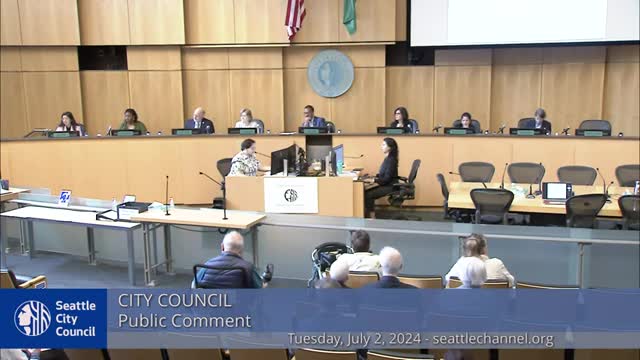
During a recent government meeting, community members voiced their strong support for increased funding for biking, walking, and public transit infrastructure in Seattle. Judy Smith, a resident of the East Lake neighborhood, highlighted the benefits of e-bikes and expressed her eagerness for the development of protected bike lanes, emphasizing the need to address gaps in the current bike lane network. She urged the council to adopt a comprehensive approach to transportation that prioritizes non-motorized options, drawing inspiration from cities like Paris.
Youth representatives from the Lake City Collective also made passionate appeals for community resources, including water features to combat heat in their neighborhoods. Diana Valdez, a summer camp organizer, and other young speakers underscored the importance of creating safe, accessible spaces for children to play and cool off.
Alberto Alvarez, a transportation advocate, pointed out the inadequacies of current sidewalks and bike paths, urging the council to support amendments that would enhance safety and accessibility for all modes of transport. He emphasized the need for better infrastructure to alleviate the city's traffic congestion.
Several speakers, including Britney Brost and Lalitha Williams, supported amendments aimed at increasing the transportation levy, arguing that it is essential for creating a more equitable and accessible city. They highlighted the importance of funding programs that cater to marginalized communities and improve overall safety for pedestrians and cyclists.
Opposition to certain amendments was also voiced, particularly from Parker Dawson, who argued that the proposed studies for alternative funding sources could undermine the primary purpose of the levy. He stressed the need for immediate infrastructure improvements rather than further studies.
The meeting concluded with a call for a more ambitious transportation plan that addresses the needs of all residents, particularly those who rely on walking, biking, or public transit. Advocates urged the council to consider the safety and accessibility of all community members as they move forward with the proposed amendments to the transportation levy.
Youth representatives from the Lake City Collective also made passionate appeals for community resources, including water features to combat heat in their neighborhoods. Diana Valdez, a summer camp organizer, and other young speakers underscored the importance of creating safe, accessible spaces for children to play and cool off.
Alberto Alvarez, a transportation advocate, pointed out the inadequacies of current sidewalks and bike paths, urging the council to support amendments that would enhance safety and accessibility for all modes of transport. He emphasized the need for better infrastructure to alleviate the city's traffic congestion.
Several speakers, including Britney Brost and Lalitha Williams, supported amendments aimed at increasing the transportation levy, arguing that it is essential for creating a more equitable and accessible city. They highlighted the importance of funding programs that cater to marginalized communities and improve overall safety for pedestrians and cyclists.
Opposition to certain amendments was also voiced, particularly from Parker Dawson, who argued that the proposed studies for alternative funding sources could undermine the primary purpose of the levy. He stressed the need for immediate infrastructure improvements rather than further studies.
The meeting concluded with a call for a more ambitious transportation plan that addresses the needs of all residents, particularly those who rely on walking, biking, or public transit. Advocates urged the council to consider the safety and accessibility of all community members as they move forward with the proposed amendments to the transportation levy.
Don't Miss a Word: See the Full Meeting!
Go beyond summaries. Unlock every video, transcript, and key insight with a Founder Membership.
✓
Get instant access to full meeting videos
✓
Search and clip any phrase from complete transcripts
✓
Receive AI-powered summaries & custom alerts
✓
Enjoy lifetime, unrestricted access to government data
30-day money-back guarantee
