California ramps up aggressive plans for zero emission vehicles
June 06, 2024 | Transportation Commission, Agencies under Office of the Governor, Executive, California
This article was created by AI summarizing key points discussed. AI makes mistakes, so for full details and context, please refer to the video of the full meeting. Please report any errors so we can fix them. Report an error »
In a recent government meeting, officials discussed critical updates on California's transportation infrastructure and environmental goals, focusing on the state's evolving approach to zero-emission vehicles (ZEVs) and greenhouse gas (GHG) reduction targets.
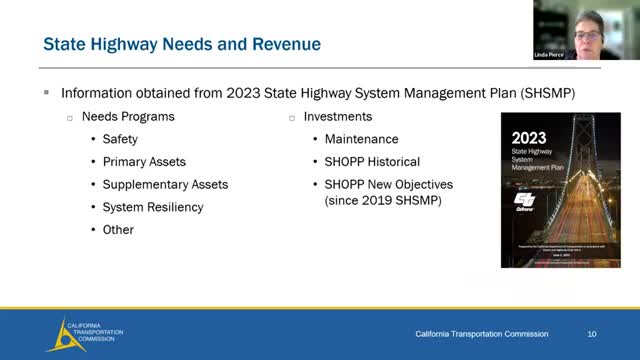
Caltrans representatives outlined the agency's asset management strategy, which prioritizes safety and system resiliency. This includes maintaining primary assets like pavements and bridges, as well as supplementary facilities for bicycles and pedestrians. The discussion highlighted the need for long-term repairs and emergency damage mitigation, emphasizing a comprehensive approach to infrastructure investment that integrates climate adaptation and wildlife connectivity.
The meeting also addressed California's ambitious GHG reduction goals, established through a series of legislative measures. The state aims to achieve a 40% reduction in emissions below 2020 levels by 2030 and an 85% reduction by 2045, with a target of carbon neutrality by the same year. Current data indicates that California is on track to meet its initial targets, but officials acknowledged the need for accelerated efforts to maintain momentum.
Key initiatives discussed included the Advanced Clean Cars Act, which mandates that all new passenger vehicles sold in California be ZEVs by 2035. Additionally, the state plans to transition medium and heavy-duty trucks to ZEVs by 2040. The phased implementation strategy aims to ease the transition for businesses and consumers while ensuring compliance with environmental standards.
Several studies were reviewed to assess the potential revenue impacts of these policies on state transportation funding. The Legislative Analyst's Office and the Mineta Transportation Institute provided insights into how increased ZEV adoption could lead to significant revenue reductions, estimating losses of up to $550 million annually by 2040. These findings underscore the financial challenges that may arise as the state shifts towards cleaner transportation options.
The meeting concluded with a breakout discussion, allowing participants to delve deeper into the implications of these findings and strategize on future actions. As California continues to lead in environmental policy, the focus remains on balancing infrastructure needs with ambitious climate goals.
Caltrans representatives outlined the agency's asset management strategy, which prioritizes safety and system resiliency. This includes maintaining primary assets like pavements and bridges, as well as supplementary facilities for bicycles and pedestrians. The discussion highlighted the need for long-term repairs and emergency damage mitigation, emphasizing a comprehensive approach to infrastructure investment that integrates climate adaptation and wildlife connectivity.
The meeting also addressed California's ambitious GHG reduction goals, established through a series of legislative measures. The state aims to achieve a 40% reduction in emissions below 2020 levels by 2030 and an 85% reduction by 2045, with a target of carbon neutrality by the same year. Current data indicates that California is on track to meet its initial targets, but officials acknowledged the need for accelerated efforts to maintain momentum.
Key initiatives discussed included the Advanced Clean Cars Act, which mandates that all new passenger vehicles sold in California be ZEVs by 2035. Additionally, the state plans to transition medium and heavy-duty trucks to ZEVs by 2040. The phased implementation strategy aims to ease the transition for businesses and consumers while ensuring compliance with environmental standards.
Several studies were reviewed to assess the potential revenue impacts of these policies on state transportation funding. The Legislative Analyst's Office and the Mineta Transportation Institute provided insights into how increased ZEV adoption could lead to significant revenue reductions, estimating losses of up to $550 million annually by 2040. These findings underscore the financial challenges that may arise as the state shifts towards cleaner transportation options.
The meeting concluded with a breakout discussion, allowing participants to delve deeper into the implications of these findings and strategize on future actions. As California continues to lead in environmental policy, the focus remains on balancing infrastructure needs with ambitious climate goals.
View the Full Meeting & All Its Details
This article offers just a summary. Unlock complete video, transcripts, and insights as a Founder Member.
✓
Watch full, unedited meeting videos
✓
Search every word spoken in unlimited transcripts
✓
AI summaries & real-time alerts (all government levels)
✓
Permanent access to expanding government content
30-day money-back guarantee
