California launches comprehensive plan to combat extreme heat
June 07, 2024 | California Department of Public Health, Agencies under Office of the Governor, Executive, California
This article was created by AI summarizing key points discussed. AI makes mistakes, so for full details and context, please refer to the video of the full meeting. Please report any errors so we can fix them. Report an error »
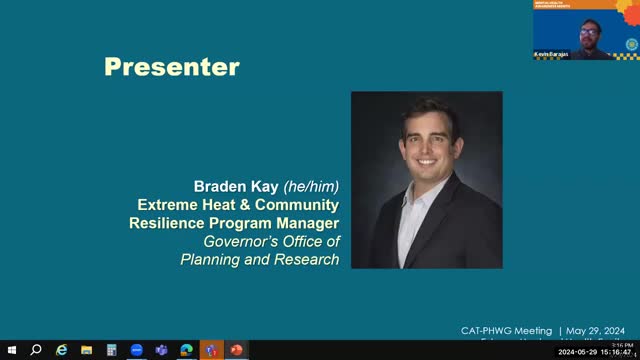
In a recent government meeting, Braden, the new extreme heat and community resilience program manager in California's Governor's Office of Planning and Research, outlined the state's comprehensive approach to combating extreme heat. Drawing from his experience as the former sustainability and resilience director in Tempe, Arizona, Braden emphasized California's leadership in developing a statewide heat action plan, first initiated in 2013 and updated in 2022, with plans for future updates every three years.
Braden highlighted the urgent need for this all-of-government strategy, citing tragic examples of Californians who have succumbed to heat-related illnesses, including young individuals and vulnerable populations such as the elderly and those experiencing homelessness. He stressed that every heat-related death is preventable, underscoring the importance of proactive measures.
The statewide heat action plan encompasses four key tracks: enhancing public awareness, strengthening community services, improving the built environment, and implementing nature-based solutions. Braden noted the significance of initiatives like the Heat Ready California program and the new extreme heat and community resilience grant program, which aims to provide immediate relief and long-term resilience against extreme heat.
The grant program, part of the Integrated Climate Adaptation and Resilience Program, focuses on climate adaptation planning, regional resilience, and immediate heat relief efforts. Braden emphasized the importance of inclusivity and language justice in program development, ensuring that the needs of all communities, particularly those most affected by climate change, are addressed.
As part of the program's development, Braden and his team conducted a listening tour to gather input from communities, highlighting the need for harm reduction and healing in addition to resilience planning. The meeting concluded with a call for innovative grant proposals that incorporate public awareness, built environment improvements, and nature-based solutions, showcasing successful examples from other states to inspire local initiatives.
Braden highlighted the urgent need for this all-of-government strategy, citing tragic examples of Californians who have succumbed to heat-related illnesses, including young individuals and vulnerable populations such as the elderly and those experiencing homelessness. He stressed that every heat-related death is preventable, underscoring the importance of proactive measures.
The statewide heat action plan encompasses four key tracks: enhancing public awareness, strengthening community services, improving the built environment, and implementing nature-based solutions. Braden noted the significance of initiatives like the Heat Ready California program and the new extreme heat and community resilience grant program, which aims to provide immediate relief and long-term resilience against extreme heat.
The grant program, part of the Integrated Climate Adaptation and Resilience Program, focuses on climate adaptation planning, regional resilience, and immediate heat relief efforts. Braden emphasized the importance of inclusivity and language justice in program development, ensuring that the needs of all communities, particularly those most affected by climate change, are addressed.
As part of the program's development, Braden and his team conducted a listening tour to gather input from communities, highlighting the need for harm reduction and healing in addition to resilience planning. The meeting concluded with a call for innovative grant proposals that incorporate public awareness, built environment improvements, and nature-based solutions, showcasing successful examples from other states to inspire local initiatives.
Don't Miss a Word: See the Full Meeting!
Go beyond summaries. Unlock every video, transcript, and key insight with a Founder Membership.
✓
Get instant access to full meeting videos
✓
Search and clip any phrase from complete transcripts
✓
Receive AI-powered summaries & custom alerts
✓
Enjoy lifetime, unrestricted access to government data
30-day money-back guarantee
