Major changes ahead for Florida water quality regulations
July 25, 2024 | Saint Petersburg City, St. Petersburg County, Florida
This article was created by AI summarizing key points discussed. AI makes mistakes, so for full details and context, please refer to the video of the full meeting. Please report any errors so we can fix them. Report an error »
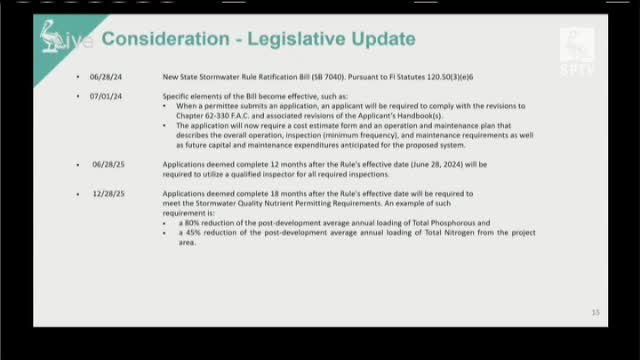
In a recent government meeting, officials discussed significant updates to local water management policies in response to new state regulations aimed at reducing nutrient loading in Florida's waterways. The changes, which are set to take effect by December 2028, mandate an 80% reduction in total phosphorus and a 45% reduction in total nitrogen from post-development runoff.
The meeting highlighted the importance of aligning city codes with the Florida Administrative Code, particularly as the state develops guidance for water management districts. City officials emphasized the need to avoid making major revisions to local codes until state guidance is finalized, to prevent contradictions.
One of the key proposals includes changing the design storm event criteria from a 10-year, 1-hour event to a 10-year, 24-hour event, which aligns with the state's upcoming requirements for a 25-year, 24-hour event. This adjustment aims to enhance water quantity management while awaiting further recommendations on water quality.
Officials also discussed the implications of new treatment and attenuation requirements for nutrient reduction, which may necessitate developers to retain more water on-site to effectively treat nutrient loading before discharge. This could lead to slower discharge rates, impacting how developments manage stormwater runoff.
Additionally, the meeting addressed the need for stricter regulations on seawall maintenance, emphasizing the responsibility of private property owners to maintain their seawalls to prevent negative impacts on local water flow and quality. The city plans to strengthen its Municipal Separate Storm Sewer System (MS4) program and align fertilizer regulations with those of Pinellas County to further enhance water quality management efforts.
Overall, the discussions reflect a proactive approach to improving water management practices in the face of evolving state requirements, with a focus on sustainability and environmental protection.
The meeting highlighted the importance of aligning city codes with the Florida Administrative Code, particularly as the state develops guidance for water management districts. City officials emphasized the need to avoid making major revisions to local codes until state guidance is finalized, to prevent contradictions.
One of the key proposals includes changing the design storm event criteria from a 10-year, 1-hour event to a 10-year, 24-hour event, which aligns with the state's upcoming requirements for a 25-year, 24-hour event. This adjustment aims to enhance water quantity management while awaiting further recommendations on water quality.
Officials also discussed the implications of new treatment and attenuation requirements for nutrient reduction, which may necessitate developers to retain more water on-site to effectively treat nutrient loading before discharge. This could lead to slower discharge rates, impacting how developments manage stormwater runoff.
Additionally, the meeting addressed the need for stricter regulations on seawall maintenance, emphasizing the responsibility of private property owners to maintain their seawalls to prevent negative impacts on local water flow and quality. The city plans to strengthen its Municipal Separate Storm Sewer System (MS4) program and align fertilizer regulations with those of Pinellas County to further enhance water quality management efforts.
Overall, the discussions reflect a proactive approach to improving water management practices in the face of evolving state requirements, with a focus on sustainability and environmental protection.
Don't Miss a Word: See the Full Meeting!
Go beyond summaries. Unlock every video, transcript, and key insight with a Founder Membership.
✓
Get instant access to full meeting videos
✓
Search and clip any phrase from complete transcripts
✓
Receive AI-powered summaries & custom alerts
✓
Enjoy lifetime, unrestricted access to government data
30-day money-back guarantee
