Worcester's Urban Forest Advocate Leaves Lasting Legacy
June 10, 2024 | Worcester City, Worcester County, Massachusetts
This article was created by AI summarizing key points discussed. AI makes mistakes, so for full details and context, please refer to the video of the full meeting. Please report any errors so we can fix them. Report an error »
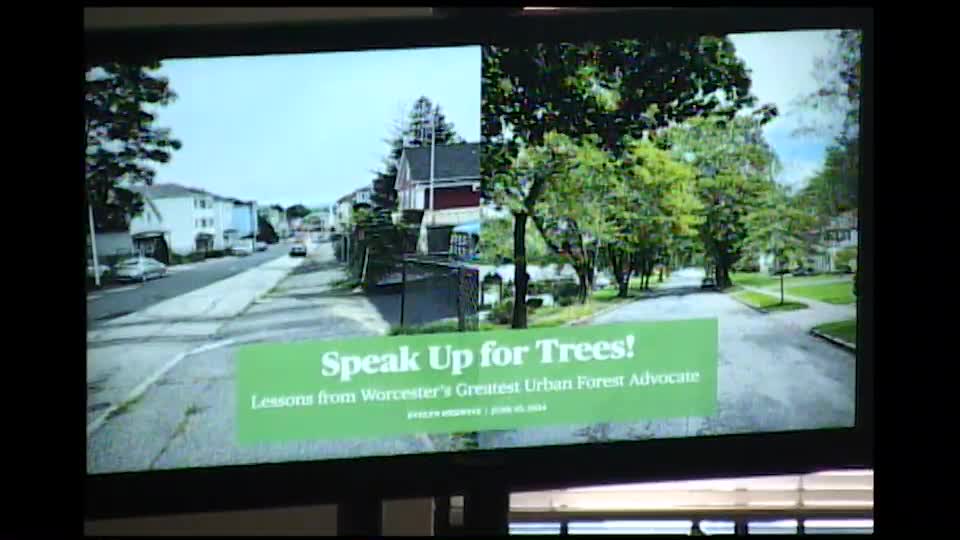
In a recent government meeting, discussions centered around the historical significance and ongoing efforts to preserve Worcester's urban forest, highlighting the legacy of Edward Winslow Lincoln, a pivotal figure in the city's environmental history. The meeting featured a presentation on Lincoln's contributions as chair of the Worcester Commission on Shade Trees and Public Grounds from 1870 to 1896, during which he championed tree planting and the establishment of public parks.
Lincoln, a descendant of the prominent Lincoln family, was instrumental in the creation of Elm Park, one of the first urban parks in the United States, purchased by the city in 1854. His advocacy for trees was driven by a recognition of their environmental benefits, particularly in the face of rapid industrialization and urbanization that characterized Worcester in the 19th century. The city's population surged from 4,000 in 1830 to over 41,000 by 1870, largely due to immigration and its strategic position as a railroad hub, which fueled industrial growth.
The meeting also addressed the historical context of deforestation in New England, which peaked between 1830 and 1880, leading to significant ecological challenges such as soil erosion and habitat loss. Lincoln's efforts were part of a broader movement among civic-minded citizens who recognized the importance of trees for public health and environmental stability.
In contemporary discussions, the city has made strides in urban forestry, with initiatives aimed at increasing tree planting and enhancing green spaces. Recent developments include the approval of an Urban Forest Master Plan, which aims to plant an additional 30,000 trees to meet the city's environmental needs. This plan is part of a larger commitment to sustainability and resilience in Worcester, reflecting a renewed focus on the urban forest that Lincoln so passionately advocated for over a century ago.
As Worcester continues to grapple with the impacts of climate change and urban development, the legacy of figures like Edward Winslow Lincoln serves as a reminder of the critical role trees play in urban environments and the ongoing need for community engagement in preserving green spaces.
Lincoln, a descendant of the prominent Lincoln family, was instrumental in the creation of Elm Park, one of the first urban parks in the United States, purchased by the city in 1854. His advocacy for trees was driven by a recognition of their environmental benefits, particularly in the face of rapid industrialization and urbanization that characterized Worcester in the 19th century. The city's population surged from 4,000 in 1830 to over 41,000 by 1870, largely due to immigration and its strategic position as a railroad hub, which fueled industrial growth.
The meeting also addressed the historical context of deforestation in New England, which peaked between 1830 and 1880, leading to significant ecological challenges such as soil erosion and habitat loss. Lincoln's efforts were part of a broader movement among civic-minded citizens who recognized the importance of trees for public health and environmental stability.
In contemporary discussions, the city has made strides in urban forestry, with initiatives aimed at increasing tree planting and enhancing green spaces. Recent developments include the approval of an Urban Forest Master Plan, which aims to plant an additional 30,000 trees to meet the city's environmental needs. This plan is part of a larger commitment to sustainability and resilience in Worcester, reflecting a renewed focus on the urban forest that Lincoln so passionately advocated for over a century ago.
As Worcester continues to grapple with the impacts of climate change and urban development, the legacy of figures like Edward Winslow Lincoln serves as a reminder of the critical role trees play in urban environments and the ongoing need for community engagement in preserving green spaces.
Don't Miss a Word: See the Full Meeting!
Go beyond summaries. Unlock every video, transcript, and key insight with a Founder Membership.
✓
Get instant access to full meeting videos
✓
Search and clip any phrase from complete transcripts
✓
Receive AI-powered summaries & custom alerts
✓
Enjoy lifetime, unrestricted access to government data
30-day money-back guarantee
