City proposes major rezoning to boost housing options
August 01, 2024 | College Station, Brazos County, Texas
This article was created by AI summarizing key points discussed. AI makes mistakes, so for full details and context, please refer to the video of the full meeting. Please report any errors so we can fix them. Report an error »
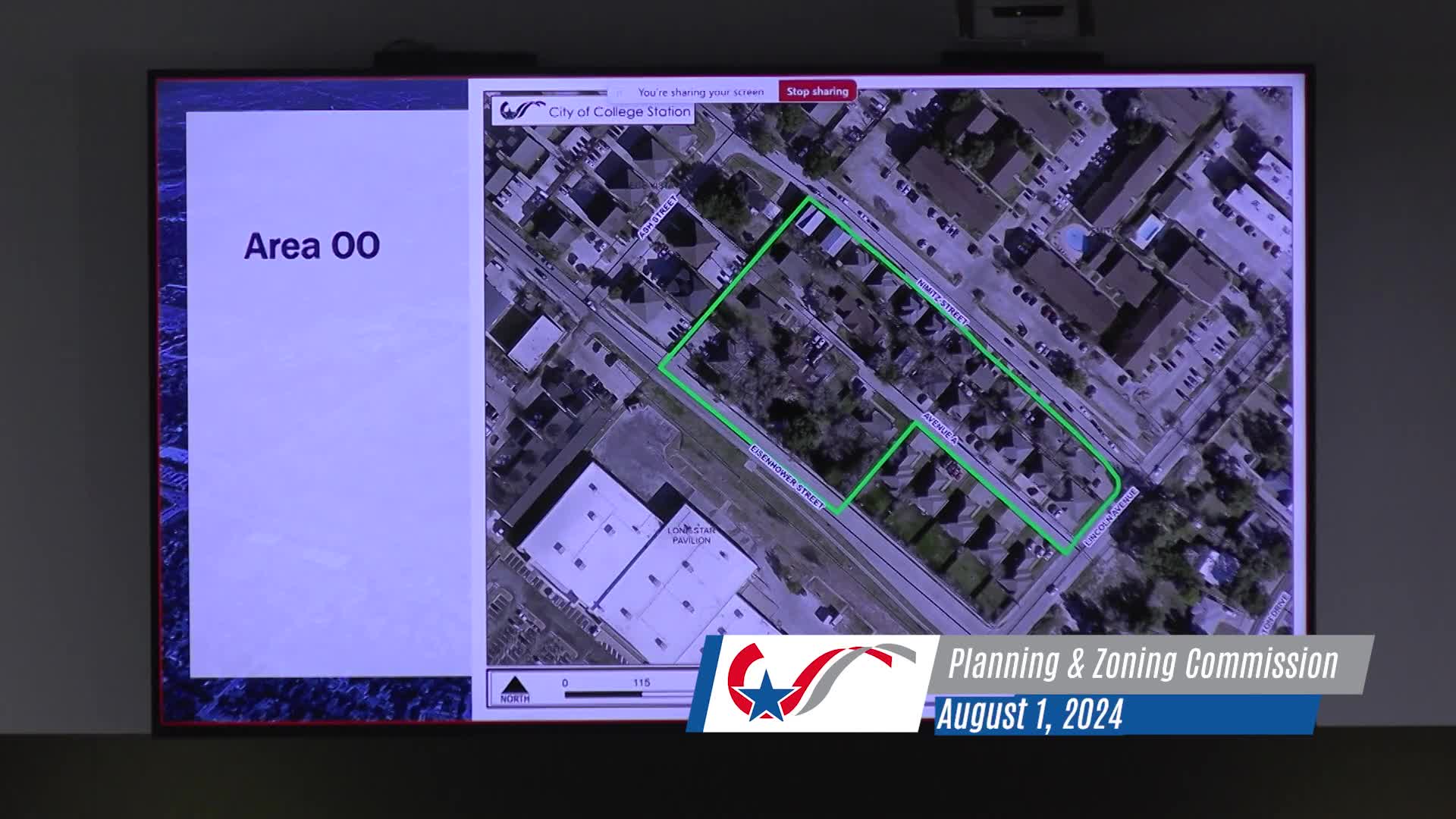
During a recent government meeting, officials discussed two significant rezoning requests aimed at increasing housing density in the community. The first proposal involves approximately 3.66 acres of land along Avenue A, which is being considered for a change from General Suburban (GS) to Middle Housing (MH) and High Occupancy Overlay (HU). This rezoning is intended to facilitate a variety of housing options, including single-family homes, duplexes, townhouses, and small multiplexes, thereby promoting efficient land use and accommodating shared housing.
However, the current condition of Avenue A poses challenges, as it does not meet fire access requirements. City staff recommended that a condition be placed on the rezoning, requiring the construction of an access drive or turnaround at the end of Avenue A. This could be achieved by extending Avenue A to connect with Eisenhower Street, Nimitz Street, or Ash Street. The need for such infrastructure improvements is critical to ensure adequate fire and sanitation access, especially with the anticipated increase in residential density.
The second area under consideration is approximately 28.15 acres along Richards and Sterling Streets, which is also proposed for rezoning from GS to MH and HU. This request follows a thorough vetting process, including necessary surveys to confirm property boundaries before moving forward.
Officials emphasized that these proposed changes are contingent upon meeting specific conditions, particularly regarding access improvements. If the conditions are not satisfied, the rezoning will not take effect. The discussions highlighted the complexities of coordinating multiple property owners in the area, as consolidation may be necessary to fulfill the requirements for the new zoning designations.
Overall, these rezoning efforts reflect a broader strategy to enhance housing availability and accommodate growing community needs, while ensuring that essential infrastructure is in place to support increased density.
However, the current condition of Avenue A poses challenges, as it does not meet fire access requirements. City staff recommended that a condition be placed on the rezoning, requiring the construction of an access drive or turnaround at the end of Avenue A. This could be achieved by extending Avenue A to connect with Eisenhower Street, Nimitz Street, or Ash Street. The need for such infrastructure improvements is critical to ensure adequate fire and sanitation access, especially with the anticipated increase in residential density.
The second area under consideration is approximately 28.15 acres along Richards and Sterling Streets, which is also proposed for rezoning from GS to MH and HU. This request follows a thorough vetting process, including necessary surveys to confirm property boundaries before moving forward.
Officials emphasized that these proposed changes are contingent upon meeting specific conditions, particularly regarding access improvements. If the conditions are not satisfied, the rezoning will not take effect. The discussions highlighted the complexities of coordinating multiple property owners in the area, as consolidation may be necessary to fulfill the requirements for the new zoning designations.
Overall, these rezoning efforts reflect a broader strategy to enhance housing availability and accommodate growing community needs, while ensuring that essential infrastructure is in place to support increased density.
View the Full Meeting & All Its Details
This article offers just a summary. Unlock complete video, transcripts, and insights as a Founder Member.
✓
Watch full, unedited meeting videos
✓
Search every word spoken in unlimited transcripts
✓
AI summaries & real-time alerts (all government levels)
✓
Permanent access to expanding government content
30-day money-back guarantee
