Concerns Rise Over Road Salt's Environmental Impact
July 02, 2024 | Clear Creek County, Colorado
This article was created by AI summarizing key points discussed. AI makes mistakes, so for full details and context, please refer to the video of the full meeting. Please report any errors so we can fix them. Report an error »
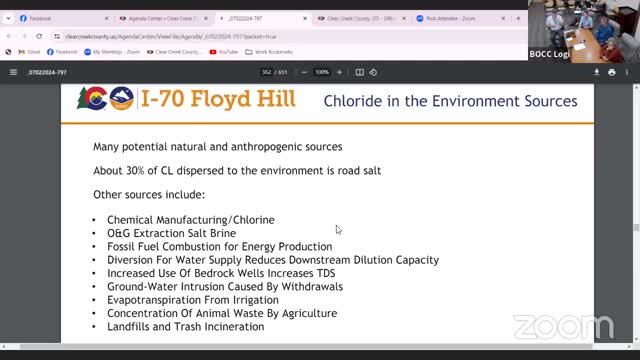
In a recent government meeting, officials discussed the use of brine for road treatment and its implications for both cost-effectiveness and environmental impact. Mike Williard, a representative from Section 9, explained that while brine was initially adopted for its efficiency and cost benefits, logistical challenges have led to its discontinuation. The brine machine, intended to produce the solution, has not been maintained adequately, limiting its availability for road treatment.
Williard noted that the heavy snowfall in the region often leaves enough residual material on the roads, reducing the necessity for brine application. He emphasized that the effectiveness of brine diminishes quickly if not applied right before a storm, particularly in adverse weather conditions. This raises concerns about the environmental consequences of road salt, with studies indicating that approximately 30% of sodium in the environment can be attributed to road salt usage.
The discussion also touched on the broader implications of road treatment materials on local ecosystems. Officials expressed concerns about the corrosion of electrical components and the health of nearby trees, particularly in areas where magnesium chloride is used. The potential correlation between road treatment and tree health was highlighted, with observations of tree die-off along treated roads prompting further investigation into the environmental impacts of these materials.
As the meeting concluded, officials acknowledged the need for a more comprehensive understanding of how road treatment practices affect both water quality and local flora, indicating a commitment to further research and monitoring in these areas.
Williard noted that the heavy snowfall in the region often leaves enough residual material on the roads, reducing the necessity for brine application. He emphasized that the effectiveness of brine diminishes quickly if not applied right before a storm, particularly in adverse weather conditions. This raises concerns about the environmental consequences of road salt, with studies indicating that approximately 30% of sodium in the environment can be attributed to road salt usage.
The discussion also touched on the broader implications of road treatment materials on local ecosystems. Officials expressed concerns about the corrosion of electrical components and the health of nearby trees, particularly in areas where magnesium chloride is used. The potential correlation between road treatment and tree health was highlighted, with observations of tree die-off along treated roads prompting further investigation into the environmental impacts of these materials.
As the meeting concluded, officials acknowledged the need for a more comprehensive understanding of how road treatment practices affect both water quality and local flora, indicating a commitment to further research and monitoring in these areas.
View the Full Meeting & All Its Details
This article offers just a summary. Unlock complete video, transcripts, and insights as a Founder Member.
✓
Watch full, unedited meeting videos
✓
Search every word spoken in unlimited transcripts
✓
AI summaries & real-time alerts (all government levels)
✓
Permanent access to expanding government content
30-day money-back guarantee
