City Council Proposes Major Overhaul of Business License Tax
July 15, 2024 | Foster City, San Mateo County, California
This article was created by AI summarizing key points discussed. AI makes mistakes, so for full details and context, please refer to the video of the full meeting. Please report any errors so we can fix them. Report an error »
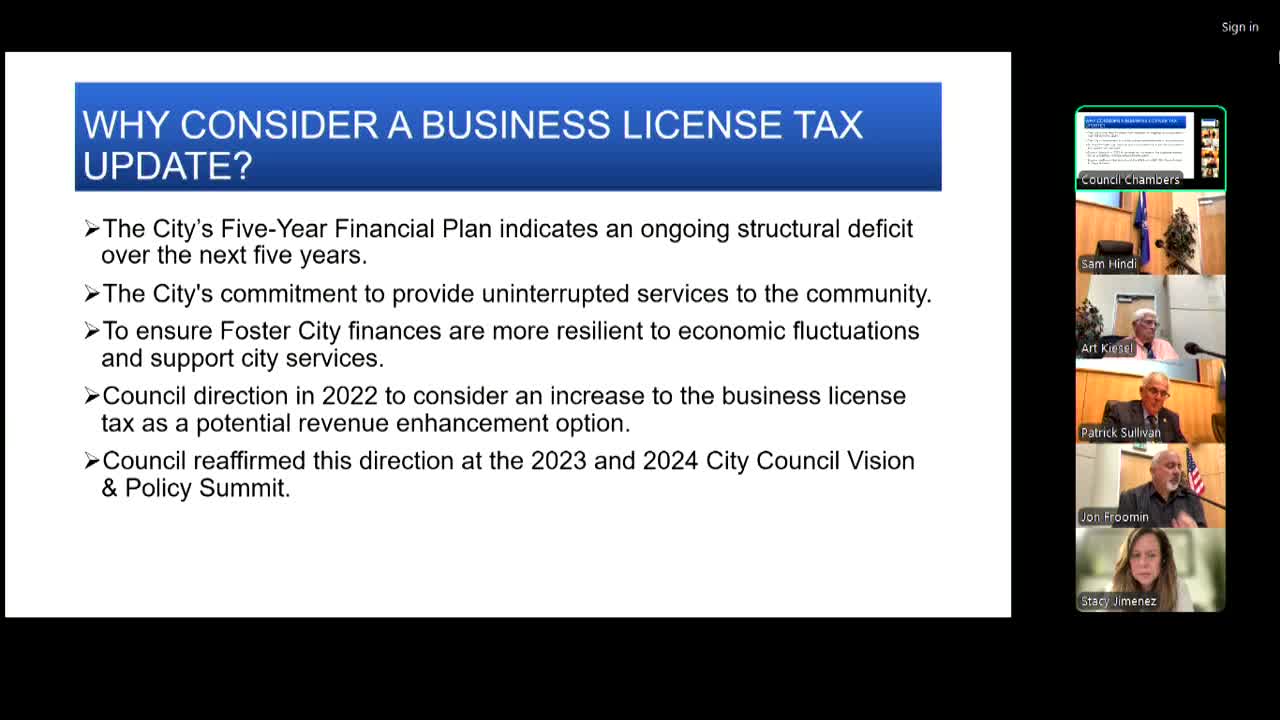
The city is actively considering an update to its business license tax structure in response to a projected five-year structural deficit estimated at $40 million, with the next two years alone potentially seeing a shortfall of $57 million. This initiative, which began discussions in 2022, aims to enhance revenue streams to ensure financial resilience against economic fluctuations and to support essential city services.
Currently, the city employs a gross receipts model with a single tax rate of 0.075 percent, unchanged since 1972. This rate applies uniformly across all businesses, leading to larger companies paying proportionally less compared to smaller enterprises. The city’s business license tax revenue for 2023 was approximately $1.6 million, with an anticipated increase to $1.8 million in 2024. However, the existing structure has limitations, including a cap on tax revenue and restrictions on the number of entities taxed.
During a recent council meeting, staff presented three potential models for restructuring the business license tax. The first model maintains the current rate but raises the maximum tax to $500,000, which could generate nearly $1 million in additional revenue. The second model proposes increasing the rate to $1 per $1,000 of gross receipts, potentially yielding an additional $1.4 million, while the third model suggests a rate of $1.25, with an estimated revenue increase of $1.9 million.
Each model retains the minimum tax of $100 and $200 for general contractors, and all three options would apply the maximum tax to a small fraction of businesses—less than 5%—that gross over $400 million to $666 million annually. Despite the potential benefits, there are concerns among stakeholders regarding the proposed cap of $500,000 being too high.
The council is expected to continue discussions on these models, weighing the need for increased revenue against the impact on local businesses.
Currently, the city employs a gross receipts model with a single tax rate of 0.075 percent, unchanged since 1972. This rate applies uniformly across all businesses, leading to larger companies paying proportionally less compared to smaller enterprises. The city’s business license tax revenue for 2023 was approximately $1.6 million, with an anticipated increase to $1.8 million in 2024. However, the existing structure has limitations, including a cap on tax revenue and restrictions on the number of entities taxed.
During a recent council meeting, staff presented three potential models for restructuring the business license tax. The first model maintains the current rate but raises the maximum tax to $500,000, which could generate nearly $1 million in additional revenue. The second model proposes increasing the rate to $1 per $1,000 of gross receipts, potentially yielding an additional $1.4 million, while the third model suggests a rate of $1.25, with an estimated revenue increase of $1.9 million.
Each model retains the minimum tax of $100 and $200 for general contractors, and all three options would apply the maximum tax to a small fraction of businesses—less than 5%—that gross over $400 million to $666 million annually. Despite the potential benefits, there are concerns among stakeholders regarding the proposed cap of $500,000 being too high.
The council is expected to continue discussions on these models, weighing the need for increased revenue against the impact on local businesses.
Don't Miss a Word: See the Full Meeting!
Go beyond summaries. Unlock every video, transcript, and key insight with a Founder Membership.
✓
Get instant access to full meeting videos
✓
Search and clip any phrase from complete transcripts
✓
Receive AI-powered summaries & custom alerts
✓
Enjoy lifetime, unrestricted access to government data
30-day money-back guarantee
