Ohio's Redistricting Debate Sparks Controversy Over Proportionality
July 31, 2024 | Governor Mike DeWine, Office of the Governor , Executive Offices, Organizations, Executive , Ohio
This article was created by AI summarizing key points discussed. AI makes mistakes, so for full details and context, please refer to the video of the full meeting. Please report any errors so we can fix them. Report an error »
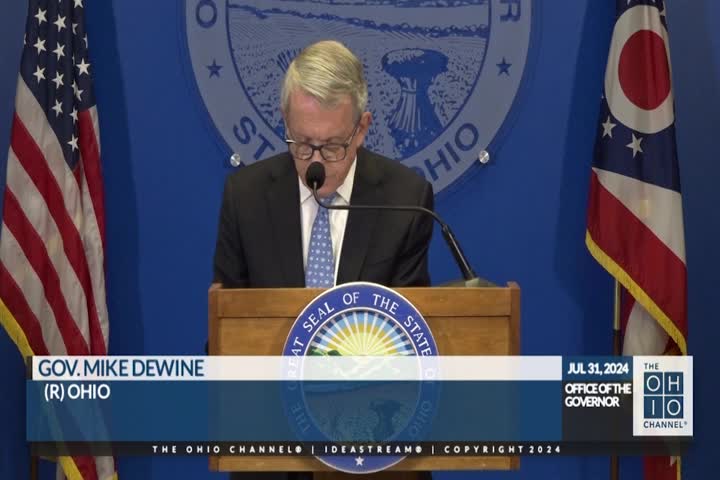
In a recent government meeting, officials discussed the implications of a proposed constitutional amendment regarding redistricting in Ohio. A key point raised was the importance of maintaining the integrity of local political subdivisions—cities, counties, villages, and townships—when drawing electoral maps. The speaker emphasized that Ohio operates as a local government state, where services are delivered at these local levels, and splitting these subdivisions could lead to inefficiencies and dissatisfaction among voters.
The speaker criticized the proposed amendment for prioritizing proportionality over other critical factors in redistricting. Proportionality, as defined in the amendment, requires that electoral districts reflect the historical voting percentages of political parties in statewide elections. This means that districts would be drawn to ensure that the number of seats held by each party aligns with their overall electoral performance, potentially at the expense of community cohesion and local governance.
The speaker argued that this focus on proportionality could lead to districts that do not accurately represent the interests of local communities, as it would override considerations such as keeping communities of interest intact and respecting existing political boundaries. They pointed out that the amendment explicitly states that proportionality must take precedence over these other criteria, which could result in districts that are confusing and unsatisfactory to voters.
To illustrate the potential consequences of the amendment, the speaker referenced a map generated by a nonpartisan website, which demonstrated how districts drawn under strict adherence to proportionality could appear. The map, described as unsettling, highlighted the possible fragmentation of communities and the odd shapes of districts that could arise from this approach.
The discussion underscored a significant debate within Ohio regarding the balance between fair representation and the preservation of local governance structures, with calls for a reconsideration of the proposed amendment to ensure that it serves the best interests of Ohio's residents.
The speaker criticized the proposed amendment for prioritizing proportionality over other critical factors in redistricting. Proportionality, as defined in the amendment, requires that electoral districts reflect the historical voting percentages of political parties in statewide elections. This means that districts would be drawn to ensure that the number of seats held by each party aligns with their overall electoral performance, potentially at the expense of community cohesion and local governance.
The speaker argued that this focus on proportionality could lead to districts that do not accurately represent the interests of local communities, as it would override considerations such as keeping communities of interest intact and respecting existing political boundaries. They pointed out that the amendment explicitly states that proportionality must take precedence over these other criteria, which could result in districts that are confusing and unsatisfactory to voters.
To illustrate the potential consequences of the amendment, the speaker referenced a map generated by a nonpartisan website, which demonstrated how districts drawn under strict adherence to proportionality could appear. The map, described as unsettling, highlighted the possible fragmentation of communities and the odd shapes of districts that could arise from this approach.
The discussion underscored a significant debate within Ohio regarding the balance between fair representation and the preservation of local governance structures, with calls for a reconsideration of the proposed amendment to ensure that it serves the best interests of Ohio's residents.
View the Full Meeting & All Its Details
This article offers just a summary. Unlock complete video, transcripts, and insights as a Founder Member.
✓
Watch full, unedited meeting videos
✓
Search every word spoken in unlimited transcripts
✓
AI summaries & real-time alerts (all government levels)
✓
Permanent access to expanding government content
30-day money-back guarantee
