Seattle's ADU Boom Reshapes Housing Landscape and Affordability
July 18, 2024 | Seattle, King County, Washington
This article was created by AI summarizing key points discussed. AI makes mistakes, so for full details and context, please refer to the video of the full meeting. Please report any errors so we can fix them. Report an error »
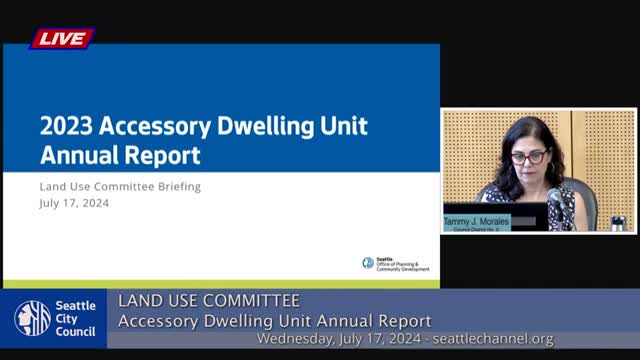
A recent government meeting highlighted significant developments in the production and regulation of Accessory Dwelling Units (ADUs) in Seattle, revealing both current trends and future implications for housing diversity and affordability.
ADUs, which are secondary dwelling units within residential zones, have seen a notable increase in permits issued, with 2023 figures showing a fourfold rise compared to 2018, the year before major reforms were enacted. In 2022, 44% of ADUs were permitted as condominiums, with an average selling price of $750,000, significantly lower than principal dwelling units and new detached homes. Approximately one-third of ADUs are utilized as long-term rentals, while around 10% serve as short-term rentals, requiring a business license for operation.
The meeting underscored the impact of recent state legislation on ADU regulations. New laws from the 2023-2024 legislative session are set to promote ADUs and middle housing, mandating Seattle to adopt zoning that allows for 4 to 6 units in areas currently designated for single-family homes. This shift aims to enhance housing supply and affordability across the city.
Despite the increase in permits, there has been a decrease in applications for new ADU permits from 2022 to 2023, attributed to rising interest rates and inflation, as well as potential shifts toward developing more dense housing options. The report indicated that 47% of ADUs permitted in 2023 were for two units on-site, primarily in neighborhood residential zones.
The meeting also addressed concerns regarding the concentration of ADU ownership among wealthier demographics, with most owners being white and earning above $200,000. In response, the city has secured a $5 million Pro Housing grant aimed at supporting legacy homeowners and preventing displacement, focusing on predevelopment assistance for those at risk of selling their properties.
As Seattle navigates these regulatory changes and market dynamics, the future of ADUs remains a critical component of the city's housing strategy, with ongoing efforts to ensure that these units continue to provide diverse and affordable living options for residents.
ADUs, which are secondary dwelling units within residential zones, have seen a notable increase in permits issued, with 2023 figures showing a fourfold rise compared to 2018, the year before major reforms were enacted. In 2022, 44% of ADUs were permitted as condominiums, with an average selling price of $750,000, significantly lower than principal dwelling units and new detached homes. Approximately one-third of ADUs are utilized as long-term rentals, while around 10% serve as short-term rentals, requiring a business license for operation.
The meeting underscored the impact of recent state legislation on ADU regulations. New laws from the 2023-2024 legislative session are set to promote ADUs and middle housing, mandating Seattle to adopt zoning that allows for 4 to 6 units in areas currently designated for single-family homes. This shift aims to enhance housing supply and affordability across the city.
Despite the increase in permits, there has been a decrease in applications for new ADU permits from 2022 to 2023, attributed to rising interest rates and inflation, as well as potential shifts toward developing more dense housing options. The report indicated that 47% of ADUs permitted in 2023 were for two units on-site, primarily in neighborhood residential zones.
The meeting also addressed concerns regarding the concentration of ADU ownership among wealthier demographics, with most owners being white and earning above $200,000. In response, the city has secured a $5 million Pro Housing grant aimed at supporting legacy homeowners and preventing displacement, focusing on predevelopment assistance for those at risk of selling their properties.
As Seattle navigates these regulatory changes and market dynamics, the future of ADUs remains a critical component of the city's housing strategy, with ongoing efforts to ensure that these units continue to provide diverse and affordable living options for residents.
Don't Miss a Word: See the Full Meeting!
Go beyond summaries. Unlock every video, transcript, and key insight with a Founder Membership.
✓
Get instant access to full meeting videos
✓
Search and clip any phrase from complete transcripts
✓
Receive AI-powered summaries & custom alerts
✓
Enjoy lifetime, unrestricted access to government data
30-day money-back guarantee
