California pushes bold housing reforms to tackle crisis
July 01, 2024 | Murrieta City, Riverside County, California
This article was created by AI summarizing key points discussed. AI makes mistakes, so for full details and context, please refer to the video of the full meeting. Please report any errors so we can fix them. Report an error »
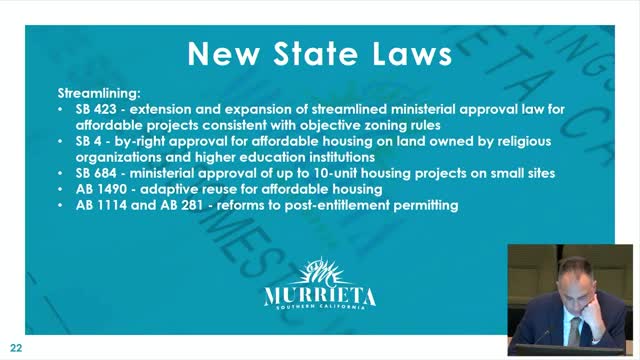
In a recent government meeting, officials discussed several significant housing bills aimed at streamlining the approval process for affordable housing projects in California. Among the key topics was Senate Bill 423, an extension of SB 35, which allows for ministerial approval of certain affordable housing projects. Although no SB 35 projects have been initiated in Murrieta, a similar project in nearby Temecula faced complications due to the discovery of cultural artifacts on the site.
Senate Bill 4, another notable piece of legislation, facilitates the construction of affordable housing on properties owned by religious organizations and higher education institutions without the need for extensive approvals. While there have been discussions about potential projects in San Diego, none have yet been proposed in Murrieta.
The meeting also highlighted Assembly Bill 490, which encourages the adaptive reuse of commercial and industrial buildings for housing, mandating that such projects be 100% affordable. Although this law is now in effect, no proposals have been submitted in Murrieta to date.
Further discussions included updates on the Density Bonus Law, which has been adjusted to provide greater incentives for developers to meet low-income housing targets. Officials expressed optimism that Murrieta would meet its low-income housing goals this year, having already achieved its market-rate targets.
The meeting also addressed the implications of new state laws that require cities to align their zoning regulations with their general plans within 180 days if a developer submits an application that meets the general plan's density allowances. This change has raised concerns among city officials about the potential for rapid development without adequate local oversight.
Additionally, the state has introduced measures to streamline the approval process for accessory dwelling units (ADUs), including allowing them to be sold separately as condominiums and removing owner-occupancy requirements by 2025. These changes are part of a broader effort to increase housing availability in California.
Officials acknowledged the challenges posed by state mandates on local control over housing development, emphasizing the need for ongoing communication with residents to address concerns about overbuilding and the impact on community resources. The meeting concluded with a commitment to continue monitoring these legislative changes and their effects on local housing initiatives.
Senate Bill 4, another notable piece of legislation, facilitates the construction of affordable housing on properties owned by religious organizations and higher education institutions without the need for extensive approvals. While there have been discussions about potential projects in San Diego, none have yet been proposed in Murrieta.
The meeting also highlighted Assembly Bill 490, which encourages the adaptive reuse of commercial and industrial buildings for housing, mandating that such projects be 100% affordable. Although this law is now in effect, no proposals have been submitted in Murrieta to date.
Further discussions included updates on the Density Bonus Law, which has been adjusted to provide greater incentives for developers to meet low-income housing targets. Officials expressed optimism that Murrieta would meet its low-income housing goals this year, having already achieved its market-rate targets.
The meeting also addressed the implications of new state laws that require cities to align their zoning regulations with their general plans within 180 days if a developer submits an application that meets the general plan's density allowances. This change has raised concerns among city officials about the potential for rapid development without adequate local oversight.
Additionally, the state has introduced measures to streamline the approval process for accessory dwelling units (ADUs), including allowing them to be sold separately as condominiums and removing owner-occupancy requirements by 2025. These changes are part of a broader effort to increase housing availability in California.
Officials acknowledged the challenges posed by state mandates on local control over housing development, emphasizing the need for ongoing communication with residents to address concerns about overbuilding and the impact on community resources. The meeting concluded with a commitment to continue monitoring these legislative changes and their effects on local housing initiatives.
Don't Miss a Word: See the Full Meeting!
Go beyond summaries. Unlock every video, transcript, and key insight with a Founder Membership.
✓
Get instant access to full meeting videos
✓
Search and clip any phrase from complete transcripts
✓
Receive AI-powered summaries & custom alerts
✓
Enjoy lifetime, unrestricted access to government data
30-day money-back guarantee
