Parents Demand Action on Special Education Barriers
August 01, 2024 | Hillsborough, School Districts, Florida
This article was created by AI summarizing key points discussed. AI makes mistakes, so for full details and context, please refer to the video of the full meeting. Please report any errors so we can fix them. Report an error »
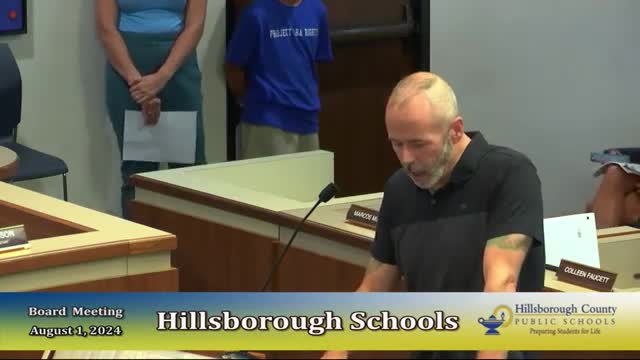
During a recent Hillsborough County School Board meeting, a series of passionate testimonies highlighted the challenges faced by families of students with special needs, particularly those requiring Applied Behavior Analysis (ABA) therapy. Advocates and parents voiced their concerns over new procedural changes that they believe create barriers to accessing essential services for their children.
One speaker, representing the newly established Hillsborough County Council of Exceptional Parents and Teachers Association (HCCEPTA), emphasized the importance of parent involvement in educational planning for students with exceptionalities. The speaker called for collaboration between parents, educators, and district staff to ensure that the needs of students are prioritized in decision-making processes.
Tamara Perez, a representative from Project ABA Rights, presented alarming statistics regarding the financial burden of raising a child with autism, noting that the average cost of ABA therapy can reach $62,000 annually. She expressed frustration over new procedural requirements that complicate the process for parents seeking to bring therapists into schools, arguing that these changes violate existing statutes and create unnecessary hurdles.
Other parents shared personal stories illustrating the impact of these policies on their children's education. Jax, a young advocate, spoke about his cousin Grayson, who has autism, and the critical role his therapist plays in his development. Similarly, Jessica Southern highlighted the need for Registered Behavior Technicians (RBTs) in classrooms to support students with emotional regulation and learning challenges.
Concerns were raised about the new Private Instruction Personnel (PIP) procedures, which many parents feel impose additional requirements that complicate access to necessary services. Parents argued that the updated paperwork is filled with legal jargon that is difficult to understand and that it places undue financial and legal burdens on families.
The meeting also touched on broader issues of equity and discipline within the school system. Educator April Cobb urged the board to make discipline data publicly accessible, arguing that transparency could lead to more equitable practices and better support for at-risk students.
As the meeting concluded, many speakers reiterated their desire for a collaborative approach to policy-making that includes the voices of parents and advocates. They called for roundtable discussions to address the concerns raised and to work towards solutions that ensure all students receive the support they need to thrive in the educational environment.
One speaker, representing the newly established Hillsborough County Council of Exceptional Parents and Teachers Association (HCCEPTA), emphasized the importance of parent involvement in educational planning for students with exceptionalities. The speaker called for collaboration between parents, educators, and district staff to ensure that the needs of students are prioritized in decision-making processes.
Tamara Perez, a representative from Project ABA Rights, presented alarming statistics regarding the financial burden of raising a child with autism, noting that the average cost of ABA therapy can reach $62,000 annually. She expressed frustration over new procedural requirements that complicate the process for parents seeking to bring therapists into schools, arguing that these changes violate existing statutes and create unnecessary hurdles.
Other parents shared personal stories illustrating the impact of these policies on their children's education. Jax, a young advocate, spoke about his cousin Grayson, who has autism, and the critical role his therapist plays in his development. Similarly, Jessica Southern highlighted the need for Registered Behavior Technicians (RBTs) in classrooms to support students with emotional regulation and learning challenges.
Concerns were raised about the new Private Instruction Personnel (PIP) procedures, which many parents feel impose additional requirements that complicate access to necessary services. Parents argued that the updated paperwork is filled with legal jargon that is difficult to understand and that it places undue financial and legal burdens on families.
The meeting also touched on broader issues of equity and discipline within the school system. Educator April Cobb urged the board to make discipline data publicly accessible, arguing that transparency could lead to more equitable practices and better support for at-risk students.
As the meeting concluded, many speakers reiterated their desire for a collaborative approach to policy-making that includes the voices of parents and advocates. They called for roundtable discussions to address the concerns raised and to work towards solutions that ensure all students receive the support they need to thrive in the educational environment.
Don't Miss a Word: See the Full Meeting!
Go beyond summaries. Unlock every video, transcript, and key insight with a Founder Membership.
✓
Get instant access to full meeting videos
✓
Search and clip any phrase from complete transcripts
✓
Receive AI-powered summaries & custom alerts
✓
Enjoy lifetime, unrestricted access to government data
30-day money-back guarantee
