Emissions Inventory Reveals Urgent Climate Challenges
July 29, 2024 | Clark County, Washington
This article was created by AI summarizing key points discussed. AI makes mistakes, so for full details and context, please refer to the video of the full meeting. Please report any errors so we can fix them. Report an error »
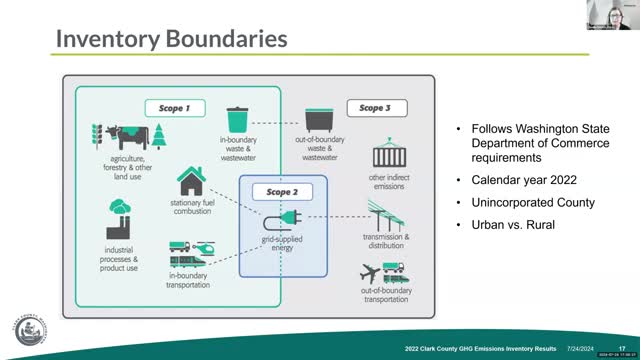
During a recent government meeting, officials discussed the findings of a greenhouse gas (GHG) inventory for Clark County, revealing critical insights into local and imported emissions. The inventory, which includes data from both urban and rural areas, indicates that local emissions total approximately 1.5 million metric tons of CO2 equivalent, translating to about 6.1 metric tons per capita. In contrast, imported emissions are estimated at over 2.5 million metric tons, resulting in a combined total of 4 million metric tons of CO2 equivalent for the county.
Key sources of local emissions were identified, with building energy and transportation each contributing around 36%. Agriculture, forestry, and land use accounted for 21%, primarily from rural areas, while industrial processes and waste management contributed smaller amounts. Notably, emissions from agriculture are significantly influenced by livestock, particularly beef and dairy cattle, which produce methane.
The meeting also highlighted the challenges in tracking emissions from wildfires and backyard burning, which are included in the inventory as a 20-year average rather than annual figures. Officials emphasized the importance of understanding both local and imported emissions, as the latter reflects the environmental impact of consumer behavior and waste generation outside the county.
Participants raised questions about the emissions from specific sources, such as a gas power plant located within Vancouver city limits, which is accounted for in the building energy emissions category. Additionally, the meeting addressed the distribution of emissions data from various cities within the county, noting that some cities, like Vancouver, conduct their own inventories.
Overall, the discussions underscored the need for ongoing monitoring and collaboration among local jurisdictions to effectively address greenhouse gas emissions and develop strategies for reduction. The full inventory report is expected to be shared with stakeholders following the meeting, providing further details on emissions across different sectors and areas within Clark County.
Key sources of local emissions were identified, with building energy and transportation each contributing around 36%. Agriculture, forestry, and land use accounted for 21%, primarily from rural areas, while industrial processes and waste management contributed smaller amounts. Notably, emissions from agriculture are significantly influenced by livestock, particularly beef and dairy cattle, which produce methane.
The meeting also highlighted the challenges in tracking emissions from wildfires and backyard burning, which are included in the inventory as a 20-year average rather than annual figures. Officials emphasized the importance of understanding both local and imported emissions, as the latter reflects the environmental impact of consumer behavior and waste generation outside the county.
Participants raised questions about the emissions from specific sources, such as a gas power plant located within Vancouver city limits, which is accounted for in the building energy emissions category. Additionally, the meeting addressed the distribution of emissions data from various cities within the county, noting that some cities, like Vancouver, conduct their own inventories.
Overall, the discussions underscored the need for ongoing monitoring and collaboration among local jurisdictions to effectively address greenhouse gas emissions and develop strategies for reduction. The full inventory report is expected to be shared with stakeholders following the meeting, providing further details on emissions across different sectors and areas within Clark County.
Don't Miss a Word: See the Full Meeting!
Go beyond summaries. Unlock every video, transcript, and key insight with a Founder Membership.
✓
Get instant access to full meeting videos
✓
Search and clip any phrase from complete transcripts
✓
Receive AI-powered summaries & custom alerts
✓
Enjoy lifetime, unrestricted access to government data
30-day money-back guarantee
