School District Launches New Funding Model to Address Inequity
July 18, 2024 | City of Chicago SD 299, School Boards, Illinois
This article was created by AI summarizing key points discussed. AI makes mistakes, so for full details and context, please refer to the video of the full meeting. Please report any errors so we can fix them. Report an error »
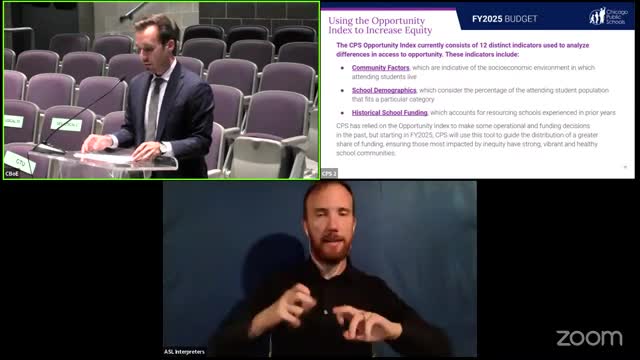
In a recent government meeting, officials outlined a new funding model aimed at addressing educational inequities across the district. Central to this initiative is the Opportunity Index, a comprehensive measure that evaluates the needs of schools based on 12 distinct socioeconomic and demographic indicators, as well as historical funding data. This year marks the first time the Opportunity Index will serve as the foundation for resource allocation, ensuring that schools with the greatest needs receive adequate support.
The Opportunity Index ranks schools by their level of need, with scores indicating the distance from opportunity for students. Schools are categorized into quintiles, with the highest need schools receiving the most resources. The new funding model guarantees that every student has access to certified teachers in core subjects, reasonable class sizes, and a minimum of three holistic courses, including arts and physical education.
For elementary schools, the allocation formula sets a student-to-teacher ratio of 26:1 for the lowest need schools, decreasing to 22:1 for the highest need schools. Additionally, a minimum of 10 core classroom teachers is guaranteed for all elementary schools to ensure adequate staffing. High schools follow a similar model, with ratios starting at 21:1 for the lowest need schools and dropping to 18:1 for those with the highest needs.
The meeting also highlighted investments in non-teaching positions, including additional counselors and assistant principals, particularly in larger and higher need schools. This approach aims to enhance support services and ensure that all schools can offer a rich educational experience.
Further resources will be allocated based on specific school needs, including interventionists for Title I schools, restorative justice coordinators, and instructional coaches. These measures are part of a broader strategy to create equitable and vibrant school communities, ultimately fostering better educational outcomes for all students in the district.
The Opportunity Index ranks schools by their level of need, with scores indicating the distance from opportunity for students. Schools are categorized into quintiles, with the highest need schools receiving the most resources. The new funding model guarantees that every student has access to certified teachers in core subjects, reasonable class sizes, and a minimum of three holistic courses, including arts and physical education.
For elementary schools, the allocation formula sets a student-to-teacher ratio of 26:1 for the lowest need schools, decreasing to 22:1 for the highest need schools. Additionally, a minimum of 10 core classroom teachers is guaranteed for all elementary schools to ensure adequate staffing. High schools follow a similar model, with ratios starting at 21:1 for the lowest need schools and dropping to 18:1 for those with the highest needs.
The meeting also highlighted investments in non-teaching positions, including additional counselors and assistant principals, particularly in larger and higher need schools. This approach aims to enhance support services and ensure that all schools can offer a rich educational experience.
Further resources will be allocated based on specific school needs, including interventionists for Title I schools, restorative justice coordinators, and instructional coaches. These measures are part of a broader strategy to create equitable and vibrant school communities, ultimately fostering better educational outcomes for all students in the district.
Don't Miss a Word: See the Full Meeting!
Go beyond summaries. Unlock every video, transcript, and key insight with a Founder Membership.
✓
Get instant access to full meeting videos
✓
Search and clip any phrase from complete transcripts
✓
Receive AI-powered summaries & custom alerts
✓
Enjoy lifetime, unrestricted access to government data
30-day money-back guarantee
