Berkeley Lab pioneers bioeconomy solutions for sustainable fuels
August 13, 2024 | California State Assembly, House, Legislative, California
This article was created by AI summarizing key points discussed. AI makes mistakes, so for full details and context, please refer to the video of the full meeting. Please report any errors so we can fix them. Report an error »
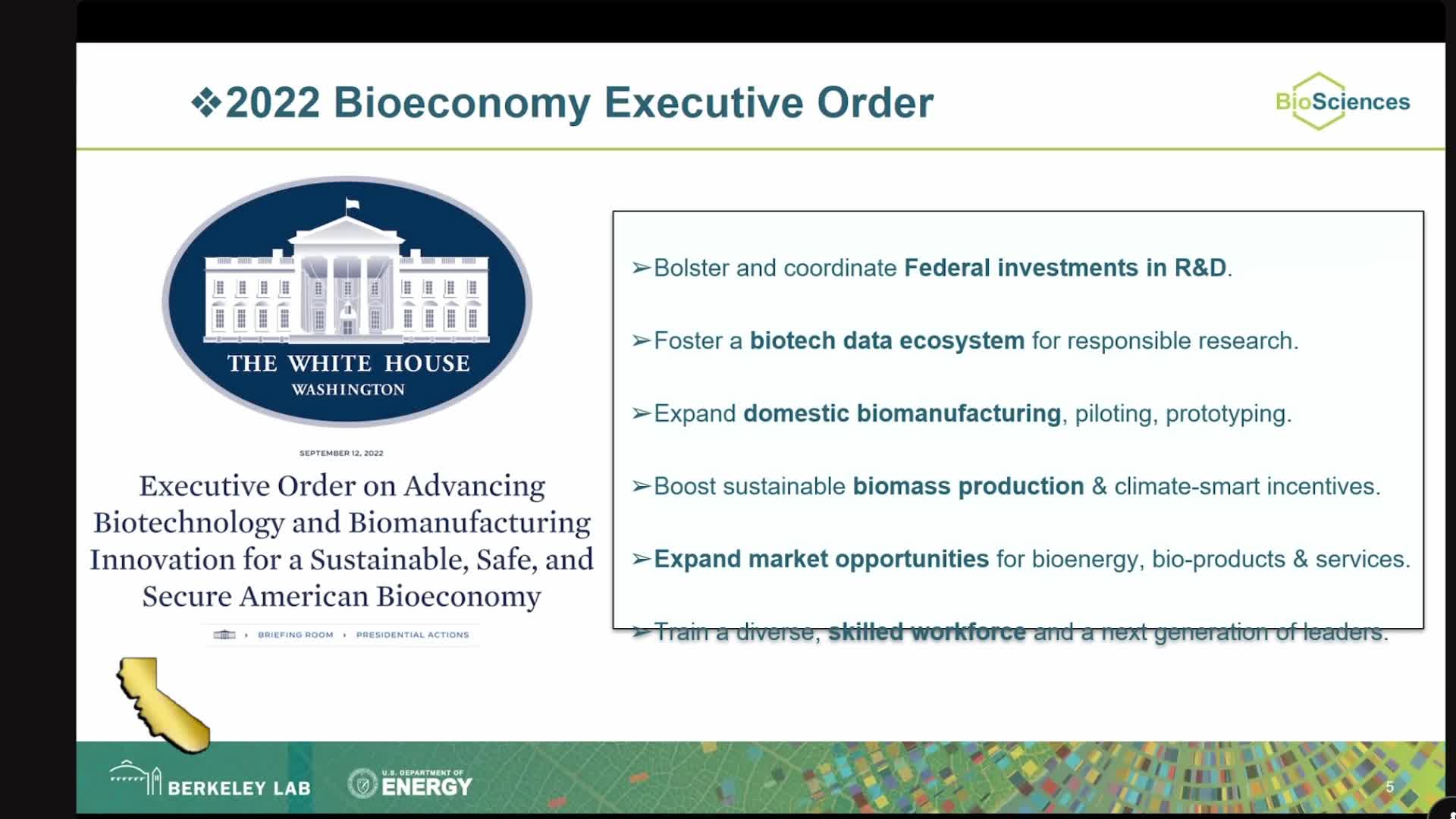
In a recent government meeting, discussions centered on the critical role of the bioeconomy in addressing environmental challenges and advancing sustainable energy solutions. Key speakers highlighted the potential of biomass, particularly waste biomass, as a significant resource for producing renewable fuels and bioproducts.
California alone has an estimated 56 million tons of waste biomass, which could be transformed into billions of gallons of jet fuel, contributing to substantial reductions in carbon emissions. This shift not only supports energy needs but also aids in mitigating the risks associated with wildfires, a growing concern in the region.
The meeting emphasized the importance of various initiatives led by the Berkeley Lab, including the Joint Bioenergy Institute (JBEI), the Agile Biofoundry, and the Advanced Biofuels and Bioproducts Process Development Unit (ABPDU). Collectively, these programs operate with an annual budget of approximately $55 million, each targeting specific aspects of bioeconomy development.
JBEI focuses on converting waste carbon and energy crops into sugars for advanced fuel production, while the Agile Biofoundry leverages synthetic biology to enhance biomanufacturing capabilities in collaboration with industry partners. The ABPDU serves as a pilot plant, helping startups scale their technologies and prepare for market entry.
A notable highlight from the meeting was JBEI's recent work on bioisoprenyl acetate, a precursor for a performance-advantaged jet fuel that is set to undergo testing for ASTM certification. The ABPDU has been instrumental in supporting numerous biomanufacturing startups, enabling them to demonstrate their technologies' scalability and attract investment.
Overall, the discussions underscored the bioeconomy's potential as a multifaceted solution to environmental challenges, emphasizing collaboration between public sector resources and private industry to foster innovation and sustainability.
California alone has an estimated 56 million tons of waste biomass, which could be transformed into billions of gallons of jet fuel, contributing to substantial reductions in carbon emissions. This shift not only supports energy needs but also aids in mitigating the risks associated with wildfires, a growing concern in the region.
The meeting emphasized the importance of various initiatives led by the Berkeley Lab, including the Joint Bioenergy Institute (JBEI), the Agile Biofoundry, and the Advanced Biofuels and Bioproducts Process Development Unit (ABPDU). Collectively, these programs operate with an annual budget of approximately $55 million, each targeting specific aspects of bioeconomy development.
JBEI focuses on converting waste carbon and energy crops into sugars for advanced fuel production, while the Agile Biofoundry leverages synthetic biology to enhance biomanufacturing capabilities in collaboration with industry partners. The ABPDU serves as a pilot plant, helping startups scale their technologies and prepare for market entry.
A notable highlight from the meeting was JBEI's recent work on bioisoprenyl acetate, a precursor for a performance-advantaged jet fuel that is set to undergo testing for ASTM certification. The ABPDU has been instrumental in supporting numerous biomanufacturing startups, enabling them to demonstrate their technologies' scalability and attract investment.
Overall, the discussions underscored the bioeconomy's potential as a multifaceted solution to environmental challenges, emphasizing collaboration between public sector resources and private industry to foster innovation and sustainability.
Don't Miss a Word: See the Full Meeting!
Go beyond summaries. Unlock every video, transcript, and key insight with a Founder Membership.
✓
Get instant access to full meeting videos
✓
Search and clip any phrase from complete transcripts
✓
Receive AI-powered summaries & custom alerts
✓
Enjoy lifetime, unrestricted access to government data
30-day money-back guarantee
