AI Surveillance Threatens Workers Rights and Privacy
August 07, 2024 | California State Assembly, House, Legislative, California
This article was created by AI summarizing key points discussed. AI makes mistakes, so for full details and context, please refer to the video of the full meeting. Please report any errors so we can fix them. Report an error »
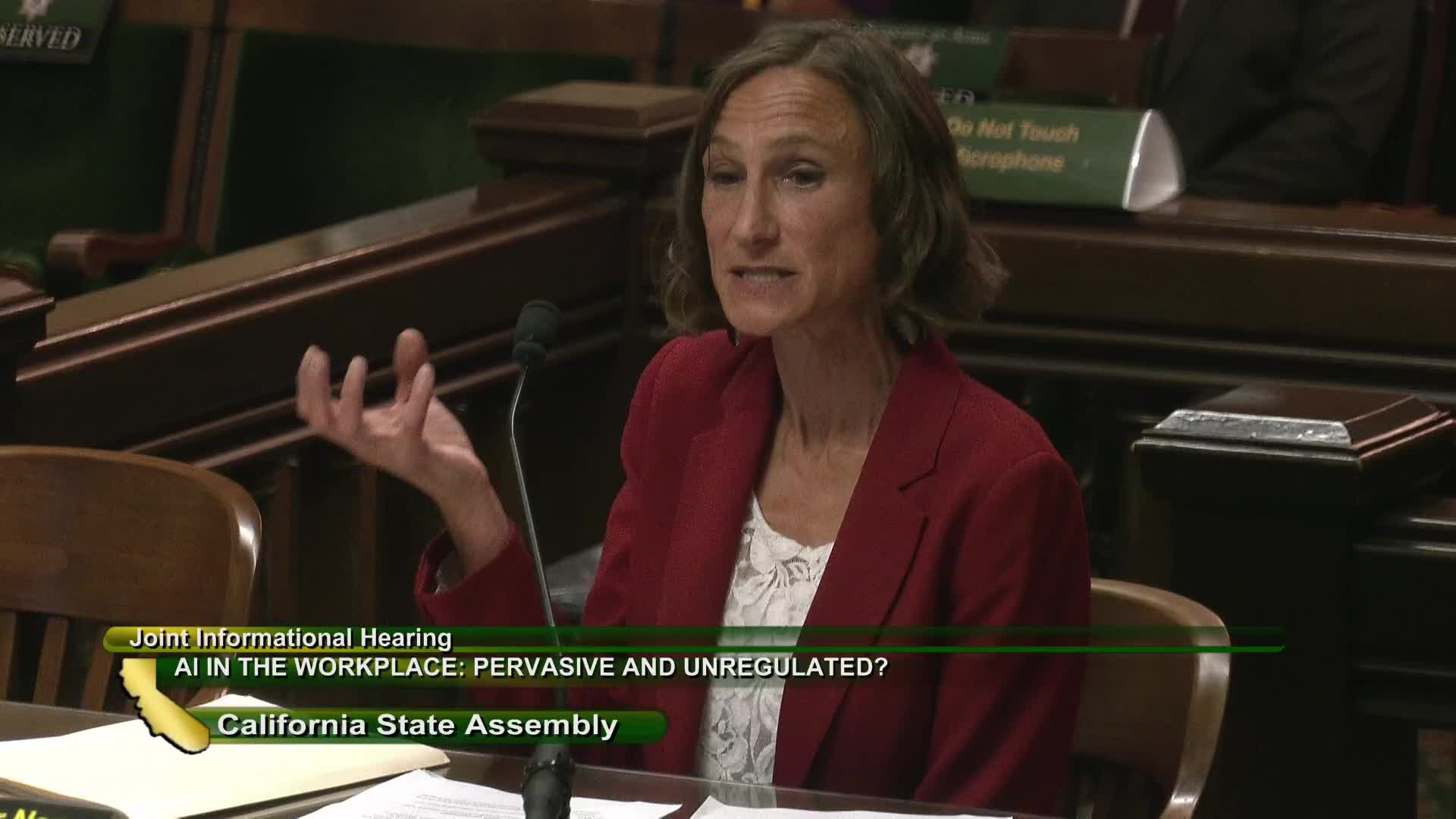
In a recent government meeting, significant concerns were raised regarding the implications of artificial intelligence (AI) and workplace surveillance technologies on workers' rights and privacy. The discussions highlighted the opaque nature of these technologies, described as \"black boxes\" where the inner workings remain largely unknown, complicating efforts to understand their impact on labor.
Key speakers pointed out that major corporations, including McDonald's, Walmart, and Amazon, are heavily investing in AI to enhance workplace surveillance and maximize productivity, often at the expense of worker welfare. Over the past five years, venture capital has poured approximately $290 billion into AI development, primarily aimed at profit generation rather than improving working conditions or safety.
The meeting underscored the alarming trend of AI exacerbating existing exploitation in the workplace. Advanced data collection methods now allow employers to monitor employees' behaviors in unprecedented ways, including tracking eye movements and keystrokes. Technologies such as the \"union vulnerability index\" are being used by Fortune 100 companies to assess the likelihood of workers unionizing, while platforms like Workplace by Facebook enable employers to suppress discussions about unionization among employees.
Moreover, the use of algorithmic management systems, such as those employed by Amazon, was criticized for treating workers like machines, with systems designed to eliminate breaks and maximize efficiency. This approach has reportedly led to a significant increase in workplace injuries.
The pervasive nature of these technologies was a central theme, with speakers noting that their influence extends beyond the workplace, affecting the general public through data collection practices in everyday environments, such as grocery stores. The discussions concluded with a call for policymakers to implement strategic and thorough regulations governing the development and deployment of these technologies, emphasizing the need for a balanced approach that prioritizes worker rights and safety.
Key speakers pointed out that major corporations, including McDonald's, Walmart, and Amazon, are heavily investing in AI to enhance workplace surveillance and maximize productivity, often at the expense of worker welfare. Over the past five years, venture capital has poured approximately $290 billion into AI development, primarily aimed at profit generation rather than improving working conditions or safety.
The meeting underscored the alarming trend of AI exacerbating existing exploitation in the workplace. Advanced data collection methods now allow employers to monitor employees' behaviors in unprecedented ways, including tracking eye movements and keystrokes. Technologies such as the \"union vulnerability index\" are being used by Fortune 100 companies to assess the likelihood of workers unionizing, while platforms like Workplace by Facebook enable employers to suppress discussions about unionization among employees.
Moreover, the use of algorithmic management systems, such as those employed by Amazon, was criticized for treating workers like machines, with systems designed to eliminate breaks and maximize efficiency. This approach has reportedly led to a significant increase in workplace injuries.
The pervasive nature of these technologies was a central theme, with speakers noting that their influence extends beyond the workplace, affecting the general public through data collection practices in everyday environments, such as grocery stores. The discussions concluded with a call for policymakers to implement strategic and thorough regulations governing the development and deployment of these technologies, emphasizing the need for a balanced approach that prioritizes worker rights and safety.
Don't Miss a Word: See the Full Meeting!
Go beyond summaries. Unlock every video, transcript, and key insight with a Founder Membership.
✓
Get instant access to full meeting videos
✓
Search and clip any phrase from complete transcripts
✓
Receive AI-powered summaries & custom alerts
✓
Enjoy lifetime, unrestricted access to government data
30-day money-back guarantee
