Smart Street Lights Revolutionize Traffic Flow and Pedestrian Safety
October 04, 2024 | Flagstaff City, Coconino County, Arizona
This article was created by AI summarizing key points discussed. AI makes mistakes, so for full details and context, please refer to the video of the full meeting. Please report any errors so we can fix them. Report an error »
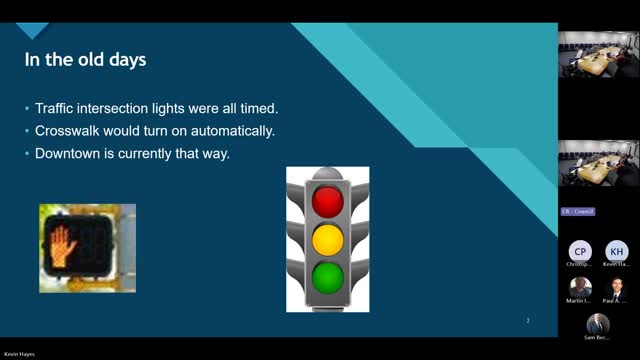
During a recent government meeting, officials discussed the functionality and implications of smart street lights and crosswalk systems in the city. The conversation highlighted the current challenges faced by pedestrians and cyclists, particularly regarding the operation of crosswalk signals and the timing of traffic lights.
One key point raised was the automatic activation of crosswalks in downtown areas, where existing press buttons are often non-functional. Instead, the lights automatically activate when the traffic signal turns green, which can create confusion for pedestrians who expect to press a button to cross safely.
The meeting also delved into the technology behind smart street lights, which utilize cameras to detect vehicles at intersections. This system allows for dynamic adjustments to green light durations based on real-time traffic conditions, enhancing vehicular flow. However, this flexibility comes at a cost to pedestrian accessibility, as many crosswalks remain set to \"do not walk\" until a button is pressed, complicating the experience for cyclists and pedestrians alike.
Officials acknowledged the need to balance traffic efficiency with pedestrian safety, noting that any changes to traffic light timings could significantly impact the city's traffic grading system. Adjustments to crosswalk timings, while potentially beneficial for pedestrians, could lead to longer wait times for vehicles, complicating the overall traffic management strategy.
The discussion also touched on the design of walk signals, with a distinction made between \"walk and rest\" and \"walk and don't rest\" signals. The former allows for a longer crossing time, while the latter minimizes the walk signal duration, potentially leading to unsafe crossing conditions for pedestrians.
Overall, the meeting underscored the complexities involved in urban traffic management and the ongoing efforts to improve the biking and walking experience in the city, while also maintaining efficient vehicle flow. As the city moves forward, officials expressed a commitment to exploring small adjustments that could enhance pedestrian safety without adversely affecting traffic patterns.
One key point raised was the automatic activation of crosswalks in downtown areas, where existing press buttons are often non-functional. Instead, the lights automatically activate when the traffic signal turns green, which can create confusion for pedestrians who expect to press a button to cross safely.
The meeting also delved into the technology behind smart street lights, which utilize cameras to detect vehicles at intersections. This system allows for dynamic adjustments to green light durations based on real-time traffic conditions, enhancing vehicular flow. However, this flexibility comes at a cost to pedestrian accessibility, as many crosswalks remain set to \"do not walk\" until a button is pressed, complicating the experience for cyclists and pedestrians alike.
Officials acknowledged the need to balance traffic efficiency with pedestrian safety, noting that any changes to traffic light timings could significantly impact the city's traffic grading system. Adjustments to crosswalk timings, while potentially beneficial for pedestrians, could lead to longer wait times for vehicles, complicating the overall traffic management strategy.
The discussion also touched on the design of walk signals, with a distinction made between \"walk and rest\" and \"walk and don't rest\" signals. The former allows for a longer crossing time, while the latter minimizes the walk signal duration, potentially leading to unsafe crossing conditions for pedestrians.
Overall, the meeting underscored the complexities involved in urban traffic management and the ongoing efforts to improve the biking and walking experience in the city, while also maintaining efficient vehicle flow. As the city moves forward, officials expressed a commitment to exploring small adjustments that could enhance pedestrian safety without adversely affecting traffic patterns.
Don't Miss a Word: See the Full Meeting!
Go beyond summaries. Unlock every video, transcript, and key insight with a Founder Membership.
✓
Get instant access to full meeting videos
✓
Search and clip any phrase from complete transcripts
✓
Receive AI-powered summaries & custom alerts
✓
Enjoy lifetime, unrestricted access to government data
30-day money-back guarantee
