Data reveals link between historic redlining and current inequities
October 13, 2024 | Utah Department of Transportation, Utah Transportation, State Agencies, Organizations, Utah Executive Branch, Utah
This article was created by AI summarizing key points discussed. AI makes mistakes, so for full details and context, please refer to the video of the full meeting. Please report any errors so we can fix them. Report an error »
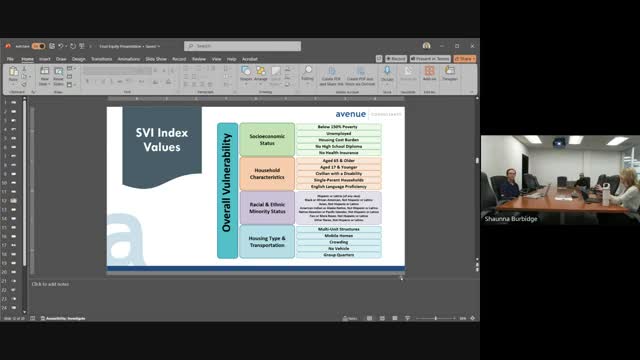
In a recent government meeting, officials presented findings from a comprehensive analysis of equity-focused areas across the state, utilizing the Social Vulnerability Index (SBI) and examining the historical impacts of redlining. The discussion highlighted the identification of 16 census tracts marked as equity focus areas, primarily located in urban centers like Ogden and Salt Lake City, as well as in economically disadvantaged regions in southeastern Utah.
The analysis revealed a significant correlation between historic redlining and current equity conditions, with areas affected by redlining showing higher concentrations of social vulnerability. The expanded study encompassed 152 tracts, representing approximately 20% of the state, allowing for a broader understanding of where investment and resources may be most beneficial.
Key findings indicated that regions with high SBI scores also reported more safety complaints, a greater number of schools, and increased infrastructure projects, suggesting that these areas are receiving attention from state agencies like the Utah Department of Transportation (UDOT). However, officials cautioned about the potential unintended consequences of infrastructure improvements on surrounding communities.
The meeting also introduced a scoring system for evaluating the built environment, which considered factors such as the presence of redlining, the number of signalized intersections, and the quality of pavement. Areas scoring four or more points out of a possible nine were flagged as having significant built environment challenges, with 252 of the 716 tracts analyzed falling into this category.
As the state moves forward, officials emphasized the importance of addressing these disparities and ensuring that investments in infrastructure and services are equitably distributed, particularly in historically marginalized communities. The findings will inform future recommendations aimed at improving equity and access across the state.
The analysis revealed a significant correlation between historic redlining and current equity conditions, with areas affected by redlining showing higher concentrations of social vulnerability. The expanded study encompassed 152 tracts, representing approximately 20% of the state, allowing for a broader understanding of where investment and resources may be most beneficial.
Key findings indicated that regions with high SBI scores also reported more safety complaints, a greater number of schools, and increased infrastructure projects, suggesting that these areas are receiving attention from state agencies like the Utah Department of Transportation (UDOT). However, officials cautioned about the potential unintended consequences of infrastructure improvements on surrounding communities.
The meeting also introduced a scoring system for evaluating the built environment, which considered factors such as the presence of redlining, the number of signalized intersections, and the quality of pavement. Areas scoring four or more points out of a possible nine were flagged as having significant built environment challenges, with 252 of the 716 tracts analyzed falling into this category.
As the state moves forward, officials emphasized the importance of addressing these disparities and ensuring that investments in infrastructure and services are equitably distributed, particularly in historically marginalized communities. The findings will inform future recommendations aimed at improving equity and access across the state.
Don't Miss a Word: See the Full Meeting!
Go beyond summaries. Unlock every video, transcript, and key insight with a Founder Membership.
✓
Get instant access to full meeting videos
✓
Search and clip any phrase from complete transcripts
✓
Receive AI-powered summaries & custom alerts
✓
Enjoy lifetime, unrestricted access to government data
30-day money-back guarantee
