Funding Boost Targets Environmental Justice in BIPOC Communities
October 04, 2024 | Minneapolis City, Hennepin County, Minnesota
This article was created by AI summarizing key points discussed. AI makes mistakes, so for full details and context, please refer to the video of the full meeting. Please report any errors so we can fix them. Report an error »
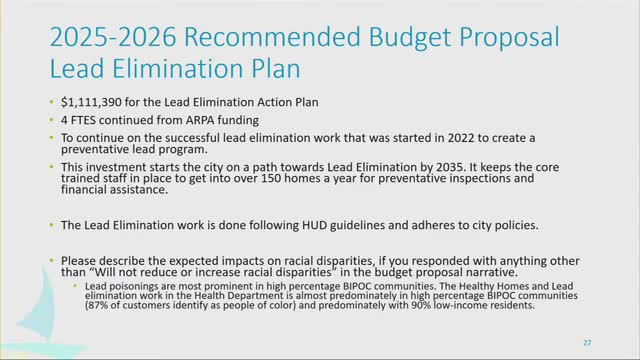
In a recent government meeting, officials discussed the ongoing implementation of programs aimed at addressing lead poisoning and climate initiatives, with a strong focus on serving BIPOC and low-income communities. The Lead and Healthy Homes program, which adheres to HUD guidelines, reported that 87% of its clients identify as people of color, with 90% coming from low-income households.
A significant budget increase of nearly $10 million was announced for the Climate Legacy Initiative, which includes $1.3 million designated for the health department. This funding will support two full-time positions: one focused on green jobs for youth, particularly from environmental justice communities, and another serving as a project manager for climate incentives. The initiative aims to engage over 500 young individuals in training programs and manage approximately 300 incentive contracts across nearly 500 properties in the city.
Additionally, the meeting highlighted the importance of community outreach and marketing efforts to raise awareness about energy efficiency and solar resources available to residents. The initiative has partnered with over eight neighborhood organizations to facilitate grassroots campaigns.
The budget also includes provisions for urban forestry, with plans to plant an additional 1,000 trees, and biochar operations aimed at carbon sequestration, which are essential for meeting the city’s climate equity goals. Officials emphasized their commitment to ensuring that at least 40% of funding is directed toward environmental justice communities, with current efforts exceeding 60%.
The discussions underscored a commitment to equity in resource distribution, ensuring that the most vulnerable populations receive the support they need.
A significant budget increase of nearly $10 million was announced for the Climate Legacy Initiative, which includes $1.3 million designated for the health department. This funding will support two full-time positions: one focused on green jobs for youth, particularly from environmental justice communities, and another serving as a project manager for climate incentives. The initiative aims to engage over 500 young individuals in training programs and manage approximately 300 incentive contracts across nearly 500 properties in the city.
Additionally, the meeting highlighted the importance of community outreach and marketing efforts to raise awareness about energy efficiency and solar resources available to residents. The initiative has partnered with over eight neighborhood organizations to facilitate grassroots campaigns.
The budget also includes provisions for urban forestry, with plans to plant an additional 1,000 trees, and biochar operations aimed at carbon sequestration, which are essential for meeting the city’s climate equity goals. Officials emphasized their commitment to ensuring that at least 40% of funding is directed toward environmental justice communities, with current efforts exceeding 60%.
The discussions underscored a commitment to equity in resource distribution, ensuring that the most vulnerable populations receive the support they need.
Don't Miss a Word: See the Full Meeting!
Go beyond summaries. Unlock every video, transcript, and key insight with a Founder Membership.
✓
Get instant access to full meeting videos
✓
Search and clip any phrase from complete transcripts
✓
Receive AI-powered summaries & custom alerts
✓
Enjoy lifetime, unrestricted access to government data
30-day money-back guarantee
