Minneapolis proposes bold funding to combat opioid crisis
October 04, 2024 | Minneapolis City, Hennepin County, Minnesota
This article was created by AI summarizing key points discussed. AI makes mistakes, so for full details and context, please refer to the video of the full meeting. Please report any errors so we can fix them. Report an error »
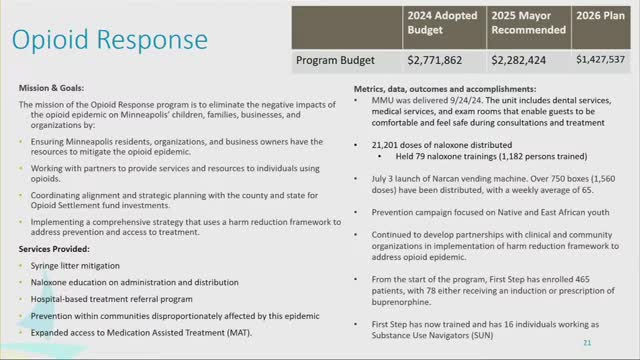
In a recent government meeting, officials discussed the allocation of opioid settlement funds and the continuation of mental health services for students. The proposal for 2025 focuses on the unpredictable nature of opioid settlement disbursements, leading to a one-year funding plan. As part of this, a budget proposal of $348,218 was presented to maintain three mental health therapist positions, which provide intensive on-site therapy to over 120 school-based clients annually.
The meeting highlighted the critical role of mental health services, with 77% of parents indicating these services as the most beneficial for students. Furthermore, 99.5% of students expressed a willingness to return to clinics that offer mental health support. The need for these services is underscored by statistics showing that approximately 70% of children and adolescents with diagnosable mental health disorders do not receive effective treatment.
In terms of opioid response strategies, the meeting outlined three key funding buckets. The first, totaling $750,000, is designated for treatment initiatives, including the operation of a mobile medical unit and a pilot program for medication-assisted treatment. The second bucket, amounting to $99,311, aims to expand a Narcan vending program to prevent overdose deaths. Lastly, $50,000 will support a collaborative initiative led by the Minneapolis Health Department to address opioid response strategies in partnership with Hennepin County and the state.
Officials emphasized that while these initiatives will benefit all Minneapolis residents, the Native American and Black communities are disproportionately affected by opioid-related issues, facing significantly higher overdose death rates compared to white residents. The meeting concluded with a commitment to addressing the root causes of addiction and overdose through collaborative efforts.
The meeting highlighted the critical role of mental health services, with 77% of parents indicating these services as the most beneficial for students. Furthermore, 99.5% of students expressed a willingness to return to clinics that offer mental health support. The need for these services is underscored by statistics showing that approximately 70% of children and adolescents with diagnosable mental health disorders do not receive effective treatment.
In terms of opioid response strategies, the meeting outlined three key funding buckets. The first, totaling $750,000, is designated for treatment initiatives, including the operation of a mobile medical unit and a pilot program for medication-assisted treatment. The second bucket, amounting to $99,311, aims to expand a Narcan vending program to prevent overdose deaths. Lastly, $50,000 will support a collaborative initiative led by the Minneapolis Health Department to address opioid response strategies in partnership with Hennepin County and the state.
Officials emphasized that while these initiatives will benefit all Minneapolis residents, the Native American and Black communities are disproportionately affected by opioid-related issues, facing significantly higher overdose death rates compared to white residents. The meeting concluded with a commitment to addressing the root causes of addiction and overdose through collaborative efforts.
Don't Miss a Word: See the Full Meeting!
Go beyond summaries. Unlock every video, transcript, and key insight with a Founder Membership.
✓
Get instant access to full meeting videos
✓
Search and clip any phrase from complete transcripts
✓
Receive AI-powered summaries & custom alerts
✓
Enjoy lifetime, unrestricted access to government data
30-day money-back guarantee
